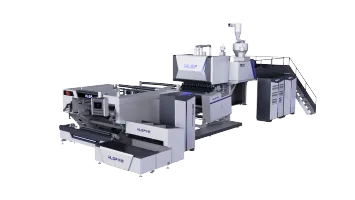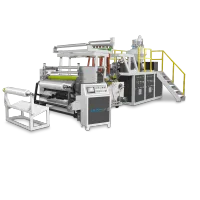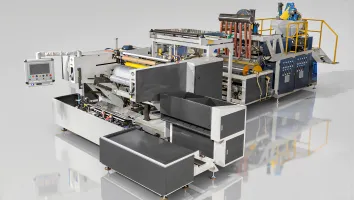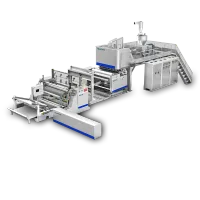
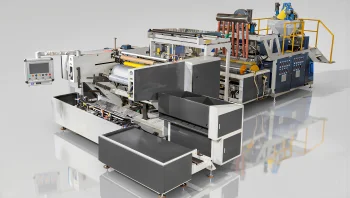
Cost-Effective 2-Layer Stretch Film Making Machine for Basic Packaging
Engineered for optimal operational economy, this 2-Layer AB Co-Extrusion Stretch Film Machine combines cost-effective resin allocation with stable performance. Featuring a compact footprint and up to 300% elongation, it is the ideal solution for standard pallet wrapping, logistics, and warehousing applications.
Cost-Effective AB Dual-Layer Co-Extrusion Engineering
Designed for optimal operational economy and seamless daily production, our 2-layer co-extrusion system delivers reliable film performance while drastically minimizing resin costs. By utilizing a proven AB layer distribution, manufacturers can optimize raw material allocation:
- Cling & Tack Layer (A): Specially formulated for high surface adhesion to ensure secure, slip-free pallet stabilization during transport.
- Core Strength Layer (B): Engineered to handle prime LLDPE, blend resins, or cost-saving recycled material without degrading tensile properties.
- This targeted layer separation reduces overall raw material expenses by 10–15% compared to monolayer extrusion, offering packaging suppliers a rapid return on investment (ROI).
Thermal Stability & Simplified Processing
To ensure consistent melt quality and minimize gauge variation during continuous runs, the 2-layer line features dual independent extrusion units calibrated within a precise 180°C to 230°C thermal range:
- Precision Barrier Screw Design: Optimized screw geometry ensures thorough melt homogenization, effectively eliminating un-melted gels and flow lines.
- High-Efficiency T-Die: Fine-tuned die lip adjustments maintain tight film thickness tolerance within ±3%, ensuring uniform film roll formation.
- Rapid Chill-Roll Cooling: Large-diameter chrome-plated cooling rollers swiftly quench the extrudate, locking in optical transparency, puncture resistance, and elongation.
High-Yield Output & Non-Stop Winding Automation
Engineered for ease of operation and low maintenance, the 2-layer machine integrates robust automation features to maximize daily throughput:
- Dual-Position Winding Unit: Enables smooth, non-stop roll changes without halting the extrusion process, reducing operational downtime and scrap generation.
- Stable Pre-Stretch Capability: Produces film with up to 250–300% elongation, delivering consistent holding force for light-to-medium industrial load wrapping.
- Compact Footprint & Low Energy Consumption: Streamlined machine architecture reduces power usage and factory space requirements, making it the ideal entry-level or expanding solution for packaging converters.
Target Applications & Industry Compliance
The film produced by this system provides a cost-effective wrapping solution across diverse industries:
- Standard palletized logistics and e-commerce warehouse packaging.
- Boxed goods, food & beverage outer wrapping, and paper carton protection.
- Agricultural silage and light-to-medium industrial cargo containment.
Application
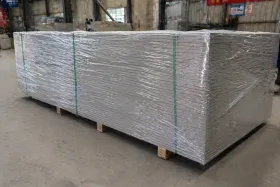
Application of 2-Layer Stretch Film Manufacturing Machine in Lightweight Building Materials Packaging
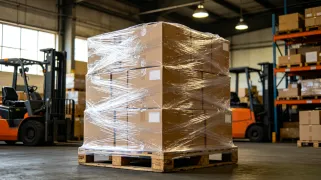
How Stretch Film Machines Optimize Integrated Packaging Supply Chains

Stretch Film Manufacturing Machines: Pallet Wrapping Applications in High-Turnover Logistics
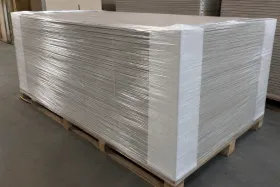
How Industrial Stretch Film Manufacturing Machines Secure Gypsum Board During Transportation
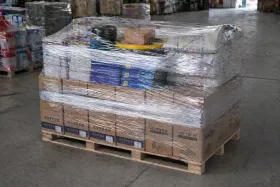
Application of 2-Layer Stretch Film Manufacturing Machine in Bulk Pallet Stabilization

Sustainable Stretch Film Manufacturing Machine for PLA-Based Premium Gift Box Packaging
Specifications
| Specification | HLCPE/75/55-1000 | Unit |
| Product Width | 500-1000mm | mm |
| Output | 80 | kg/hr |
| Product Thickness | 0.01-0.05 | mm |
| Mechanical Design Line Speed | 80 | m/min |
| Heating Power | 60 | kw |
| L/D | 30:1 | |
| Screw Diameter | φ75/φ55 | mm |
| Total Power | 110 | kw |
| Power Supply | 380/3/4/50 | Volt/Ph/Line/Hz |
| Motor Power | 30/18.5 | kw |
| Weight | 5000 | kg |
| Overall Dimensions | 10439*4140*2939 | (L×W×H)mm |
Product Comparison
| Comparison Item | Our Machinery | Other Manufacturers |
|---|---|---|
| T-Die | Using JC-TIMES high-precision T-DIE, the die lip gap tolerance is controlled within ±0.01mm, and the nitriding hardness reaches HRC ≥ 58, ensuring uniform and stable film thickness. 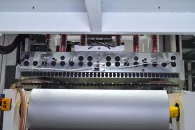 | Ordinary T-Die features low processing precision (tolerance > 0.05 mm) and hardness below HRC45. They are prone to wear and deformation, resulting in uneven film thickness. 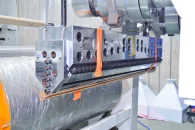 |
| Chain | Hualiang timing belt delivers zero-error transmission synchronization, requires no lubrication or maintenance, operates at a noise level of less than 65 dB, and ensures the film roll is perfectly smooth and flawless. 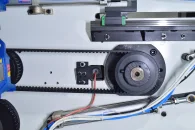 | Ordinary chains have a cumulative error of more than 0.5 mm, require regular lubrication, and their vibration causes convex ribs on the film roll. 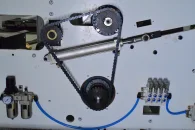 |
| Walled Barrel &Screw Design | Thick-Walled Barrel: Enhanced thermal retention minimizes heat loss, reducing power consumption by 15–20% compared to thin-walled barrels. Uniform Melt Temperature: Maintains stability within ±5°C, ensuring consistent bubble formation and achieving a thickness tolerance of ±3%. 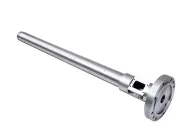 | Thin-Walled Barrels: Rapid heat dissipation requires constant reheating, resulting in 25–30% higher energy waste. Temperature Fluctuations: lead to uneven melting and thickness variations (±8–10%). 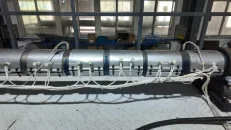 |
| Motor | The Permanent Magnet Synchronous Motor (PMSM) reduces energy consumption by 20%, delivers torque control accuracy of ±1%, and enables instant start-stop response. 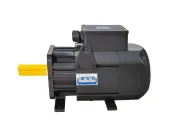 | Asynchronous motors feature higher operational inertia and an IE2 efficiency of 94.2%. 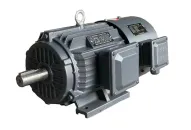 |
| Heating System | Hualiang Infrared Heating System boosts thermal efficiency by 40% and reduces overall energy consumption by 20%. 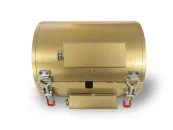 | Conventional heating coils feature slow heating, inadequate insulation, and high power consumption. 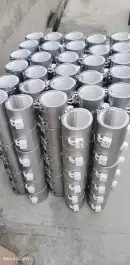 |