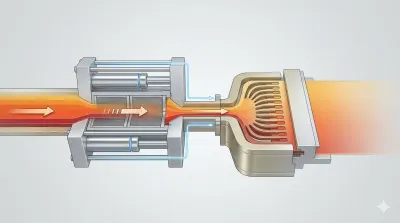
In high-output cast film coextrusion, maintaining a highly stable melt pressure is the fundamental prerequisite for operational efficiency and premium film quality. For advanced multi-layer coextrusion lines—specifically 2-layer, 3-layer, and 5-layer stretch film machines—any micro-fluctuation in polymer melt pressure directly destabilizes the gauge consistency. Uncontrolled pressure variations alter the flow channel dynamics, leading to sudden thickness deviations, cross-direction (CD) profile irregularities, and costly material waste through off-spec film roll rejection.
Achieving a zero-defect production standard requires an engineered, synchronized system where the cast film die and the continuous hydraulic screen changer do not operate as isolated components, but function together as a unified, closed-loop pressure-controlled ecosystem.
The Technical Interplay: How the Die and Screen Changer Synchronize
The operational synchronization between an advanced cast film die and an automatic hydraulic screen changer directly eliminates the root causes of melt pressure instability during the filtration cycle.
- Melt Filtration and Flow Disruption: The screen changer utilizes high-precision, hardened slide plates or dual-piston configurations fitted with fine wire mesh screens to continuous filter out unmelted gels, degraded polymers, and foreign impurities. This filtration is critical to prevent die land scratching, streaks, and premature die clogging. However, during a mechanical screen shift, the introduction of a new, clean screen cavity into the active melt stream inherently alters the flow resistance, creating a severe downstream pressure drop or backpressure spike.
- Closed-Loop Hydraulic Control Automation: Modern high-end melt management systems resolve this vulnerability by integrating high-speed closed-loop hydraulic control logic. Linked to highly sensitive upstream and downstream melt pressure transducers, the system monitors pressure differentials in real time. Upon detecting a shift sequence, advanced proportional valves adjust the hydraulic cylinder movement speed within milliseconds. This precise actuation pre-fills the oncoming cavity and counteracts the pressure surge or drop before the shockwave can propagate into the die manifold.
- Laminar Flow Profile Maintenance: The cast film die, engineered with a coat-hanger internal manifold geometry or paired with an advanced coextrusion feedblock, relies entirely on a constant, unyielding inlet pressure. Stable melt pressure ensures that the complex multi-layer shear rates remain uniform across the entire die width. This precision prevents interfacial waves and layer-to-layer distortion, protecting the distinct structural integrity and layer ratios within high-performance 3-layer and 5-layer film configurations.
Key Performance Benefits for Stretch Film Production Lines
Integrating this synchronized tandem melt filtration and distribution technology into fully automatic or high-speed semi-automatic stretch film lines delivers immediate, measurable technical and operational advantages:
- Continuous Maximum Line Speeds: Eliminates the legacy requirement of slowing down extrusion line speeds during screen changes to mitigate pressure spikes. Production lines safely maintain full-throttle running speeds of 300 to 500 m/min on high-output cast lines without generating a single meter of scrap film during the shift transition.
- Strict Thickness Tolerances: Guarantees rigid gauge tolerances within ±1 micron on ultra-thin 20-micron films. Consistent thickness uniformity ensures the optimized development of the film’s mechanical properties, such as high stretch ratios, puncture resistance, and predictable cling characteristics.
- Optimized Overall Equipment Effectiveness (OEE): Drastically reduces edge-trim waste and startup scrap rates, leading to a direct 2% to 5% increase in OEE and a corresponding drop in total material consumption per ton of finished product.
- Extended Component Lifespan: Eliminates the destructive "pressure hammering" phenomenon caused by sudden hydraulic shifts. Continuous, smooth pressure management prevents severe thermal stress and mechanical fatigue within the cast film die body and bolts, extending the standard maintenance and die-cleaning intervals from a typical 3-month cycle to over 12 months of continuous operation.
Industry 4.0 Process Control and Future-Proofing
As modern extrusion lines transition toward smart manufacturing, the integration of the cast film die and the hydraulic screen changer represents a vital stepping stone toward a fully automated Industry 4.0 factory floor.
Future-ready melt filtration systems feature advanced communication protocols (such as OPC UA) that link directly with the central extruder PLC. By utilizing predictive machine-learning algorithms based on historical pressure data, the system automatically calculates accurate screen blinding rates. This allows the line to schedule automated, optimized screen shifts at the exact thermodynamic window, completely neutralizing human error. For global manufacturers operating 2-layer to 5-layer stretch film lines, deploying this advanced, synchronized melt pressure control layout future-proofs production against tighter thickness regulations while maximizing long-term material and energy efficiency.