5 Critical Technical Parameters to Confirm with Suppliers Before Buying a Stretch Film Extrusion Machine
2026-07-01
Choosing the right production line for your plastic packaging business is a landmark investment that dictates your factory's floor efficiency and long-term profitability. In a highly competitive market, finding a machine that delivers flawless film quality while keeping operational costs low can be a challenge.
As a dedicated stretch film extrusion machine manufacturer, we believe that transparency in technical specifications is what separates a standard production line from a truly exceptional one. We have meticulously designed our own machinery around top-tier component integration to ensure that every critical benchmark is effortlessly met.
Screw Length-to-Diameter Ratio and Geometry for Melt Homogeneity
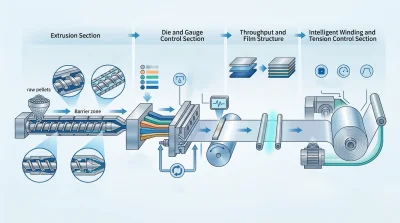
The extrusion screw and barrel configuration serve as the mechanical heart of any cast film line. Many standard machines available today utilize outdated screw geometries that suffer from severe melt temperature gradients and local viscosity fluctuations. For factory operators running these lower-grade systems, this engineering flaw manifests as gauge banding across the web, localized weak spots, poor film cling properties, and frequent line breakages that destroy daily uptime.
To prevent these quality defects, we have engineered our stretch film extrusion machines with an uncompromised extrusion system featuring a minimum Length-to-Diameter (L/D) ratio of 30:1. By integrating our proprietary high-efficiency mixing barrier screws into our machinery, we ensure complete polymer plasticizing and total thermal homogenization of the melt stream before it ever reaches the feedblock.
By ensuring superior melt homogeneity through our advanced barrel design, our machinery offers exceptional resin versatility. Whether you are operating our economical 2-layer line or our high-speed 5-layer co-extrusion system, this robust screw configuration allows you to blend high percentages of post-industrial regrind or recycled resins with virgin LLDPE and metallocene.
Sustainable Continuous Throughput Curves versus Peak Output Claims
A common pitfall in equipment procurement is purchasing machinery based on misleading "peak output" ratings listed under ideal laboratory conditions. In real-world, 24/7 manufacturing, short-term peak capacity is meaningless if the overall line cannot sustain that speed during continuous operation. Unbalanced machines often push the extruder past its thermal limit, causing melt degradation, or they run into cooling capacity bottlenecks at the chill roll, forcing operators to slow down production.
Our machinery engineering philosophy focuses entirely on balanced, synchronized continuous output. We calculate the extrusion capacity, die geometry, and cooling roll heat-transfer coefficients using a precise 1-to-1 operational match to ensure that no single component becomes a bottleneck.
Our high-output 3-layer and 5-layer co-extrusion stretch film extrusion machines boast an official rated capacity of 600 kg/h. When manufacturing 0.01-0.05mm stretch film, our complete machine line delivers a verified, continuous real-world throughput of 300 to 600 kg/h. This reliable output is maintained over days of continuous operation without web instability, giving your planning team predictable production volumes and zero output deception.
Integrated In-Line Edge Trim Recycling System Capacity
Material yield is a primary driver of profitability in film extrusion, yet traditional machines lack an efficient mechanism to handle the thick edge trims generated during the cast process. Standard setups force factories to manually wind the edge trim, store it, and transport it to an offline pelletizing line. This outdated process invites contamination, consumes massive floor space, incurs extra labor costs, and subjects the polymer to secondary heat history, which degrades the resin and introduces severe gel blocks or dark spots when reintroduced into the main extruder.
To eliminate this operational waste, we build a fully automated, continuous recovery loop directly into our production lines. Our stretch film extrusion machines feature an integrated, heavy-duty in-line edge trim recycling system as a standard built-in function. This integrated unit utilizes high-hardness, wear-resistant granulators positioned directly below the slitting station. The trimmed edges are instantly pulverized into uniform flakes and conveyed back to the main extruder hopper via a precision high-pressure pneumatic transport system, bypassing manual handling entirely.
Because our machines re-feed this edge scrap at a perfectly metered ratio while it is still hot, it prevents moisture absorption and polymer degradation. This built-in function achieves absolute zero scrap accumulation and 100% immediate material re-utilization. By eliminating offline pelletizing labor and secondary energy draw, our complete machinery solution instantly recovers up to 5% of raw material losses, injecting pure profit back into your daily operation.
Online Automatic Gauge Control Scanners and Closed Loop Feedback
Transverse direction thickness variations are a major cause of downstream processing failures. If a finished roll has thick or thin spots, it will experience severe neck-in and uneven unwinding tension on high-speed automated wrapping lines, prompting immediate customer rejections. Older or lower-tier 2-layer or 3-layer lines without automated thickness correction routinely exhibit edge-to-center thickness deviations exceeding 6%, driving final factory reject rates above 8%.
Our stretch film extrusion machines come fully equipped with a high-precision online automatic gauge control function. Mounted on a heavy-duty, vibration-isolated scanning frame, this advanced system conducts high-frequency, full-width web scans to log micro-level gauge variations in real time, while simultaneously tracking layer distribution across multi-layer co-extrusions.
The central processing system of our machine communicates instantly with the automatic thermal bolts inside the extrusion die. Through this smart, closed-loop feedback mechanism, the machine automatically adjusts local die lip temperatures to correct deviation trends before they impact the film quality. This automated micro-adjustment locks the final cross-directional gauge tolerance within a strict ±1.5% margin, virtually eliminating out-of-spec waste.
Intelligent Surface Center Winding Functionality and Central PLC Control
The final quality benchmark of a stretch wrap roll is its roll geometry and winding hardness. Poor tension management during the winding phase leads to defects like starring or telescoping during storage and intermodal shipping. If a roll telescopes, it becomes impossible to unwind and is rendered completely useless to the consumer. Manual mechanical adjustments on older winding systems are simply too crude to handle modern high-speed tension curves.
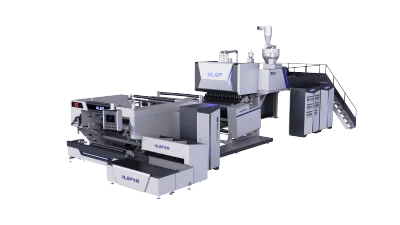
The definitive defense against poor roll geometry is our fully automatic surface-center combination winding function governed by an advanced, industrial-grade central PLC control system built into every machine we build. Utilizing proprietary algorithms, our central PLC independently calculates and modulates the three critical winding variables in real-time: contact nip pressure, lay-on roll torque, and taper tension.
Final Procurement Verification and Long Term Return on Investment
Selecting industrial plastic machinery based solely on a low purchase price is a recipe for long-term operational losses. The true competitiveness of stretch film extrusion machines is measured by their Total Cost of Ownership, which is determined by material yield, continuous uptime, and energy efficiency per ton of marketable film produced.
By holding equipment manufacturers to strict parameters—specifically demanding a 33:1 L/D mixing screw, true continuous throughput data, integrated in-line recycling, closed-loop gauge tolerances under ±1.5%, and PLC-controlled combination winding—you insulate your business against market volatility and production waste.
As an established machinery manufacturer, we welcome you to contact our engineering team today to review our detailed machine line blueprints and secure a high-efficiency production solution tailored to your exact manufacturing requirements.