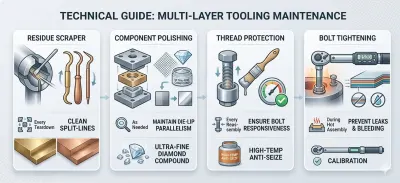
Proper T-die cleaning and maintenance are critical for maintaining stretch film thickness uniformity, surface quality, and stable extrusion pressure. In modern high-speed stretch film making machines, the T-die is the heart of the co-extrusion system. Whether your line is configured for 2-layer, 3-layer, or advanced 5-layer stretch film production, even microscopic carbon buildup inside the die manifold can cause severe gauge variations, interlayer gauge mismatch, optical defects, and costly film breakage.
Implementing a standardized preventive maintenance schedule minimizes die lines, gel defects, resin degradation, and unplanned production downtime. This comprehensive technical guide outlines the step-by-step procedures for cleaning and maintaining your stretch film extrusion T-die.
1. Understanding T-Die Complexity in Multi-Layer Stretch Film Machines
Before disassembly, operators must consider the specific architecture of the stretch film making machine. Multi-layer co-extrusion requires precise flow-channel management:
- 2-Layer & 3-Layer Systems: Typically utilize a feedblock system or a multi-manifold T-die to combine clinger and release resins (such as LLDPE and mLLDPE). Cleaning must focus on the junction zones where different layers meet to prevent inter-layer bleeding.
- 5-Layer Co-Extrusion Lines: Highly sophisticated 5-layer stretch film making machines rely on ultra-precise internal flow geometry to distribute core, sub-core, and skin layers. A tiny carbon particle in a 5-layer T-die can ruin the puncture resistance and stretch ratio of the entire film structure.
2. Preparation and Hot Die Disassembly
Die maintenance must be performed while the equipment is hot to ensure the polymer remains in a molten, workable state.
- Purge the Extruder: Before shutting down, run a specialized, high-viscosity purging resin through all extruders (whether it is a 2, 3, or 5-layer setup) to displace the functional stretch film resins. This lowers internal pressure and reduces carbonization during shutdown.
- Safety First: Equip operators with high-temperature heat-resistant gloves, face shields, and protective clothing.
- Safe Disassembly: Disconnect all heating elements, thermocouples, and sensor wiring. Carefully back out the die body bolts while keeping the die at its designated operating temperature.
3. Polymer Residue Removal with Specialized Tools
Never use steel scrapers, wire brushes, or harsh abrasives on a T-die. The precision-ground flow channels and die lips are highly sensitive to scratching.
- Soft Metal Tools: Use exclusively brass scrapers, copper gauze, or aluminum tools to scrape away the molten polymer residue. These metals are softer than the chrome-plated or tool-steel surfaces of the die.
- Internal Flow Channel Cleaning: For 3-layer and 5-layer T-dies, clean from the center feedblock/manifold outward toward the ends. Ensure the coat-hanger manifold and pre-land zones are completely free of degraded resin gel.
4. Die Lip Inspection and Precision Polishing
The die lip dictates the final optical properties and gauge profile of your stretch film. Minor nicks or scratches here will create persistent die lines on the film surface.
- Visual Inspection: Inspect the lip surfaces for micro-scratches, pits, or uneven wear using high-intensity lighting.
- Precision Polishing: If minor imperfections are found, use an ultra-fine polishing paste (such as diamond compound) and a soft felt wheel. Always polish parallel to the polymer flow direction, never crosswise.
5. Lip Adjustment Bolt Maintenance and Calibration
Stretch film manufacturing relies heavily on automated (automatic thermal bolts) or manual flexible lip adjustment bolts to control cross-direction (CD) thickness uniformity.
- Bolt Cleaning: Remove the adjustment bolts, clean their threads, and inspect them for stripping or thermal seizing.
- Lubrication: Apply a premium high-temperature, anti-seize lubricant to all bolt threads before reassembly to ensure smooth calibration and responsive gauge control during production.
6. Reassembly and Torque Calibration
Incorrect tightening of the die body bolts causes localized thermal distortion, leading to polymer leakage between the multi-layer split lines and gauge inconsistencies.
- Star Pattern Tightening: Reassemble the die segments and tighten the main body bolts in a sequential, cross-diagonal star pattern.
- Torque-Wrench Calibration: Use a calibrated torque wrench to tighten all bolts incrementally. Refer strictly to the manufacturer's specified torque charts (typically executed in 3 to 4 escalating torque stages).
- Final Heat-Up Check: Once the T-die reaches its target operating temperature on the production line, perform a final torque check to compensate for thermal expansion.
Technical Summary for Multi-Layer Operators
| Maintenance Action | Recommended Tool / Material | Frequency | Co-Extrusion Focus (2/3/5 Layers) |
|---|---|---|---|
| Residue Scraper | Brass or Copper tools only | Every teardown | Clean internal split-lines thoroughly |
| Component Polishing | Ultra-fine diamond compound | As needed upon inspection | Maintain flawless die-lip parallelism |
| Thread Protection | High-temperature anti-seize | Every reassembly | Ensure smooth thermal bolt responsiveness |
| Bolt Tightening | Calibrated torque wrench | During hot assembly | Prevent layer bleeding and polymer leaks |