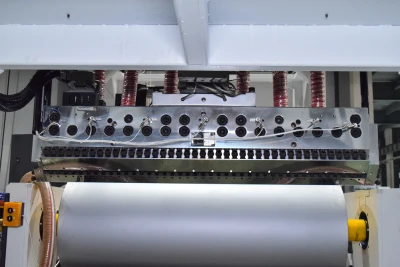
Differences Between High-Precision T-DIE and Traditional Ordinary T-DIE
2026-07-28
In modern stretch film manufacturing, production quality is closely related to the precision of the extrusion system. As customers require thinner film gauges, better stretching performance, and more consistent packaging results, a stretch film extrusion machine must provide accurate melt control throughout continuous production.
Among all extrusion components, the T-DIE plays a critical role in determining how evenly polymer melt is distributed before film formation. Although traditional T-DIE systems can support basic stretch film production, their limitations become more noticeable when manufacturers require higher output stability, tighter thickness control, and long-term continuous operation.
To meet these advanced production requirements, our stretch film extrusion machine integrates JC-TIMES high-precision T-DIE technology. Compared with conventional T-DIE solutions, this advanced extrusion component provides more accurate melt distribution, stronger structural stability, and improved wear resistance, helping the complete machine achieve higher film quality and more reliable production performance.
Limitations of Traditional T-DIE Systems in Stretch Film Production
The performance of a stretch film extrusion machine depends on the coordination of the extruder, temperature control system, casting unit, winding system, and T-DIE. Among these components, the T-DIE directly influences the uniformity of the molten polymer layer before cooling and stretching.
Traditional ordinary T-DIE systems are often limited by machining accuracy and structural design. One common challenge is insufficient control of the die lip gap. When the processing tolerance is relatively large, the melt flow distribution across the full width of the die may become uneven.
During stretch film production, uneven melt distribution can result in thickness variation across the film width. Areas with excessive thickness increase material consumption, while areas with insufficient thickness may affect tensile strength and packaging reliability. For manufacturers operating high-speed stretch film extrusion machines, these variations can reduce production efficiency and increase the difficulty of maintaining consistent film quality.
Another limitation of conventional T-DIE systems is reduced long-term stability. During continuous extrusion, the die is exposed to high temperature, constant melt pressure, and repeated thermal expansion. Without sufficient surface hardness and structural rigidity, the die lip may gradually experience wear or deformation, affecting extrusion accuracy over time.
For manufacturers requiring stable production over long periods, these issues may lead to more frequent adjustments, maintenance requirements, and production interruptions.
JC-TIMES High-Precision T-DIE Technology for Advanced Stretch Film Extrusion Machine
To improve extrusion performance and overcome the limitations of traditional T-DIE systems, our stretch film extrusion machine adopts JC-TIMES high-precision T-DIE technology.
The JC-TIMES high-precision T-DIE is manufactured with advanced precision processing technology, allowing the die lip gap tolerance to be controlled within approximately ±0.01 mm. This precise control improves melt distribution uniformity across the entire extrusion width, creating a more stable foundation for producing high-quality stretch film.
For the stretch film extrusion machine, accurate melt distribution directly contributes to better thickness consistency. A more uniform polymer layer helps maintain stable film properties during stretching and winding, allowing manufacturers to produce stretch film with reliable mechanical performance and consistent appearance.
Surface treatment technology is another important advantage of the JC-TIMES high-precision T-DIE. Through advanced nitriding treatment, the surface hardness can reach HRC58 or above, significantly improving resistance against wear during long-term extrusion operation.
Compared with ordinary T-DIE structures, the enhanced surface durability helps maintain the original processing accuracy of the die for a longer period. When integrated into our stretch film extrusion machine, this feature reduces the impact of component wear on production stability and helps manufacturers achieve more consistent output.
The structural design of the JC-TIMES high-precision T-DIE is also optimized for high-temperature and high-pressure extrusion conditions. Improved rigidity helps minimize deformation caused by thermal expansion and melt pressure, maintaining stable die lip alignment during continuous operation.
This structural stability is particularly valuable for modern stretch film extrusion machines that operate at higher speeds and require consistent film quality throughout long production cycles.
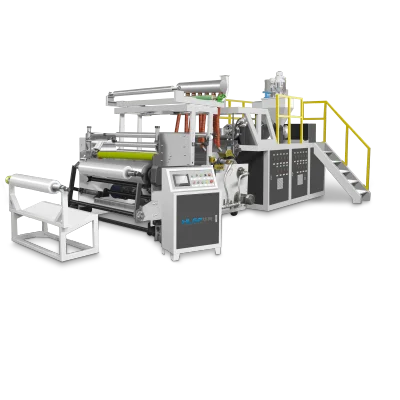
Production Benefits of Stretch Film Extrusion Machine Equipped with JC-TIMES High-Precision T-DIE
The application of JC-TIMES high-precision T-DIE technology improves not only the extrusion component itself but also the overall performance of the stretch film extrusion machine.
One major advantage is improved thickness control. With more uniform melt distribution, the machine can produce stretch film with better gauge consistency across the film width. This helps manufacturers meet different application requirements, from standard packaging film to high-performance industrial stretch film.
Another important benefit is improved material utilization. Inconsistent thickness distribution can cause unnecessary resin consumption because some areas contain more material than required. By improving extrusion accuracy, the stretch film extrusion machine helps manufacturers achieve more precise weight control and reduce raw material waste during production.
Production stability is also enhanced through the combination of JC-TIMES high-precision T-DIE and the complete machine system. Stable die performance reduces the need for frequent manual adjustments and supports continuous production with fewer interruptions.
When combined with advanced temperature control, automatic thickness monitoring, and optimized mechanical structures, the stretch film extrusion machine can provide a more reliable production solution for manufacturers seeking higher efficiency and consistent product quality.
Our Stretch Film Extrusion Machine with Advanced T-DIE Technology
For stretch film manufacturers, selecting equipment is not only about production speed but also about long-term quality control, operating stability, and production efficiency. The extrusion system must maintain precise performance throughout the entire manufacturing process to ensure consistent film output.
A traditional stretch film extrusion machine using ordinary T-DIE technology may satisfy basic production requirements, but advanced applications require higher extrusion accuracy and stronger component reliability.
By integrating JC-TIMES high-precision T-DIE technology, our stretch film extrusion machine provides manufacturers with improved melt control, stable film thickness, reduced material loss, and reliable long-term operation. The high-precision T-DIE works together with the complete extrusion system to enhance overall machine performance and support higher-quality stretch film production.
For companies looking to improve production capability and build stronger competitiveness in the stretch film market, choosing a stretch film extrusion machine equipped with JC-TIMES high-precision T-DIE technology provides a practical solution for achieving consistent quality and efficient manufacturing.