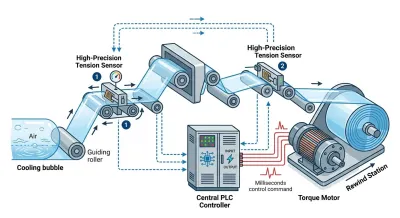
In a high-speed bubble film making machine, precise web tension control determines final product quality. Inconsistent tension during extrusion causes severe defects, including transversal wrinkling, permanent film stretching, and loose or telescoped rewinding.
An automated, digital tension control system optimizes the co-extrusion process. It ensures dimensional stability, maximizes material yield, and maintains web flatness across 2-layer to 7-layer bubble film production lines.
How Closed-Loop Tension Control Works
The automatic tension control system operates on a high-speed, real-time closed-loop PLC architecture. This continuous tracking mechanism eliminates manual adjustments and ensures precise film flatting through three core technical phases:
- Real-Time Sensing: High-precision tension sensors continuously monitor substrate speed and web tension from the co-extrusion die through the cooling rollers to the rewind station.
- PLC Processing: The central PLC instantly calculates required torque adjustments based on dynamic shifts in film thickness, width, and thermal shrinkage.
- Millisecond Execution: The system commands a magnetic powder brake or torque motor to apply micro-adjustments within milliseconds, balancing under-tension and over-tension.
Critical Technical Points for Multi-Layer Production
Multi-layer co-extrusion (including 3-layer, 5-layer, and 7-layer bubble film machines) introduces complex thermal and physical dynamics that demand advanced tension management.
Cooling Transition Stability
As molten polymers pass from the die to the cooling rollers, thermal shrinkage occurs. Automatic tension tracking dynamically compensates for this volumetric change. It prevents the film from slackening or over-stretching during critical phase transitions.
Eliminating Failure Modes
- Over-Tension Prevention: Eliminates film deformation, thinning, and popping of the extruded bubbles.
- Under-Tension Prevention: Eliminates slack-induced wrinkling, air trapping, and web drifting.
Performance Benefits on the Production Floor
1. Superior Rewind Quality
Precise tension control ensures tight, uniform film rolls without telescoping or star-shaped gaps. This high-quality final roll eliminates the need for secondary rewinding processes.
2. Higher Line Speeds
Maintaining a stable web allows operators to safely increase line speeds by up to 15% on high-speed models without risking film flatness or structural integrity.
3. Reduced Material Waste
The auto-tensioning system adapts to different film grades in real time. This instant adaptation reduces material waste during startup and product changeovers by an average of 20%.
4. Low-Maintenance Hardware
Utilizing a magnetic powder brake eliminates the mechanical wear associated with traditional friction clutches. This wear-free operation significantly reduces long-term maintenance overhead and downtime.
Data Logging and Future Automation
The integrated PLC logs all operational tension data during the extrusion process. This data architecture provides a foundation for digital factory integration and AI-driven predictive maintenance, ensuring long-term production reliability and consistent output quality.