Automated PLC Bubble Film Extrusion Machine: Reduce Labor Costs
2026-07-03
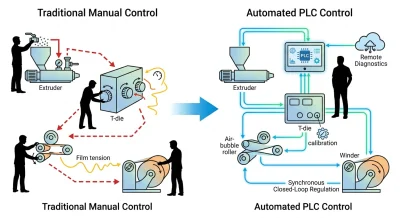
As global packaging demand continues to expand, manufacturers are expected to deliver higher output volumes with tighter quality tolerances and lower production costs. In response to these pressures, bubble film extrusion machines have evolved from traditionally manual systems into highly automated production platforms driven by PLC-based intelligent control.
Modern production environments can no longer rely on operator experience alone to maintain consistency in film thickness, bubble stability, and layer distribution. Instead, automation has become the foundation of stable and scalable manufacturing. Advanced PLC-controlled systems now allow producers to synchronize every stage of the extrusion process, ensuring consistent performance even under high-speed and multi-shift operation.
This transformation is reshaping how bubble film production lines are designed, operated, and optimized across the packaging industry.
Challenges in Traditional Bubble Film Production Lines
Despite widespread use, conventional extrusion systems still present several critical inefficiencies that limit productivity and increase costs.
High Dependence on Skilled Labor
Traditional bubble film extrusion lines require constant human supervision across multiple stages, including resin feeding, temperature control, die adjustment, tension regulation, and winding synchronization. Each adjustment depends heavily on operator experience.
This dependence leads to:
- Increased labor costs per production shift
- Inconsistent output quality between operators
- Higher risk of human error during long production cycles
As labor costs continue to rise globally, this model becomes increasingly unsustainable.
Inconsistent Product Quality and Gauge Variation
Manual adjustments often result in unstable film thickness distribution. Small deviations in T-die settings or melt flow balance can lead to:
- Uneven bubble formation
- Weak points in film structure
- Higher rejection rates in final products
For manufacturers producing packaging films for logistics, electronics, or industrial cushioning, even minor inconsistencies can result in significant material waste and customer dissatisfaction.
Inefficient Production Coordination
In traditional systems, each component of the production line operates semi-independently. Feeding systems, extrusion units, and winding sections often lack real-time synchronization.
This leads to:
- Long setup and changeover times
- Increased downtime during material switching
- Higher probability of film breakage during transitions
These inefficiencies reduce overall equipment effectiveness and limit factory scalability.
PLC Automation: The Core Technology Behind Modern Extrusion Systems
Modern bubble film extrusion machines integrate programmable logic controller (PLC) systems to unify and automate the entire production process. Instead of relying on isolated manual adjustments, PLC systems coordinate every stage of extrusion in real time.
Closed-Loop Process Control
The most important advantage of PLC integration is closed-loop regulation. The system continuously monitors key parameters such as melt pressure, tension, and layer distribution, automatically adjusting them to maintain stability.
This results in:
- Consistent film thickness across the full web
- Reduced risk of bubble instability
- Lower material waste during startup and operation
By eliminating manual intervention, production becomes more predictable and repeatable.
Intelligent Recipe Management System
Modern bubble film extrusion machines are equipped with digital recipe storage functions that allow operators to save and recall production settings for different materials and product specifications.
Key benefits include:
- Fast switching between production orders
- Reduced setup time between different film types
- Elimination of manual recalibration errors
In many industrial applications, changeover time can be reduced to just a few minutes, significantly improving overall production efficiency.
Integrated Industrial Communication and Diagnostics
Advanced systems also support Ethernet/IP communication protocols, enabling real-time monitoring and remote diagnostics.
This allows manufacturers to:
- Detect anomalies before system failure occurs
- Reduce unexpected downtime
- Support remote technical troubleshooting
Predictive maintenance capabilities further enhance machine uptime and operational reliability.
Multi-Layer Extrusion Capabilities for Advanced Applications
One of the most important developments in bubble film extrusion machines is the ability to support multi-layer co-extrusion structures. These configurations allow manufacturers to produce films with improved strength, flexibility, and barrier properties.
Two-Layer Systems for Simplified Production
Two-layer systems are designed for operational efficiency and ease of use. With automated synchronization and reduced manual intervention, a single operator can manage multiple machines simultaneously. This significantly reduces labor requirements while maintaining stable production output.
Three to Five Layer Systems for Flexible Manufacturing
Mid-range systems support complex material combinations, enabling manufacturers to customize film properties for different applications. The PLC system ensures precise layer alignment and fast recipe switching, reducing downtime during product transitions.
These systems are widely used in packaging industries requiring balance between cost efficiency and performance.
Seven Layer Systems for High-End Performance
Advanced seven-layer co-extrusion systems represent the highest level of extrusion technology. They provide:
- Superior interlayer bonding strength
- Enhanced puncture and tear resistance
- Highly uniform melt distribution across all layers
These machines are ideal for high-performance packaging applications requiring maximum durability and consistency.
Speed Optimization and Energy Efficiency
Modern bubble film extrusion machines are designed with multiple speed configurations to meet different production needs.
Low-Speed Mode for Stability and Control
Low-speed operation is ideal for startups, testing phases, or small batch production. It ensures stable bubble formation and reduces the risk of defects during early-stage extrusion.
Medium-Speed Mode for Energy Efficiency
Medium-speed operation focuses on balancing productivity and energy consumption. Advanced heating and drive systems can reduce energy usage per kilogram of output by approximately 15%, improving long-term operational cost efficiency.
High-Speed Mode for Maximum Output
High-speed configurations enable production speeds of up to 40 meters per minute while maintaining tight thickness tolerances of ±5 microns. The PLC system ensures synchronized control of winding tension and extrusion flow, preventing instability even at high throughput levels.
Operational Benefits and Production Efficiency Improvements
The integration of automation into bubble film extrusion machines delivers measurable improvements in factory performance.
Manufacturers typically experience:
- Reduction of labor requirements by 40% to 50%
- Significant decrease in material waste during startup and changeover
- Improved raw material utilization by up to 20%
- Reduced machine downtime through predictive diagnostics
- Higher consistency in final product quality across shifts
These improvements directly translate into lower production costs and higher profitability, making automation a critical investment for modern packaging manufacturers.
The Future of Bubble Film Manufacturing
The transition from manual control systems to fully automated PLC-based bubble film extrusion machines represents a major technological leap in the packaging industry. By integrating closed-loop control, intelligent recipe management, and multi-layer co-extrusion capabilities, manufacturers can achieve a production environment that is faster, more stable, and significantly more cost-efficient.
As global competition intensifies, companies that adopt advanced bubble film extrusion machines will gain a clear advantage in both operational efficiency and product quality consistency. Automation is no longer an optional upgrade—it is becoming the new standard for sustainable and scalable film production.