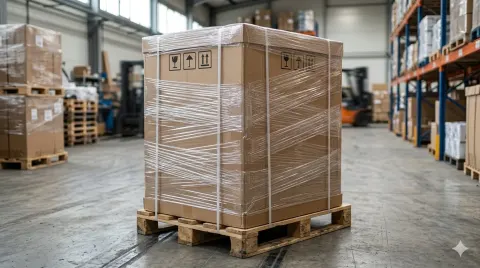
Shipping heavy household appliances like washing machines involves navigating a punishing logistics chain. From forklift vibrations to container ocean transit, these units are highly vulnerable to cosmetic and structural damage. Utilizing a dedicated stretch film manufacturing machine allows manufacturers to produce industrial-grade co-extruded wrap specifically engineered to solve these appliance packaging challenges.
Structural Hazards in Washing Machine Logistics
Washing machines present unique packaging vulnerabilities due to their weight distribution and internal components. Standard commercial film fails to provide adequate protection against the specific hazards encountered during transit:
- Cabinet Denting and Scratching: Lateral shifting during truck cornering causes friction between adjacent pallets, leading to sheet metal deformation.
- Internal Drum Misalignment: Inadequate load retention allows the heavy internal concrete counterweights and suspension springs to suffer shock damage from sudden braking.
- Electronic Component Corrosion: Temperature fluctuations inside shipping containers create condensation, risking electrical shorts in the main PCB boards.
Application of Co-Extruded Stretch Film in Appliance Unitization
Advanced co-extrusion technology transforms linear low-density polyethylene (LLDPE) into a high-performance protective barrier tailored for heavy machinery. A specialized stretch film manufacturing machine controls layer distribution to achieve the precise mechanical properties needed on the factory floor.
Multi-Layer Film Configurations and Their Practical Applications
1. Heavy-Duty Load Retention (3-Layer Stretch Film Machine)
The film produced by a 3-layer stretch film machine serves as the primary structural wrap for standard domestic shipping.
- Application: It binds the washing machine, EPS corner protectors, and wooden pallet into a single rigid unit. The high-tensile core layer absorbs multi-directional G-forces during transit, preventing the machine from sliding off its base.
2. Friction-Free Palletization (5-Layer Stretch Film Machine)
For high-density warehousing and international container shipping, a 5-layer stretch film machine offers advanced material zoning.
- Application: It produces differential-tack film. The high-cling inner layer locks tightly onto the washing machine packaging, while the ultra-smooth, zero-tack outer layer prevents adjacent pallets from grabbing, tearing, and puncturing each other during forklift loading and unloading.
3. Sharp Edge and Corner Puncture Resistance
Washing machine bases often feature sharp sheet-metal edges, screws, or rugged plastic feet that instantly puncture low-grade wraps.
- Application: By integrating metallocene LLDPE (mLLDPE) into the center layers via a multi-layer production line, the film gains high tear-propagation resistance. This prevents a single puncture from propagating into a catastrophic film snap when the wrap is stretched over sharp appliance corners.
Optimizing Application Performance via Production Automation
To ensure the film performs flawlessly on high-speed orbital wrapping lines, the manufacturing process must maintain absolute uniformity. Variations in film gauge lead to inconsistent wrap tension and premature tearing.
- Uniform Gauge Application: Utilizing a fully automatic stretch film machine with automatic thickness control holds tolerances to +/- 2 microns. This guarantees that every meter of film applied to the appliance exerts identical containment force.
- Tension-Free Unwinding: Servo-driven winding systems eliminate soft centers and roll telescoping. This ensures smooth, high-speed dispensing on the packaging line without breaking, keeping appliance assembly lines running at maximum throughput.
- Adaptable Batch Production: For specialized runs—such as extra-thick anti-UV film for outdoor appliance staging—a semi-automatic stretch film machine provides the operational flexibility to switch formulations quickly with minimal material waste.
Conclusion: Securing the Appliance Supply Chain
Protecting washing machines during global transit requires more than generic packaging. Investing in a dedicated stretch film manufacturing machine enables the precise engineering of film density, cling, and puncture resistance. By matching the film's mechanical properties to the physical demands of appliance logistics, manufacturers can guarantee flawless load stability, pristine electronics, and zero transit defects from the factory to the consumer.