In industrial stretch film manufacturing, roll quality serves as the definitive mechanical metric. Common winding defects like wrinkling, telescoping, and starring cause irreversible material waste and escalate operational costs. Traditional winding systems rely on static, fixed parameters. This rigid approach leads to inconsistent internal roll hardness and structural collapses during downstream unwinding. Advanced winding profiles solve these systemic issues, transforming a standard stretch film making machine into a high-precision engineering asset.
The Technical Mechanics of Winding Profiles
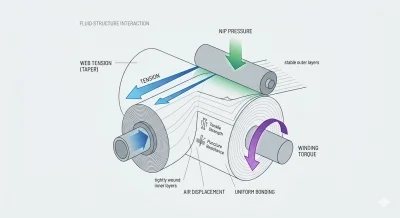
At the fluid-structure interaction core, winding profiles dynamically regulate three critical process variables: web tension, nip pressure, and winding torque.
- Advanced Taper Tension Control
Web tension must gradually decrease as the winding roll diameter increases. This intentional decay prevents the accumulation of excessive radial stress near the core. - Uniform Density and Air Displacement
The system winds inner layers tightly to avoid core crushing under compressive stress. Concurrently, outer layers remain stable without loose shifting. This continuous micro-adjustment minimizes high-speed air entrapment. - For a multi-layer stretch film machine, precise profile regulation is mathematically vital. Multi-layer structures demand exceptionally uniform interlayer bonding. This bonding preserves key mechanical properties, including high tensile strength and puncture resistance, across all layers.
Operational Advantages Across Equipment Configurations
Implementing adaptive winding controls yields measurable production performance advantages across various industrial machine classifications:
- Scrap Rate Minimization
Defect-free winding directly increases the net sellable yield per production run. It eliminates edge telescoping completely. - Gauge Consistency Optimization
A fully automatic stretch film machine achieves uniform roll hardness across both ultra-thin and heavy-duty gauges. - Operator Skill Independence
On a semi-automatic stretch film machine, automated profiles replicate premium results. It removes manual adjustments and reduces human error. - On a 2-layer stretch film machine utilized for heavy bulk pallet stabilization, uniform roll hardness ensures predictable unwinding kinetics. This elimination of roll deformation prevents film snapping on high-speed wrapping equipment.
Closed-Loop Automation and Next-Gen Control
The plastics machinery industry is actively shifting toward intelligent, closed-loop winding systems. Next-generation stretch film making machines now integrate real-time tension sensors and load cells to auto-calibrate winding profiles instantaneously. This technological evolution promises zero-defect manufacturing. Every processed film roll meets stringent dimensional tolerances and weight specifications automatically. Advanced winding technology remains the core feature securing high-margin premium roll quality.
Maximize Production ROI with Engineering Excellence
Optimizing winding profiles is not an optional technical luxury. It is a strategic necessity to maximize the return on investment for every stretch film production line. High-speed extrusion requires a winding system that matches its capacity without creating bottlenecks. Modern equipment must deliver exceptional mechanical reliability alongside smart process automation.
Our next-generation stretch film machines feature advanced, sensor-driven winding technology designed for zero-defect output. Whether upgrading a 3-layer co-extrusion line or deploying a fully automatic stretch film machine running 24/7, our intelligent taper control systems guarantee rock-solid roll stability and perfect gauge distribution. Eliminate waste, maximize line speeds, and secure your market position as a premium supplier by utilizing our industry-leading winding solutions.