Why Multi-Screw Inline Mixing is Gaining Popularity in High-End Stretch Film Extrusion Machines
2026-07-01
The global industrial packaging market is undergoing a massive paradigm shift toward sustainability, material reduction, and extreme production efficiency. In this highly competitive landscape, high-performance stretch film production demands exceptional melt uniformity, precise gauge control, and flawless thermal stability. As manufacturing speeds escalate to meet soaring volume demands, conventional single-screw extrusion systems frequently fail to deliver the intensive mixing required for ultra-thin formulations.
To overcome these physical limitations, forward-thinking manufacturers are rapidly transitioning to advanced multi-screw inline mixing technology. This crucial engineering shift directly resolves melt inhomogeneities, additive agglomeration, and thermal degradation, elevating production standards across the entire extrusion line. By upgrading the core mechanical heart of stretch film extrusion machines, plastic producers can move past traditional processing bottlenecks and unlock unprecedented levels of film quality and profitability.
The Pitfalls of Traditional Single-Screw Extrusion in Modern Film Production
For decades, single-screw extruders served as the backbone of the flexible packaging industry. However, the rise of sophisticated metallocene linear low-density polyethylene (mLLDPE) resins, complex tackifier masterbatches, and post-industrial recycled (PIR) materials has pushed these traditional systems past their mechanical limits. When operating a high-speed three-layer stretch film machine or an advanced five-layer stretch film machine, achieving absolute rheological uniformity across all co-extruded layers is paramount.
Conventional single-screw setups rely primarily on chaotic, pressure-driven flow to achieve mixing. This rudimentary mechanical action often results in severe melt stratification and inconsistent spatial distribution of critical additives. When the polymer stream enters the feedblock and die slot, minor variations in layer viscosity cause catastrophic layer interdiffusion. This structural breakdown destabilizes the precise nano-layer architecture required for high-end cast films, leading to frequent web breaks, uneven gauge profiles, and weak spots across the width of the web.
Furthermore, traditional single-screw designs generate excessive, localized frictional heat within the extrusion barrel. These localized hot spots trigger thermal degradation, cracking long-chain polymers into low-molecular-weight fragments. This degradation causes severe carbon buildup and polymer accumulation directly at the die lips, requiring frequent, costly maintenance shutdowns. Undissolved additives and degraded resins also manifest as micro-gels and fish-eyes, destroying the optical clarity and mechanical integrity of the finished product.
Engineering Advantages of Multi-Screw Inline Mixing Technology
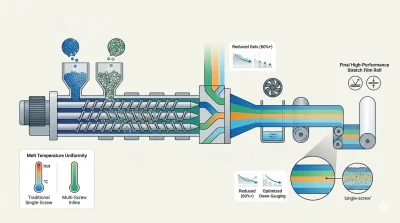
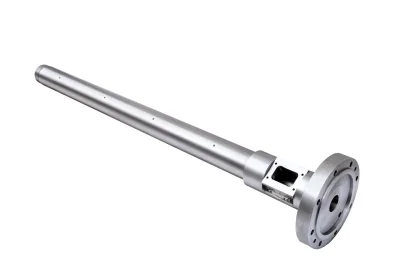
Integrating multi-screw inline mixing technology into the extrusion barrel completely transforms the polymer processing dynamics. By utilizing multiple intermeshing, co-rotating screws, the system subjects the polymer melt to continuous, high-intensity mechanical manipulation. This advanced architectural setup replaces unpredictable pressure-driven flow with forced positive displacement, ensuring that every cubic millimeter of resin undergoes the exact same shear history and residence time.
This mechanical configuration optimizes both distributive and dispersive mixing to a degree that single-screw systems cannot match. Distributive mixing ensures the perfect spatial arrangement of different resin types, liquid tackifiers, and color masterbatches throughout the entire melt stream. Simultaneously, dispersive mixing generates controlled high-shear zones that efficiently break down stubborn polymer agglomerates and tightly bound additive clusters. By reducing the incidence of gel defects and fish-eyes by over sixty percent, this technology establishes a genuinely flawless, uniform melt before the material ever reaches the die slot.
Beyond superior mixing capability, multi-screw configurations act as highly efficient heat exchangers. The continuous intermeshing action redistributes heat evenly across the polymer mass, delivering surgical-grade thermal uniformity throughout the entire melt stream. By eliminating localized hot spots, the system successfully suppresses polymer chain degradation and maintains an exceptionally stable melt pressure. This precise temperature control provides a wider, more forgiving processing window, allowing manufacturers to run complex resin blends and variable-viscosity materials with complete confidence.
Transforming Extrusion Lines into Zero-Defect Production Solutions
The ultimate value of multi-screw inline mixing technology lies in how it empowers the entire assembly of modern stretch film extrusion machines. When installed on a high-output, fully automatic stretch film machine, the stabilized melt quality permits non-stop operation at maximum mechanical line speeds. Because the polymer stream is completely free of micro-gels and structural weak spots, the risk of bubble instability, edge weaving, and catastrophic web breaks is virtually eliminated, keeping downtime to an absolute minimum.
Even when integrated into a semi-automatic stretch film machine, this technology provides immediate competitive advantages by expanding processing versatility. The optimized torque distribution and rock-solid melt pressure stability allow the extrusion system to easily process high percentages of post-industrial recycled resins. Variable raw materials that would normally cause severe pressure surges and thickness variations in a single-screw extruder are effortlessly homogenized into a premium-grade cast film.
Crucially, this advanced thermal and mechanical stability unlocks the ability to pursue aggressive down-gauging strategies without sacrificing performance. Multi-screw inline mixing enables the reliable, high-speed extrusion of ultra-thin, high-performance stretch packaging down to a mere five microns in thickness. Despite this extreme thinness, the flawless uniformity of the internal nano-layer structure ensures that the finished film preserves peak puncture resistance, strict tear propagation limits, and excellent cling retention. Manufacturers can significantly reduce raw material consumption per roll while delivering a superior product that meets the rigid standards of automated high-speed wrapping equipment.
Maximizing Operational Efficiency and Long-Term Profitability
Transitioning to multi-screw technology delivers quantifiable economic benefits that directly impact a manufacturing facility's bottom line. By drastically minimizing scrap rates due to a sixty percent reduction in gel-related defects, factories can convert more raw resin into sellable, prime-grade inventory. The elimination of localized overheating prevents carbon buildup at the die lips, extending continuous running times and decreasing the frequency of labor-intensive die cleaning procedures.
Furthermore, the capability to produce elite five-micron films allows plastic producers to position themselves at the absolute top tier of the global packaging market. As corporate clients demand greener, more efficient logistics solutions, the ability to supply reliable, ultra-thin high-performance film opens doors to lucrative long-term supply contracts. Multi-screw inline mixing serves as the technical foundation for zero-defect, high-speed stretch film manufacturing, turning raw engineering superiority into sustained market leadership.