Introduction
In stretch film production, screw shear stress directly determines film quality. For extruders running a 5-layer stretch film machine, fully automatic stretch film machine, 2-layer stretch film machine, 3-layer stretch film machine, or semi-automatic stretch film machine, the screw behavior within the extruder is the most decisive factor for metallocene linear low-density polyethylene (mLLDPE) plasticization. Mismanaged shear stress causes crystal gels, thickness variations, and melt fracture.
The Molecular Impact of Screw Stress on mLLDPE
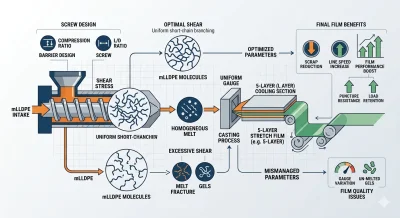
At the molecular level, mLLDPE features uniform short-chain branching. This unique structure requires precise shear to achieve optimal macromolecular entanglement and melting uniformity.
- Optimal Shear Profile
The polymer plasticizes uniformly. Unmelted particles are eliminated. The homogeneous melt ensures superior film gauge control. - Excessive Shear Stress
Aggressive screw geometry or improper temperature profiling causes molecular degradation. Chain scission and cross-linking lead to flow instabilities and a severe drop in tensile strength. - Multi-layer structures amplify single-layer defects. Therefore, operators using a 3-layer stretch film machine or 5-layer stretch film machine must control these parameters strictly.
Real-World Production Benefits of Stress Optimization
Optimizing screw stress through barrier designs, specific compression ratios, and precise L/D ratios yields measurable production advantages:
- Scrap Reduction
Material waste drops by up to 18%. - Line Speed Increase
Throughput rises by 12% to 15% with zero performance loss. - Film Performance Boost
Puncture resistance improves by 20%. Load retention force increases by 15%.
Next-Gen Intelligent Control Systems
The plastic packaging industry is shifting toward automated screw stress monitoring via closed-loop control systems. Next-generation multi-layer stretch film machines integrate real-time torque and melt pressure sensors. These sensors automatically adjust screw speed and barrel heating zones to maintain the ideal processing window. This integration mitigates raw material variations and guarantees consistent film elasticity.