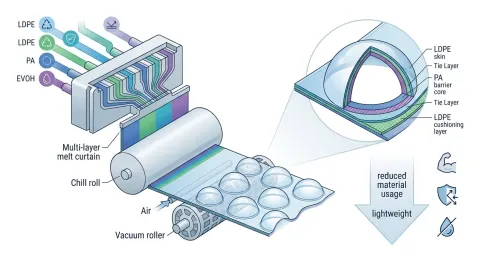
Multi-layer co-extrusion technology in bubble film manufacturing machines enables the production of high-strength protective films with improved mechanical stability, reduced material usage, and enhanced impact resistance. By combining multiple polymer layers in a single extrusion process, the structure achieves better bubble integrity and more stable film performance under high-speed production conditions.
Bubble film typically uses 2-layer, 3-layer, 5-layer, or 7-layer co-extrusion structures. Outer layers made of LDPE or MLDPE provide puncture resistance, abrasion resistance, and surface strength, while inner layers enhance cushioning performance and structural stability. Functional layers such as PA or EVOH can be introduced to significantly improve oxygen and moisture barrier properties. Meanwhile, tie layers are used to ensure strong adhesion between incompatible polymers and prevent delamination during stretching and forming.
The co-extrusion die head plays a critical role in layer distribution and melt flow stability. It ensures uniform thickness across all layers, maintains balanced pressure distribution, and supports stable bubble formation during continuous operation. Advanced die head systems further reduce gauge variation, improve layer symmetry, and enhance overall film consistency, especially in high-output production environments.
By integrating virgin resins, recycled materials, and functional polymers such as HDPE, LDPE, MLDPE, PA, and EVOH, multi-layer bubble film systems achieve an optimized balance between strength, flexibility, and weight reduction. In many modern configurations, overall film thickness can be reduced while still maintaining or even improving puncture resistance and tensile strength, contributing to material savings and lower production costs.
In 5-layer and 7-layer structures, barrier layers significantly enhance resistance to oxygen and moisture transmission, making the film suitable for high-protection packaging applications such as electronics, precision instruments, and long-distance logistics packaging. These advanced structures also improve thermal stability and extend product shelf life in sensitive packaging environments.
Continuous production systems are engineered for stable long-term operation, improved filtration efficiency, and reduced maintenance frequency. Enhanced screw design, optimized temperature control, and automated tension regulation ensure consistent output quality over extended production cycles, even under high-speed conditions.
Overall, multi-layer co-extrusion bubble film machines are widely used for producing lightweight yet highly shock-resistant packaging films. The combination of advanced layer structure design, precise extrusion control, and stable bubble formation results in improved energy absorption, higher production efficiency, and more sustainable material usage in modern industrial protective packaging applications.