Multi-Layer Co-Extrusion Bubble Film Extrusion Machine Trends
2026-05-07
The global protective packaging landscape is undergoing a paradigm shift, driven by stringent environmental regulations and the demand for high-performance material efficiency. The following key trends are defining the future of multi-layer co-extrusion bubble film extrusion machine technology.
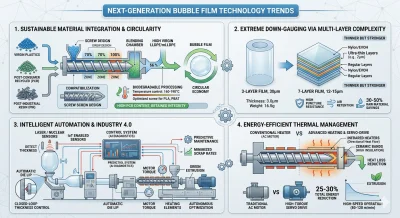
1. Sustainable Material Integration and Circularity
The most significant trend is the transition from virgin plastics to circular economies. Future extrusion systems are being engineered to handle high percentages of Post-Consumer Recycled (PCR) and Post-Industrial Resin (PIR) without compromising film clarity or cushioning integrity.
- Compatibilization Technology: Advanced screw designs now allow for the seamless blending of recycled content with virgin LLDPE/mLLDPE.
- Biodegradable Processing: Machines are increasingly optimized for compostable resins (such as PLA or PBAT), requiring precise temperature control to prevent thermal degradation during the extrusion process.
2. Extreme Down-Gauging via Multi-Layer Complexity
To reduce carbon footprints, the industry is moving toward "thinner but stronger" films. The trend is shifting from 2-3 layer structures toward 5-layer and 7-layer co-extrusion.
- Functional Layering: By isolating high-performance resins (like Nylon or EVOH) into ultra-thin functional layers, 7-layer machines can produce 12-15 micron films that offer higher puncture resistance and air retention than traditional 30-micron monolayer bubbles.
- Material Savings: This evolution allows for a 30-50% reduction in raw material usage while maintaining superior load protection.
3. Intelligent Automation and Industry 4.0
Automation is evolving from simple control to autonomous optimization. Future-ready bubble film machines integrate IoT-enabled sensors to minimize human intervention and scrap rates:
- Closed-Loop Thickness Control: Utilizing nuclear or laser sensors, systems now provide real-time feedback to automatic die lips, ensuring sub-micron thickness uniformity across the entire web width.
- Predictive Maintenance: AI-driven diagnostics monitor motor torque and heating element efficiency, predicting component failure before downtime occurs.
4. Energy-Efficient Thermal Management
As energy costs rise, the focus has turned to the "Green Extrusion" concept.
- Infrared & Ceramic Heating: Modern lines are adopting directional infrared heaters and high-insulation ceramic bands to reduce heat loss.
- Servo-Drive Dominance: Replacing traditional AC motors with high-torque servo drives has become the standard, cutting total energy consumption by up to 25-30% during high-speed operations (80-120 m/min).
5. Functional Specialization in Co-Extrusion
Beyond standard cushioning, there is a growing trend toward multi-functional protective films produced in a single pass. Co-extrusion technology enables the simultaneous integration of:
- Anti-static and VCI (Volatile Corrosion Inhibitor) properties for electronics and automotive parts.
- Light-blocking and UV-resistant layers for long-term outdoor storage or sensitive medical supplies.