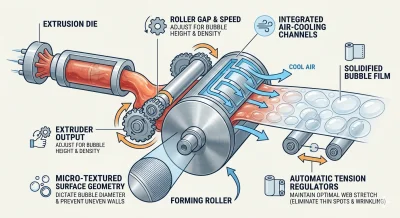
A single burst bubble may seem like a minor defect, but on a high-speed production line, repeated inconsistencies quickly lead to rejected rolls, material waste, and increased production costs. Uneven bubble walls, weak seals, and collapsed air cushions frequently stem from unstable forming conditions, making the forming roller a critical component in the extrusion process. Positioned downstream of after the extrusion die, the forming roller shapes the molten polymer into a consistent bubble structure while regulating bubble geometry, wall uniformity, and overall film formation. Its design and operating stability directly govern the quality and consistency of the finished bubble film.
Why Traditional Forming Roller Designs Keep Falling Short
Many of the defects that manifest in finished bubble film originate at the roller surface. Older or lower-precision rollers are often machined with basic surface textures yielding inconsistent bubble wall thickness. Those thin spots become vulnerable failure points, whether on the line, in a warehouse, or during transit.
Synchronization is another common weak point. When roller gap and rotational speed aren't matched precisely to extruder output, bubble height and structural density drift, making it difficult to hold tight dimensional tolerances. Cooling adds a further layer of risk — without rapid, uniform heat transfer to solidify the semi-molten polymer immediately after forming, bubble structures can collapse or deform before achieving dimensional stability, especially at higher line speeds. When the forming roller isn't properly coordinated with tension control, the film is prone to thin spots, necking, and surface wrinkling. Furthermore, many single-profile rollers cannot accommodate different product specifications, making transitions between gauge ranges or bubble sizes require lengthy mechanical changeovers and extended downtime.
Critical Applications Impacted by Forming Roller Inconsistencies
The operational impact of forming roller quality becomes clearest in applications where protective packaging performance leaves minimal room for defects.
In automotive components and precision machinery packaging, items such as sensor modules, precision bearings, and instrument assemblies endure complex, multi-stage logistics chains. These parts depend on bubble film with high structural density and high resistance to compressive deformation to maintain cushioning protection. When forming roller density control is inconsistent, localized support degrades, leading to surface scratching or impact damage.
Glass and ceramic products present a different challenge. These items are extremely sensitive to localized impact, and their irregular shapes make consistent wrapping difficult without a uniform, highly resilient bubble architecture. A forming roller that produces uneven bubble wall thickness creates weak points along critical stress concentrations, causing premature bubble rupture during handling.

Precision Bubble Forming Across Different Machine Configurations
We design the forming roller in our extrusion platforms around three coordinated functions rather than treating bubble shaping as a single mechanical step. Precision geometric molding starts at the roller surface, where micro-textured patterns are engineered to set a consistent initial bubble diameter and prevent uneven wall distribution that leads to premature bursting. That geometry is paired with synchronized extrusion flow control, where roller gap and rotational speed are matched precisely to extruder output, keeping bubble height and structural density consistent across the full length of every run rather than drifting batch to batch.
Rapid thermal stabilization closes the loop. Integrated air-cooling channels solidify the semi-molten polymer quickly enough to lock the bubble shape in place before structural collapse becomes a risk, even at high line speeds where dwell time is limited. The forming roller also works in coordination with automatic tension regulators across the machine, maintaining even web stretch so thin spots, necking, and surface wrinkling are addressed as part of the forming process rather than corrected after the fact.
This engineering translates into measurable performance differences depending on machine configuration. On 2-layer high-speed lines, the forming roller supports continuous line speeds exceeding 180 meters per minute while holding bubble dimensional tolerance within ±0.05 mm, which typically increases shift output by 12% to 15% compared to standard roller designs. On 7-layer high-speed co-extrusion lines, multi-zone forming rollers handle the added complexity of multi-layer structures, producing ultra-thin, high-barrier bubble films without sacrificing bubble integrity — a capability especially relevant for electronics and medical packaging, where both cushioning performance and barrier properties matter. For 3-5 layer medium-speed machines, a single roller profile handles a wide gauge range from 0.2 mm to 2.5 mm, giving manufacturers the flexibility to run diverse product specifications while cutting mechanical changeover downtime by up to 40%.
For the automotive and precision component packaging applications this level of density control directly addresses the support and compression-resistance requirements those parts demand. And for glass and ceramic packaging, precise, uniform bubble geometry means the film wraps cleanly around irregular shapes and edges without localized weak points that cause early bubble failure.
Where Forming Roller Technology Is Headed
The next generation of forming roller design incorporates servo-driven, actively cooled rollers with real-time feedback loops. These systems utilize infrared bubble measurement to continuously monitor bubble geometry as it forms, automatically adjusting roller gap and internal cooling rates to compensate for ambient temperature shifts or fluctuations in raw material melt flow rate. For advanced 3-5 layer high-speed and 7-layer production lines, this responsive control dramatically reduces defect rates and enables reliable production of complex micro-bubble structures, antistatic films, and biodegradable packaging materials that static roller designs cannot process with equivalent consistency.
For manufacturers evaluating a new bubble film line, the forming roller is a critical component, as it governs whether raw polymer is successfully converted into structurally sound protective cushioning. Precision geometry, synchronized flow control, rapid cooling, and closed-loop servo feedback separate a bubble film line that delivers consistent, high-yield output from one that leaves quality to chance.