How Multi-Layer Bubble Film Extrusion Machines Enhance Cushioning Protection
2026-07-02
In the rapidly evolving landscape of e-commerce, global logistics, and industrial supply chains, product safety during transit is paramount. As shipping distances lengthen and handling touchpoints multiply, the demand for superior protective packaging has reached an all-time high. Traditional packaging materials often fall short, leading to costly product damages, high return rates, and diminished brand reputation. To address these vulnerabilities, forward-thinking manufacturers are turning to advanced manufacturing technologies. Among these innovations, modern multi-layer bubble film extrusion machines stand out as the definitive solution for producing next-generation cushioning materials that offer unmatched protective performance.
The Pitfalls of Legacy Protective Packaging and Traditional Systems
For decades, standard mono-layer or simple traditional bubble wraps were the industry standard. However, as the modern supply chain introduces more rigorous handling, these older materials are exposing severe limitations. Traditional air bubble films suffer from high gas permeability. Under sustained mechanical stress or during long-haul transit, air gradually leaks out of the bubbles. This phenomenon, known as "bubble flattening," leaves products highly vulnerable to subsequent shocks and vibrations.
Furthermore, older manufacturing machinery lacks the technical capability to process advanced material formulations or integrate recycled plastics without severely compromising the film's tensile strength. As a result, manufacturers are often forced to increase the overall film thickness to achieve acceptable protection levels. This inefficient approach drastically spikes raw material costs and contradicts modern corporate sustainability mandates.
Operationally, legacy machinery presents an uphill battle for factory owners. These older lines suffer from frequent web breaks, uneven extrusion thickness, high energy consumption, and lengthy changeover times. The inability to maintain consistent bubble geometry across the entire width of the web leads to massive material waste and unpredictable product quality, ultimately destroying profit margins.
Decoding the Configurations: Machinery Classification and Purpose
To meet diverse market demands, our versatile line of bubble film extrusion machines is engineered into three specialized technical classifications: 2-layer, 3-5 layer, and 7-layer configurations. Each system serves a distinct market purpose, allowing packaging producers to perfectly balance production costs, raw material versatility, and cushioning performance.
2-Layer Bubble Film Machines: Standard and Economical Packaging
The 2-layer configuration produces the baseline standard bubble film, consisting of a flat backing film and a molded bubble layer. This setup is highly economical and ideal for lightweight applications, surface scratch protection, and short-distance shipping. It offers a fast production turnaround with minimal material overhead, making it the perfect choice for high-volume, entry-level protective wrapping markets.
3-5 Layer Bubble Film Machines: Enhanced Shielding and High Performance
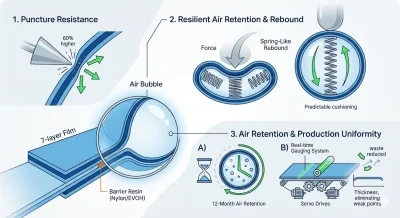
By stepping up to our 3-5 layer co-extrusion machines, manufacturers unlock vastly superior structural strength. The 3-layer configuration traps the air bubbles symmetrically between two flat surface sheets, which drastically increases tensile strength and prevents items from snagging. Moving into 4 and 5-layer setups, the machinery incorporates advanced co-extrusion blocks to inject a functional barrier resin—such as Nylon (PA) or EVOH—directly into the core matrix. This structural architecture creates an impenetrable wall that traps air molecules permanently, ensuring that the bubbles do not flatten even under prolonged heavy loads during intercontinental shipping.
7-Layer Bubble Film Machines: Ultimate Barrier and Recycled Material Integration
Our top-tier 7-layer extrusion lines represent the absolute pinnacle of modern high-barrier packaging engineering. Featuring a highly sophisticated multi-channel die head design, these lines split the film into seven highly specific functional zones. This complex layout allows high-performance barrier resins to be flanked by ultra-strong tie layers, while the bulk of the film thickness can utilize cost-effective materials.
Redefining Profitability through Material Flexibility and Sustainable Manufacturing
Modern industrial lines do more than just produce a stronger product; they completely re-engineer the economics of protective packaging production. One of the most significant advantages of our multi-layer bubble film extrusion machines is their unparalleled recipe flexibility, especially prominent in our 5 and 7-layer systems. By separating the film structure into distinct functional layers, manufacturers no longer need to use expensive, 100% virgin resins throughout the entire film.
- High-Ratio Recycled Material Integration: The internal core layers can comfortably utilize up to 40% to 60% of post-industrial recycled (PIR) or post-consumer recycled (PCR) plastics, as well as calcium carbonate (CaCO₃) fillers.
- Flawless Exterior Aesthetics: Because the recycled materials are completely encapsulated within the internal layers, the exterior surfaces of the bubble film maintain an ultra-clear, premium aesthetic and flawless heat-sealability.
- Downgauging with Enhanced Strength: The precise gauge control of modern extrusion lines allows for massive material downgauging. Manufacturers can reduce total film thickness by up to 20% while achieving cushioning metrics that far surpass thicker, traditional films.
Fully Automated Continuous Winding and Slitting Systems
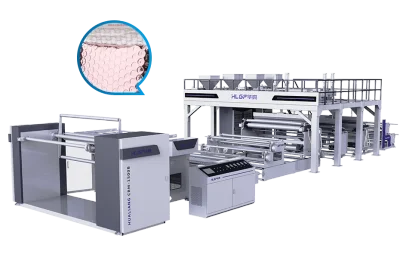
The extrusion line features an advanced, non-stop automatic flip-flop turret winder equipped with high-speed flying knives. When a roll reaches its target length, the machine executes an instantaneous, automated cut and transfer to a new core without slowing down the extrusion speed. Integrated inline slitting units allow users to slice a wide master roll into multiple custom-width smaller rolls simultaneously, eliminating the need for a secondary, offline slitting process.
Closed-Loop Smart Control and Tension Management
The entire system is powered by a state-of-the-art PLC coupled with an intuitive Human-Machine Interface (HMI). Operators can monitor and adjust the entire production line from a centralized touch screen. Synchronized closed-loop tension control systems automatically adjust the winding speed and torque based on real-time sensor data from the dancer rolls. This precision prevents any stretching or distortion of the freshly formed bubbles, ensuring uniform roll density.
Sustainable Inline Edge Trim Recycling
To achieve zero-waste manufacturing goals, our machinery integrates a high-efficiency, inline edge-trim recycling system. The trimmed edges of the film are automatically drawn into a heavy-duty granulator, crushed, pneumatically transported, and fed directly back into the extruder hopper in real time. This immediate closed-loop recycling eliminates material contamination, saves storage space, and ensures 100% material utilization.
The Future of Cushioning Protection and Market Competitiveness
Investing in a high-performance multi-layer bubble film extrusion line is a strategic move that addresses the dual pressures of cost reduction and quality enhancement. By transitioning from single-layer limitations to the robust capabilities of our 2, 3-5, and 7-layer co-extrusion technology, packaging producers can deliver a premium product that guarantees long-lasting air retention, exceptional puncture resistance, and unmatched structural integrity. Contact our engineering team today to get a customized technical proposal and quotation for your factory.