In modern packaging manufacturing, cooling performance is a critical determinant of final film quality, production stability, and overall line efficiency. Whether in high-speed cast extrusion or bubble film production, thermal management directly determines clarity, gauge uniformity, mechanical strength, and process reliability.
As production demands rise, both stretch film making machines and bubble film making machines must integrate more precise and adaptive cooling technologies to maintain competitive output quality and line throughput.
Critical Challenges in Industrial Film Cooling Systems
In conventional extrusion environments, cooling systems serve as a hidden bottleneck limiting productivity and product consistency. One of the most common issues is uneven heat removal during high-speed production. When cooling is not uniform, the molten polymer does not solidify consistently, leading to gauge variations, reduced optical clarity, and inconsistent mechanical properties.
Another significant challenge is imprecise temperature control. In many traditional systems, temperature fluctuations across the cooling surface alter polymer crystallization. This results in inconsistent tensile strength, surface haze, or internal stress that negatively impacts downstream processing.
Structural films, such as those produced on bubble film making machines, face even greater difficulty. Because the material must be formed into a bubble structure while simultaneously being cooled, any instability in thermal control can cause bubble collapse, uneven height distribution, or weak cushioning performance.
As multilayer co-extrusion becomes more common, especially in 5-layer and 7-layer configurations, traditional cooling systems struggle to respond dynamically to changing thermal loads, making process optimization increasingly complex.
Limitations Of Conventional Cooling Methods In Cast And Bubble Film Production
In cast film production systems, commonly used in stretch film making machines, traditional cooling relies on basic chill roll configurations that often lack precise thermal zoning. These systems may suffer from inconsistent surface temperatures across the roll width, resulting in transverse thickness variation in the final film.
Additionally, insufficient surface finishing on cooling rolls can introduce unwanted friction during high-speed web handling. This affects line stability and can create surface defects that reduce film transparency and gloss. When operating at higher production speeds, these limitations become more pronounced and can significantly reduce output quality.
In bubble film production, the challenges are even more complex. Bubble formation depends on a delicate balance between internal air pressure, vacuum shaping, and rapid cooling. Traditional cooling systems often fail to stabilize this interaction, leading to bubble deformation or collapse.
Poor thermal conductivity and slow heat dissipation prevent rapid structural fixation of the bubble shape. As a result, cushioning performance becomes inconsistent, and product reliability is compromised, particularly in packaging applications requiring high shock absorption.
Advanced Cooling Architecture In Stretch Film Making Machines
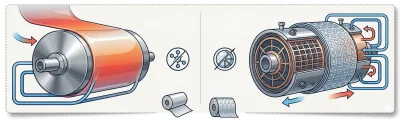
Modern stretch film making machines rely on high-precision cast cooling systems designed to ensure uniform heat extraction across a flat polymer web. The core component of this system is the precision-engineered chill roll.
These chill rolls are typically manufactured with highly polished steel surfaces to prevent surface defect during high-speed film conveyance. This smooth surface ensures uniform film contact, minimizing the risk of surface scratches or flow marks while maintaining continuous operation at industrial speeds.
Within the roll structure, a closed-loop water circulation system maintains a tightly controlled temperature range, typically between 10°C and 18°C. This narrow temperature window is critical for controlling crystallization of the polymer melt. By ensuring consistent heat extraction across the entire roll surface, the system stabilizes film gauge and enhances optical clarity.
Another key advantage of this cooling architecture is its ability to support multilayer structures, including 2-layer, 3-layer, and 5-layer film configurations. Even at high output rates, the system maintains consistent cooling efficiency, enabling consistent tensile strength and load retention in finished stretch films.
Vacuum-Assisted Cooling Technology in Bubble Film Making Machines
Unlike cast film systems, bubble film lines require a fundamentally different cooling approach due to the structural nature of bubble formation. In this process, cooling involves not only temperature reduction but also maintaining geometric stability during expansion.
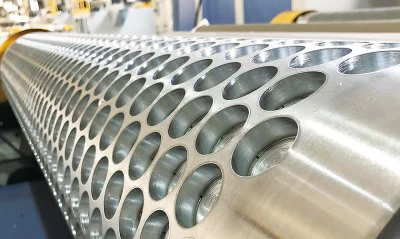
The system typically utilizes forming rollers equipped with internal multi-channel water circulation, engineered to extract heat efficiently from the molten polymer as it is drawn into shape.
As the film exits the die, the vacuum system actively draws the material onto the forming roller's cylindrical cavities, creating uniform air pockets that define the bubble structure. At the same time, rapid cooling locks the geometry in place, preventing structural collapse during expansion.
Multi-zone thermal control ensures that different sections of the cooling roller operate at optimal temperatures. This zoned approach enables control over bubble height, wall thickness, and cushioning resilience — all critical performance parameters in protective packaging applications.
Comparative Cooling Mechanisms Between Cast And Bubble Film Systems
Although both systems aim to stabilize the polymer melt, their cooling strategies differ significantly due to differing product geometries.
Stretch film lines rely on direct contact cooling via smooth chill rolls. The goal is rapid quenching of a flat film web while maintaining dimensional stability and optical clarity. Heat transfer occurs primarily through conduction between the polymer melt and the roll surface.
In contrast, bubble film lines combine vacuum shaping with conductive cooling through the forming roller. Instead of a flat web, the polymer forms enclosed air pockets, requiring simultaneous structural support and heat extraction. The cooling mechanism must thus stabilize both bubble geometry and material properties at the same time.
From a thermal engineering perspective, stretch systems focus on suppressing crystallization, whereas bubble systems focus on structural solidification. This fundamental difference defines the design philosophy of their respective cooling architectures.
Performance Benefits Of Modern Integrated Cooling Systems
Advanced cooling systems significantly improve the performance of both stretch film lines and bubble film lines. As a cast-film-based process, precise temperature control reduces gauge variation and enhances film clarity, improving load stability and material efficiency in industrial packaging applications.
In bubble film production, enhanced thermal stability directly improves cushioning performance and structural consistency. Uniform bubble formation ensures predictable shock absorption, essential for protective packaging in e-commerce and logistics.
Modern systems also enable higher line speeds without compromising quality. By optimizing heat transfer, manufacturers can boost throughput while maintaining consistent product specifications. This improves overall equipment effectiveness (OEE) and minimizes downtime caused by thermal fluctuations.
Future Development Of Adaptive Cooling Technology
As industrial demand shifts toward more complex multilayer structures, cooling systems are evolving toward intelligent adaptive control. Next-generation stretch film lines and bubble film lines are increasingly integrating real-time monitoring systems that adjust cooling parameters dynamically.
These adaptive systems analyze line speed, ambient temperature, and melt conditions to regulate water flow rates and pressure distribution. This prevents thermal imbalances from affecting product quality and ensures stable operation even under fluctuating operating conditions.
With continuous advancements in chill roll design, vacuum cooling systems, and adaptive thermal control, modern extrusion lines are achieving higher efficiency, stability, and product quality. As multilayer film structures become more complex, cooling integration will remain a key driver of innovation in the packaging industry.
To meet these demands, our bubble film lines and stretch film lines are engineered with optimized vacuum-assisted cooling and multi-zone thermal control, ensuring superior bubble stability, consistent cushioning performance, and higher production efficiency. This enables manufacturers to achieve reliable output quality while maximizing long-term operational value.