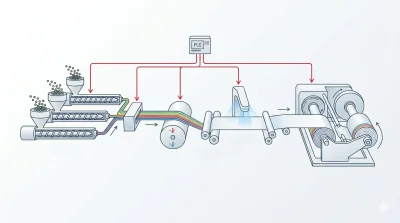
In modern packaging manufacturing, production efficiency and process stability have become critical factors determining competitiveness. As extrusion lines continue to evolve toward higher speeds exceeding 200 m/min and more advanced multi-layer structures such as 3-layer, 5-layer, and 7-layer configurations, the technical requirements for control accuracy have increased significantly.
In this environment, bubble film making machines and stretch film making machines face the same fundamental challenge: maintaining stable melt behavior, consistent layer distribution, and precise mechanical synchronization under high-speed continuous operation. Even minor fluctuations in temperature, screw speed, or tension can lead to defects such as uneven thickness, bubble collapse, or layer delamination. These issues directly impact material waste, downtime, and final product quality.
To solve these challenges, programmable logic controller (PLC) systems have become the core intelligence of modern extrusion equipment, transforming complex mechanical and thermal variables into real-time automated control decisions.
Industry Challenges in High-Speed Film Production
The current generation of film extrusion equipment operates under increasingly demanding production conditions. While output capacity has significantly improved, process stability has become more difficult to maintain.
One of the most critical issues is the synchronization of multi-layer co-extrusion systems. In stretch film making machines and bubble film making machines, different polymers such as LLDPE, LDPE, and functional additives must be precisely metered and combined. Any mismatch in screw speed ratios or melt pressure can result in inconsistent layer thickness or structural weakness in the final film.
Temperature instability is another major concern. Extrusion barrels and die heads contain multiple heating zones, and even small deviations in thermal balance can change polymer viscosity, affecting flow behavior and product uniformity. In traditional systems, these adjustments are often reactive rather than predictive, leading to instability during continuous production.
Mechanical coordination also becomes increasingly complex at high speeds. As line speed increases beyond 200 m/min, the synchronization between extruders, chill rolls, vacuum forming units, and winding systems must remain perfectly aligned. Without real-time digital control, the risk of film breakage, bubble collapse, or tension imbalance increases significantly.
Finally, conventional production environments struggle with waste reduction and downtime control. Start-up scrap, manual calibration delays, and unexpected equipment failures all contribute to reduced operational efficiency.
Limitations of Traditional Control Systems
Before the widespread adoption of plc-based automation, most extrusion lines relied on manual adjustments or basic relay-based electrical control systems. These approaches are no longer sufficient for modern high-speed production requirements.
Manual control systems depend heavily on operator experience, which introduces variability between shifts and production batches. Adjustments to temperature, speed, and tension are typically made after visible defects appear, meaning the system operates in a reactive rather than proactive mode.
In addition, traditional systems lack the ability to coordinate multiple subsystems simultaneously. Extruders, haul-off units, and winding stations often operate independently, making it difficult to maintain precise layer alignment and consistent film thickness across the entire production line.
Another key limitation is the absence of real-time data integration. Without continuous monitoring and feedback loops, manufacturers cannot track performance trends or predict equipment degradation. This results in higher maintenance costs and unexpected downtime, especially in continuous production environments.
As production speeds increase and product specifications become more demanding, these limitations create a clear need for advanced automation solutions.
PLC Control Systems as the Core of Modern Extrusion Intelligence
Modern plc control systems act as the central processing unit of film extrusion lines, integrating mechanical, thermal, and electrical subsystems into a unified intelligent control architecture. This transformation enables real-time decision-making and closed-loop optimization across the entire production process.
One of the most important functions is multi-extruder synchronization. In stretch film making machines and bubble film making machines, the plc precisely controls the screw speed ratios of different extruders to ensure accurate layer distribution. This prevents delamination and ensures consistent mechanical properties across the film structure.
Another key capability is automated die gap control. When integrated with online thickness measurement systems, the plc continuously analyzes film profile data and adjusts thermal bolt positions on the t-die. This allows thickness variation to be controlled within a tight ±2% tolerance, significantly improving product consistency.
High-speed winding control is also a critical function. At production speeds exceeding 200 m/min, the plc coordinates turret rotation, web cutting, and core switching without stopping the line. This ensures continuous production while maintaining precise tension control throughout the rewinding process.
Temperature management is handled through multi-zone pid control algorithms. Each heating zone along the barrel and die is independently regulated, maintaining temperature stability within ±1°C. This precise thermal balance ensures optimal melt viscosity and stable bubble or film formation.
Tension and speed synchronization are equally important. The plc dynamically adjusts motor torque and frequency across haul-off rollers, cooling systems, and winding units to maintain stable web tension. This prevents defects such as film stretching, wrinkling, or bubble collapse.
Predictive diagnostics further enhance system reliability. By continuously monitoring motor load, heater performance, and sensor feedback, the system can detect early signs of component wear and trigger maintenance alerts before failures occur. This reduces unplanned downtime and extends equipment lifespan.
Application in Bubble Film Making Machines and Stretch Film Making Machines
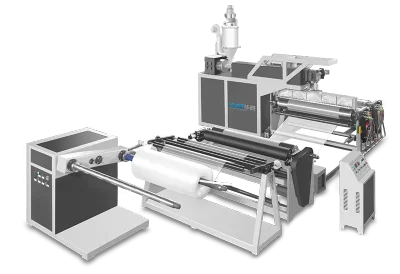
In bubble film making machines, the role of plc control is especially critical due to the sensitivity of bubble structure formation. The process requires precise coordination between extrusion output, vacuum forming rollers, and cooling systems.
The plc ensures that the vacuum forming section operates in perfect synchronization with melt delivery from the extruder. Any mismatch in speed can lead to bubble deformation or collapse. By continuously adjusting roller speed and vacuum pressure parameters, the system maintains stable bubble geometry even at high production speeds.
Multi-zone temperature control plays a key role in ensuring proper bubble formation. Since bubble stability depends on polymer viscosity, maintaining consistent thermal conditions across the barrel and die is essential. The plc achieves this through real-time pid regulation across multiple heating zones.
For laminated bubble film structures, such as those combined with epe foam, aluminum foil, or kraft paper, tension control becomes even more critical. The plc dynamically adjusts torque based on roll diameter changes, preventing excessive pressure that could damage the bubble structure during rewinding.
In stretch film making machines, the focus is on layer accuracy and mechanical strength. The plc ensures precise synchronization of multi-layer co-extrusion, allowing manufacturers to produce films with high puncture resistance, excellent cling properties, and uniform thickness distribution. High-speed turret winding systems further enhance productivity by eliminating downtime during roll changes.
Industrial Benefits and Smart Manufacturing Value
The integration of plc control systems delivers measurable improvements across multiple dimensions of production performance.
Material efficiency is significantly improved through real-time feedback control. By continuously adjusting extrusion parameters based on live data, startup waste can be reduced by up to 15 percent. Energy consumption is also optimized through variable frequency drive coordination, resulting in energy savings of approximately 10 to 12 percent.
Production stability is greatly enhanced due to closed-loop control of temperature, speed, and tension. This reduces defect rates and ensures consistent product quality across long production runs.
Maintenance efficiency is improved through predictive diagnostics. Early detection of system anomalies allows manufacturers to perform scheduled maintenance rather than emergency repairs, reducing downtime by up to 30 percent.
Finally, integration with smart factory systems enables full digitalization of production data. Manufacturers can store recipes, track performance trends, and optimize production strategies using centralized analytics platforms.
The Future of Intelligent Film Extrusion
As the packaging industry continues to move toward higher automation and precision manufacturing, plc control systems have become the foundation of modern extrusion technology. Their ability to integrate mechanical, thermal, and digital systems into a unified control architecture makes them indispensable for high-speed production environments.
For bubble film making machines and stretch film making machines, plc technology not only improves efficiency and stability but also enables full transition toward intelligent manufacturing and Industry 4.0 standards. With continuous advancements in automation, data integration, and predictive control, the future of film extrusion will be defined by smarter, faster, and more reliable production systems.