Automated Gauge Control: How PLC Reduces Variation in Bubble Film Extrusion Machines
2026-07-02
In modern packaging industries, bubble film extrusion machines are required to operate at increasingly higher speeds while maintaining extremely tight film thickness tolerances. However, achieving consistent gauge control in multi-layer co-extrusion processes remains a significant technical challenge.
During high-speed production, even minor fluctuations in melt temperature, polymer viscosity, die lip alignment, or haul-off tension can result in continuous thickness variation across the film web. These deviations directly affect bubble uniformity, leading to unstable cushioning performance, premature bubble rupture, and inconsistent roll geometry.
As production speeds increase and multi-layer structures evolve from 2-layer systems to advanced 5-layer and 7-layer configurations, manual adjustment becomes insufficient. Operators cannot respond quickly enough to multi-variable fluctuations, making automated control systems a necessity in modern extrusion lines.
Industry Problems: Why Traditional Gauge Control Methods Fail
Traditional bubble film extrusion systems rely heavily on operator experience and manual adjustment. While this approach may work in low-speed or single-layer production, it becomes highly unstable under modern high-output conditions.
One of the major issues is cross-web thickness variation, where film thickness is uneven across the width of the sheet. This leads to weak points in bubble formation and inconsistent mechanical strength.
Another critical problem is process instability caused by thermal and pressure fluctuations. Melt temperature drift changes polymer flow behavior, while viscosity variations affect layer distribution in co-extrusion structures. These small deviations accumulate quickly in high-speed production lines.
In addition, mechanical factors such as die lip misalignment and inconsistent haul-off tension introduce further instability. Without real-time correction, these errors propagate through the entire roll, resulting in scrap material, wasted resin, and unstable winding geometry.
Ultimately, traditional systems lack the ability to coordinate multiple variables simultaneously. This creates a production environment that is reactive rather than proactive, leading to inefficiency and inconsistent product quality.
Core Technology: PLC-Based Automated Gauge Control System
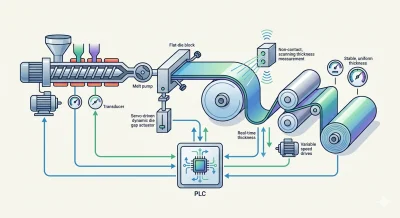
To solve these limitations, modern bubble film extrusion machines are now equipped with an advanced automated gauge control system powered by a centralized PLC closed-loop feedback network.
This system continuously monitors film thickness and extrusion pressure using high-precision online sensors and pressure transducers installed along the production line. Unlike manual systems, which rely on periodic sampling, this architecture provides real-time continuous data feedback.
Once a deviation from the target thickness setpoint is detected, the PLC controller instantly processes the information and triggers a synchronized corrective response. This response occurs within milliseconds, preventing deviation accumulation.
The system simultaneously adjusts multiple parameters, including automatic die gap regulation for precise flow control, extruder screw speed modulation to stabilize output volume, and haul-off tension calibration to maintain dimensional consistency.
This multi-variable coordination ensures that the entire extrusion system operates as a unified control loop rather than independent mechanical components.
Multi-Layer Adaptability and High-Speed Stability
One of the key advantages of PLC-based automated gauge control systems is their ability to adapt to complex multi-layer co-extrusion structures, ranging from 2-layer basic films to advanced 7-layer bubble films.
In high-speed production environments, where output volumes are extremely large, maintaining bubble stability becomes critical. The system dynamically adjusts internal air pressure and cooling airflow to stabilize bubble formation. This helps eliminate structural deformation issues such as the banana effect, where the film drifts laterally during extrusion.
At the same time, the system maintains strict control over thickness tolerance, typically within ±2%, ensuring consistent product quality even under maximum line speed conditions.
For medium and low-speed operations, especially when processing thin-gauge films or recycled resin blends, the system plays an equally important role. It synchronizes material output with downstream take-up systems, preventing defects such as neck-in and edge bead accumulation, while ensuring uniform flatness from the center to the edges of the film.
This flexibility allows a single machine platform to maintain stable performance across a wide range of production conditions.
Engineering Advantages: From Manual Control to Digital Precision
The integration of PLC-driven automated gauge control transforms bubble film extrusion from a manually controlled process into a fully digital and repeatable manufacturing system.
One of the most significant advantages is material efficiency improvement. By maintaining optimal thickness distribution in real time, the system reduces raw material consumption by up to 5%, directly lowering production costs.
Equally important is the reduction in scrap rates. Because deviations are corrected instantly rather than after detection delays, startup waste and off-spec production are significantly minimized.
Another key advantage is operational stability. Operators no longer need to perform constant manual adjustments, allowing the production line to run continuously with minimal intervention. This improves overall equipment uptime and reduces dependency on operator experience.
In addition, the system enhances long-term consistency. Every production batch follows the same digital control logic, ensuring repeatable product quality regardless of operator variation or environmental conditions.
High-Performance Bubble Film Extrusion with PLC Intelligence
By integrating advanced PLC-based automated gauge control systems, modern bubble film extrusion machines achieve a fundamental shift in manufacturing capability.
Instead of reacting to quality problems after they occur, the system prevents them in real time through continuous monitoring and intelligent correction. This creates a stable production environment where thickness, bubble structure, and mechanical properties remain consistent even at high speeds.
The final result is a significant improvement in product performance. The bubble structure becomes more stable, impact resistance is enhanced, and film uniformity is significantly improved. These characteristics are essential for high-end protective packaging applications where reliability and cushioning performance are critical.
In conclusion, PLC-driven automated gauge control technology is not just an upgrade, but a core requirement for next-generation bubble film production. It enables manufacturers to achieve higher efficiency, lower cost, and superior product quality in an increasingly competitive global market.