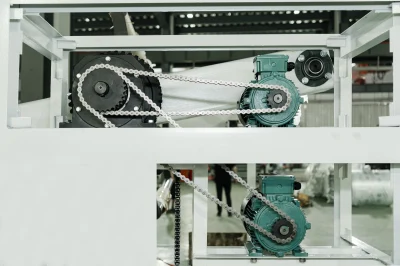
A roll of bubble film only looks finished once it comes off the winder, but what happens at that final station determines whether the roll is actually usable. Even a perfectly extruded, well-formed bubble structure can be ruined in seconds by a winding system that can't hold consistent tension or keep the film edges aligned. For manufacturers running high-speed lines, the winding system is where production stability, roll quality, and downstream processing efficiency either come together — or fall apart.
Where Traditional Winding Systems Fall Short
Many older bubble film making machine designs still rely on largely mechanical tension control — friction brakes, weighted dancer arms, or fixed-ratio drive systems that were never built to respond to a changing roll diameter in real time. As a roll builds from core to outer diameter, the tension required to keep it wound evenly has to change continuously. A system that can't track that shift tends to wind too tight near the core and too loose toward the outside, or the reverse, and the result shows up as wrinkles, trapped air pockets, or telescoping rolls that shift sideways in transit.
Edge control is often just as inconsistent. Without an active alignment mechanism, film edges drift during winding, leaving rolls with ragged, uneven sides that complicate palletizing, labeling, and any automated unwinding downstream. And because many conventional machines still depend on manual roll changes, every completed roll means a full production stop — the line sits idle while an operator swaps the core, which adds up to meaningful lost output over a full shift, especially on high-speed or wide-format lines. On top of that, many older winding stations are built around a single fixed configuration, making it difficult to adapt to different core sizes, film widths, or roll diameters without significant manual reconfiguration.
How Winding Quality Affects Bubble Film Applications
The consequences of poor winding aren't limited to the machine room — they show up wherever the film is eventually used.
In electronics packaging, bubble film is chosen specifically for its cushioning uniformity, protecting sensitive components from shock and vibration during transit. A roll wound with uneven tension can carry inconsistent bubble compression across its width, which means the cushioning performance isn't as reliable as the material's specification would suggest.
For furniture and fragile goods logistics, the film needs to provide even compressive support across large wrapped surfaces. Rolls with tension variation or telescoping tend to unwind unevenly on the packing line, forcing operators to compensate manually and slowing down what should be a fast wrapping process.
In pharmaceutical and medical device packaging, roll appearance and edge quality carry real weight — clean, tightly wound rolls with straight edges feed smoothly through automated labeling and cartoning equipment, while ragged or loosely wound rolls jam or misfeed.
And in fresh food and perishable goods packaging, where bubble film is frequently layered with other protective or barrier materials, consistent multilayer structure and clean roll formation make it easier to combine with complementary packaging films without introducing weak points.
Winding System Design for Stable Bubble Film Production
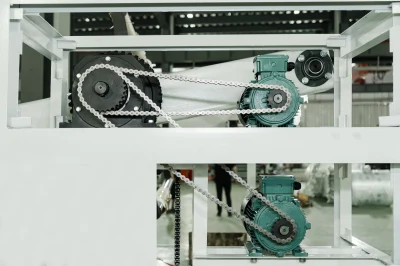
We built the winding system on our bubble film making machine platforms around real-time responsiveness rather than fixed mechanical settings. The system is configured as either a surface winding or center-surface winding structure, giving it stable performance across a range of film thicknesses and bubble profiles rather than being tuned for just one product spec.
At the core of the system is a servo-driven, closed-loop tension control setup. Feedback from load cells or dancer rollers is continuously monitored, and the servo motors adjust winding parameters on the fly to keep tension consistent from the very first wrap around the core all the way to the finished outer diameter. This dynamic response is what prevents the wrinkling, air trapping, and telescoping that plague less responsive systems, and it's especially important on multilayer bubble film, where uneven tension can distort the bubble structure and compromise the cushioning performance layer by layer.
Edge quality is handled by an automatic gap and edge alignment mechanism that keeps film edges neat and parallel throughout the winding process, so rolls come off the machine ready for storage and transport without manual trimming. On wider-format or higher-output configurations, oscillating winding or trimming systems can be integrated as well, adding a further layer of roll uniformity and edge control for demanding production environments.
To address the downtime problem, higher-performance configurations of our bubble film making machine support an automatic roll-changing mechanism, allowing the line to keep running continuously rather than stopping for every roll change. For large-scale manufacturing operations where every minute of uptime matters, this kind of continuous operation translates directly into higher throughput without adding labor.
Flexibility is built in as well. The winding system is designed to accommodate a range of core sizes, film widths, and roll diameters, with adjustable winding pressure and speed settings that let a single machine serve both standard production runs and customized orders without a full mechanical changeover.
Built for Consistency at Production Speed
The purpose of a well-engineered winding system is ultimately simple: it should disappear as a variable. Operators shouldn't need to babysit tension settings, chase edge drift, or plan around scheduled downtime for roll changes. By combining closed-loop tension control, automatic edge alignment, and an automatic roll-changing mechanism, our bubble film making machine is designed to deliver rolls that meet consistent industrial standards for durability, appearance, and usability — run after run, without the manual intervention that traditional winding systems demand. For manufacturers evaluating a new bubble film making machine, the winding station deserves the same scrutiny as the extrusion and die system, because it's the last point where quality can either be preserved or lost before the roll ever leaves the factory floor.