MFI in Bubble Film Extrusion Machine: The Ultimate Quality Guide
2026-08-28
Inconsistent bubble formation remains one of the most stubborn bottlenecks in producing export-grade cushioning film. Batch-to-batch shifts in the polymer melt flow index, or MFI, can trigger cell rupture, uneven bubble height, and high scrap rates almost overnight. On high-speed lines running above 80 meters per minute, even a small swing in melt rheology is enough to turn a stable production run into a costly one. As a manufacturer of bubble film extrusion machine equipment, we built our platforms specifically to keep that variability under control rather than letting operators fight it batch after batch.
Why Melt Instability Still Trips Up Traditional Machines
Most conventional bubble film lines were never designed to compensate for real-world variation in raw material. Their screw and barrel geometry tends to follow a single, generic profile, which works fine with consistent virgin resin but struggles the moment melt viscosity shifts from one lot to the next. Without dedicated mixing sections, poorly homogenized melt often carries gel spots straight through to the die, showing up later as weak points in the finished film.
Temperature control on older machines is usually handled in broad zones rather than through tight, closed-loop regulation. That leaves room for localized overheating, which quietly pushes the polymer's MFI upward and destabilizes the melt right before it reaches the forming stage. Die and air ring designs compound the problem further, since fixed cooling airflow cannot adjust to a melt front that is behaving differently than expected. The result is bubbles that either overexpand and collapse or set unevenly across the film width. At high line speeds, all of this gets magnified: rupture rates climb, edge trim waste increases, and recycled-content blends become nearly impossible to run reliably.
Where Stable Bubble Formation Really Counts
The consequences of unstable melt flow are not just a production-floor inconvenience, they follow the film into the field. In export and long-haul logistics packaging, rolls travel through multiple handling points before they are ever used, and any inconsistency in bubble integrity tends to surface exactly where it matters least, in a warehouse far from the factory that made it. A batch with hidden rupture points or uneven cell height can mean an entire roll gets rejected on arrival, along with the customer relationship that comes with it.
Medical device and pharmaceutical packaging raises the bar even further. These products depend on cleanliness, uniform bubble dimensions, and long-term air retention in ways that ordinary commercial packaging simply does not require. A shipment of diagnostic equipment or glass vials cannot afford a soft spot in the cushioning layer, and the quality tolerances buyers in this sector apply are considerably stricter than what most industries expect. When melt flow drifts even slightly, the resulting variation in wall thickness or cell collapse becomes exactly the kind of weak point that shows up as a damaged shipment, and in this industry that damage carries a much higher cost than a returned parcel.
Engineering the Melt for Predictable Bubbles
This is precisely the gap our bubble film extrusion machine platforms are designed to close, through a combination of mechanical, thermal, and structural controls working together rather than any single fix.
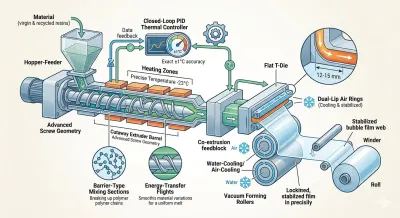
Screw geometry is the first layer of defense. Our high-speed machines, offered in 2-layer, 3-layer, 5-layer, and 7-layer configurations, use barrier-type mixing sections that physically break down high-MFI polymer chains before they can form gel spots downstream. Energy-transfer flights along the screw further reduce viscosity swings caused by material variation, so the melt stays uniformly sheared even when recycled resin is blended with virgin material.

Temperature stability comes from a closed-loop, multi-zone PID heating system holding accuracy within plus or minus one degree Celsius. Each co-extruded layer is kept within its own ideal processing window rather than sharing a single broad setpoint, which prevents the localized overheating that would otherwise push MFI out of range and cause thermal degradation.
For medium-speed and low-speed configurations, where hardware needs to handle lower-MFI resins without overloading the motor, the die and cooling system are tuned just as carefully. An optimized die land length of 12 to 15 millimeters balances internal extrusion pressure and allows the polymer to relax before exiting the die lips, reducing internal stress that could otherwise distort bubble shape. Dual-lip air rings deliver a high-volume, low-velocity cooling stream that stabilizes the melt front, preventing bubbles from either overexpanding or collapsing prematurely. Vacuum forming rollers, cooled by water or air depending on the configuration, run in precise synchronization with extrusion speed so that each cell locks in right at its optimal point in the MFI crystallization window.
What Tighter Melt Control Delivers Across the Lineup
These controls translate into measurable gains that differ by machine tier, matched to the production priorities each one serves. On the 7-layer high-speed bubble film machine, rated at 900 kilograms per hour, keeping MFI variability within plus or minus 1.5 grams per 10 minutes has cut rupture rates by roughly 45 percent at maximum output, while a stable melt profile keeps film thickness uniform across the full width and sharply reduces edge trim waste, both of which matter directly for high-volume export orders where consistency at scale is non-negotiable.
The 3-to-5-layer medium-speed machine benefits from a constant pressure differential during bubble formation, holding cell diameter within plus or minus 0.2 millimeters for a clean, uniform appearance suited to premium packaging. That same stability also delivers around 15 percent higher compression strength per unit thickness, allowing manufacturers to downgauge film without giving up protective performance, an advantage that fits both logistics packaging and the tighter tolerances demanded by medical and pharmaceutical customers.
On the 2-layer low-speed machine, the same melt stabilization principles show up as roughly 30 percent better layflat consistency for lightweight, small-bubble film, along with more predictable processing of post-industrial and post-consumer recycled pellets. That makes it a practical fit for lighter-duty applications and for manufacturers looking to increase recycled content without sacrificing film elasticity.
Turning Unpredictable Material Into a Reliable Advantage
Raw material variability is not going away, but it no longer has to dictate production outcomes. By combining tailored screw geometry, closed-loop PID thermal management, and synchronized die and forming roller design, our bubble film extrusion machine lineup turns unstable melt behavior into a controlled, repeatable process. Whether the priority is scaling up high-volume export production or running a leaner line that still needs to meet strict cushioning tolerances for demanding sectors like medical packaging, the underlying melt control stays the same. That consistency is what keeps rupture rates down, scrap rates low, and bubble film performing exactly the way it is supposed to, roll after roll.