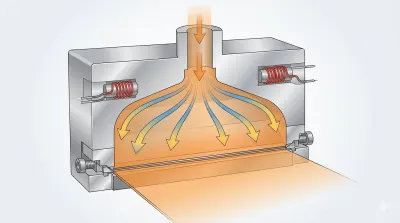
In flexible packaging production, the extruder’s T-die serves as the precision flow distributor that determines film thickness uniformity, mechanical performance, and material efficiency. For both stretch film machines and bubble film machines ranging from 2-layer to 7-layer co-extrusion systems, the T-die functions as the mechanical heart of the entire production line, directly governing cross-web gauge consistency, layer distribution, and overall product quality.
How T-Die Geometry Controls Melt Distribution
At its core, a T-die regulates molten polymer distribution by directing the melt into an elongated manifold chamber that gradually expands into a wide, thin slit.
- Flow-Channel Design: Advanced coat-hanger and fishtail manifold geometries ensure that polymer melt spreads evenly across the full die width, minimizing pressure variations, flow imbalance, and dead zones.
- Thermal Homogeneity: Modern T-dies used in high-speed stretch film and bubble film machines incorporate multi-zone heating systems and adjustable restrictor bars to maintain temperature stability within ±1°C across the die face.
- Resin Versatility: Precise thermal management minimizes die drool, melt fracture, and degradation when processing LLDPE, LDPE, mLLDPE, and specialty resin blends at high production rates.
By ensuring uniform melt flow, the T-die creates the foundation for consistent film thickness, improved optical properties, and reduced material waste throughout the extrusion process.
Precision Lip-Gap Technology and Thickness Control
Lip-gap adjustment technology is one of the most critical factors affecting film quality. Modern T-dies utilize micro-adjustable lip bolts and precision-machined die lips capable of gap adjustments as fine as 0.01 mm.
Integration in Stretch Film Machines
On fully automatic stretch film machines, these micro-adjustable systems integrate with closed-loop Automatic Profile Control (APC). Thickness scanners continuously monitor the film profile and transmit real-time correction signals to the die lip adjustment system.
As a result, manufacturers can achieve gauge variations below ±2% across wide film widths while reducing raw material consumption, improving tensile strength, and enhancing puncture resistance.
Integration in Bubble Film Machines
In bubble film production, the T-die is equally critical because it determines the thickness uniformity of the base film before downstream forming and laminating operations. Any thickness variation in the extruded sheet can lead to uneven material distribution, affecting bubble structure consistency, cushioning performance, and overall product quality.
For 3-layer, 5-layer, and 7-layer co-extruded bubble film machines, precision T-dies maintain micron-level layer ratio accuracy, ensuring that each functional layer contributes effectively to impact protection, moisture resistance, and material efficiency without excessive resin consumption.
Supporting Multi-Layer Co-Extrusion Performance
As packaging requirements continue to evolve, multi-layer film structures have become increasingly common. Modern T-dies are engineered with sophisticated feed-block and manifold designs that enable precise separation and distribution of multiple polymer streams.
For stretch film applications, this allows optimized combinations of cling layers, core layers, and reinforcement layers. In bubble film production, multi-layer T-dies support structures that combine strength, flexibility, sealing performance, and protective functionality within a single film construction.
The ability to maintain stable layer distribution across the entire web width is essential for achieving consistent product performance and maximizing the benefits of co-extrusion technology.
Minimizing Downtime Through Advanced Die Engineering
Production efficiency depends not only on output speed but also on equipment reliability.
- Anti-Carbon Surface Technology: Hardened die lips and optimized flow paths reduce carbon buildup and polymer degradation, extending cleaning intervals and minimizing unplanned downtime.
- Modular Construction: Interchangeable die components simplify maintenance procedures, accelerate product changeovers, and lower long-term tooling costs.
- Improved Flow Dynamics: Carefully engineered internal surfaces eliminate stagnation zones where degraded resin can accumulate, improving process stability during long production runs.
For both stretch film and bubble film manufacturers, these improvements translate directly into higher machine utilization rates and lower operating costs.
The Future of Intelligent T-Die Technology
The next generation of T-dies is moving toward intelligent automation. Active die control systems integrated with thickness scanners, pressure sensors, and viscosity monitoring devices can automatically compensate for process variations in real time.
By continuously optimizing flow distribution and lip-gap settings, smart T-dies help manufacturers achieve tighter tolerances, lower scrap rates, and higher production efficiency. Many advanced stretch film and bubble film extrusion lines are already being designed to accommodate these Industry 4.0 capabilities.
Conclusion
Whether producing high-performance stretch films or protective bubble films, the T-die remains one of the most influential components in the extrusion process. Its ability to control melt distribution, thickness uniformity, thermal stability, and layer structure directly determines product quality, raw material efficiency, and overall profitability.
Investing in a precision-engineered T-die is not simply an equipment upgrade—it is a strategic investment in production stability, operational efficiency, and long-term competitiveness in the flexible packaging industry.