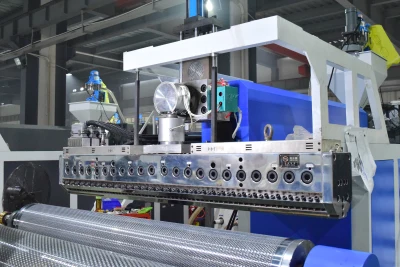
Advantages of Precision Extrusion T-Die Compared to #45 Steel T-Die
2026-09-01
Every extrusion line depends on one component to translate melt flow into finished output, and that component is the T-die. Whether the line is producing stretch film or bubble film, die performance is what ultimately determines thickness consistency, thermal stability, and how efficiently the whole system runs. Material selection and heating design inside the die aren't secondary specifications — they're the foundation everything downstream is built on.
Thermal Stability Challenges of 45 Steel T-Dies
A 45 steel T-die relies on external heating, which offers a genuine advantage during initial warm-up — heat reaches the surface quickly. But that speed comes at a cost once production actually begins. External heating struggles to distribute temperature evenly through the die body, and significant heat is lost to the surrounding environment rather than retained where it's needed. That uneven, leaky thermal environment makes stable temperature control difficult to sustain through a production run, and any drift in temperature translates directly into inconsistent melt flow.
The material itself compounds the problem. 45 steel lacks the hardness and thermal stability of higher-grade mold steel, and under sustained high-temperature, high-pressure operation, it becomes more prone to thermal deformation over time. Dimensional accuracy that looked fine when the die was new tends to degrade gradually with continued use, which is a real liability for any producer running continuous, high-precision production rather than short, low-volume batches.
These two weaknesses feed directly into thickness variation. When melt flow consistency breaks down because of thermal fluctuation, the film coming off the die stops holding a uniform gauge, and inconsistent gauge is one of the most common root causes behind rejected rolls and customer complaints. On top of the quality impact, external heating systems are simply less thermally efficient, which pushes energy consumption higher than it needs to be — a cost that adds up steadily across continuous production and works against any operation trying to control its cost per ton.

Why Die Performance Matters Across Different Applications
These weaknesses don't stay theoretical — they show up differently depending on what the film is being used to protect or wrap.
In agricultural silage and hay bale wrapping, stretch film needs to hold consistent thickness and reliable UV resistance because it stays exposed outdoors for extended periods, often through changing seasons. When die-driven thickness variation compromises seal integrity, oxygen and moisture find their way into the bale, accelerating spoilage in exactly the product the wrap was meant to protect.
In toy and consumer goods packaging, bubble film needs both visual clarity and uniform gauge, since the packaging is doing double duty — protecting the product in transit and presenting it well on a shelf or in an unboxing moment. Uneven thickness caused by inconsistent die heating shows up as visible surface irregularities, undermining both the cushioning performance and the finished appearance that consumer-facing products depend on.
How Our Precision Extrusion T-Die Delivers Better Performance
Our Precision Extrusion T-Die is manufactured from P20H/2311 mold steel, engineered specifically for high-performance applications that demand tight tolerances and stable, long-term operation. Compared to 45 steel, this higher-grade mold steel offers significantly better mechanical stability and resistance to thermal deformation, which means dimensional accuracy holds up over extended, continuous production rather than gradually drifting the way a lower-grade die tends to. For any producer running high-precision output day after day — whether the line is making stretch film or bubble film — that durability translates directly into more consistent results over the die's working life.
The internal heating design is where the real thermal advantage comes from. Rather than relying on external heat that has to fight its way through the die body unevenly, internal heating distributes temperature uniformly across the entire die structure, substantially improving heat retention. That stable thermal environment is what allows the system to hold film thickness uniformity within ±3 percent, run after run. For agricultural silage and hay bale wrapping, that consistency is what keeps stretch film sealing reliably regardless of seasonal temperature swings, protecting bale integrity through months of outdoor exposure.
That same thermal stability carries directly into gauge consistency for bubble film applications. Because melt flow stays even when die temperature stays even, the die supports the kind of uniform thickness and surface clarity that toy and consumer goods packaging depends on — bubble film that looks clean on the shelf and performs consistently as cushioning, without the localized weak spots that uneven heating tends to produce.
Beyond quality, the internal heating structure also reduces heat loss during operation, which improves overall energy efficiency and lowers power consumption compared to an externally heated die. For continuous production environments running either stretch film or bubble film lines, that efficiency gain is a direct, ongoing reduction in operating cost rather than a one-time improvement.
Taken together, the material upgrade to P20H/2311 mold steel and the shift to internal heating design give the Precision Extrusion T-Die a clear, compounding advantage over a traditional 45 steel T-die — in thermal management, in thickness control, and in energy efficiency. As a core component shared across both stretch film and bubble film extrusion lines, the die a producer chooses has an outsized effect on everything downstream. For manufacturers focused on consistent, high-quality output, precision starts at the die.