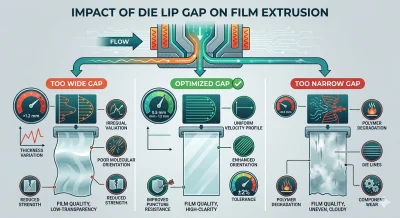
Every roll of stretch film depends directly on the calibration of a critical die geometry parameter: the die lip gap. This single dimension, measured in fractions of a millimeter, governs how evenly polymer melt distributes across the die width, transverse direction (TD) gauge uniformity, load retention capability, and scrap generation during startup. In stretch film extrusion, proper lip gap calibration determines whether a stretch film maintains structural integrity during automated pallet wrapping or suffers premature failure under load.
Why an Imprecise Die Lip Gap Still Plagues Many Production Lines
Most gauge variation originates from a single root cause: inadequate die lip gap stability and control precision. On conventional or entry-level lines, the gap is manually adjusted using mechanical lip bolts and remains static throughout production, regardless of melt temperature, pressure, or viscosity drift. Because polymer melt rheology is highly sensitive to thermal fluctuations, a gap setting optimized at startup yields significant profile drift as thermal equilibrium evolves.
An excessively wide gap reduces shear rate, compromising molecular orientation and inducing transverse direction (TD) gauge variation, which impairs tensile strength and puncture resistance. Conversely, an overly narrow gap drastically increases shear stress, risking thermal degradation, melt fracture, die lines, and accelerated lip wear. Neither extreme is acceptable; conventional manual dies cannot dynamically compensate for these rheological shifts during continuous production.
Critical Industrial Applications Requiring Precise Gauge Control
The operational cost of die lip gap instability varies depending on the end-use application.
In high-performance pallet wrapping applications, stretch film requires high load retention and puncture resistance to stabilize mixed loads during transit. When gauge control drifts, thin spots act as stress concentration points, causing premature stretch film breakage during high-speed prestretching or transportation.
For cold-chain and fresh produce packaging, optical clarity is essential for non-destructive inspection. A die lip gap that fluctuates induces cross-web gauge variation, generating visible streaking and uneven haze that impair stretch film transparency.
Bundling of construction materials, pipe, and profile extrusions requires uniform tensile strength and consistent elongation across the width, since a single thin section under tension is often where the bundle lets go. Finally, for electronics and precision component packaging, where anti-static or moisture-barrier layers are frequently co-extruded, tight thickness tolerance across every layer is non-negotiable; a wandering die gap makes that kind of multilayer consistency very difficult to guarantee shipment after shipment.
How Our Die Technology Solves This at the Source
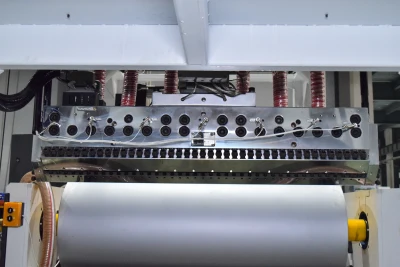
We designed our stretch film line platforms to ensure die lip gap control does not depend on a single fixed setting or a technician's judgment call. Depending on the configuration, the line is available with high-precision manual micrometer adjustment for direct mechanical control, or a closed-loop die system that adjusts continuously during production. Either way, the gap is engineered to maintain precise alignment across the die width, delivering a consistently uniform melt velocity profile.
The closed-loop configuration provides maximum operational stability. Paired with real-time automatic thickness gauging, the system continuously measures the web as it forms and feeds that data back into the die, fine-tuning the lip gap dynamically to compensate for temperature and pressure fluctuations that would otherwise cause gauge drift. In practice, this closed-loop response allows the line to maintain a tight, consistent transverse direction (TD) gauge tolerance, rather than only at the moment the die was last adjusted by hand.
That level of control translates directly into stretch film performance, supporting strong elongation and stable holding force — metrics which depend directly on the melt being sheared evenly across the full die width rather than in isolated bands. For customers running 3-layer or 5-layer co-extrusion configurations, the same precision extends to layer ratio control, keeping each layer's individual gauge stable so that a high-cling inner layer, a high-strength core, and a UV-stable outer layer all perform their intended function without inter-layer interference. The result is a stretch film line that consistently meets recognized standards such as ASTM D5458, giving converters and end users a reliable basis for quality control.
Built to Scale Across Configurations
Because die precision is engineered into the platform rather than bolted on as an afterthought, it extends throughout the full range of configurations available. Whether a manufacturer requires a 2-layer line for straightforward pallet wrap, a 3-layer system for balanced cling and puncture resistance, or a 5-layer setup for advanced down-gauging without sacrificing strength, the same high-precision die control and closed-loop thickness gauging are available throughout. Winding automation — semi-automatic or fully automatic roll-changing — can be matched to the die configuration independently, so production throughput and stretch film quality can both be optimized without one constraining the other.
For manufacturers evaluating a new stretch film line, die lip gap control is a critical factor in achieving consistent film gauge, mechanical performance, and surface quality. Our stretch film lines are designed with precision die systems and stable process control to maintain uniform stretch film output across diverse production requirements. By combining accurate die adjustment with reliable extrusion and winding systems, the equipment provides a practical solution for manufacturers seeking consistent stretch film quality and stable long-term production.