How Temperature Affects Stretch Film Extrusion Machines & Seasonal Adjustments
2026-07-02
In modern packaging manufacturing, stretch film extrusion machines operate under increasingly demanding conditions where product consistency, high-speed output, and multi-layer film performance must remain stable throughout the year. Among all external influencing factors, ambient temperature is one of the most underestimated yet technically critical variables. Whether a production line is running a 2-layer stretch film extrusion machine, a 3-layer stretch film extrusion machine, or a high-performance 5-layer stretch film extrusion machine, seasonal temperature fluctuations directly affect polymer melt behavior, cooling efficiency, and final film quality.
Ambient Temperature as a Core Process Variable in Film Extrusion
In stretch film production, the extrusion process is governed by a delicate balance between melt temperature, die stability, and cooling conditions. When polymer melt exits the die, it enters a controlled cooling zone where crystallization begins. The surrounding ambient temperature directly influences how efficiently heat is removed from the film surface, which in turn determines the final molecular structure.
If the production environment is stable, stretch film extrusion machines can maintain consistent crystallization rates and produce uniform film layers. However, in real industrial settings, seasonal variations introduce continuous thermal instability. Winter conditions accelerate cooling beyond design expectations, while summer conditions reduce cooling efficiency and disturb the solidification process. Both scenarios lead to structural inconsistencies that directly affect product performance.
Winter Challenges: Rapid Cooling and Increased Film Brittleness
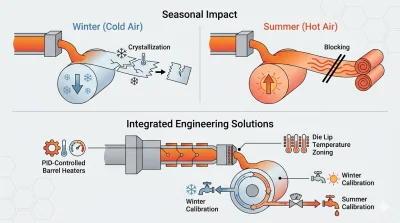
During cold seasons, the ambient temperature in production facilities can significantly drop, especially in regions without advanced climate control systems. This environmental shift accelerates heat dissipation on the chill roll surface, causing the polymer melt to solidify too quickly.
When cooling is excessively rapid, crystallization becomes overly aggressive. The polymer chains lose mobility before proper orientation is achieved, resulting in a film structure that is more rigid and brittle than intended. This directly impacts elongation at break and reduces the film’s ability to withstand mechanical stress during stretching and wrapping operations.
On a 2-layer stretch film extrusion machine or a 3-layer stretch film extrusion machine, this issue becomes particularly noticeable during high-speed unwinding and winding cycles. The brittle film structure increases the risk of web breakage, tension instability, and production interruptions. These failures not only reduce output efficiency but also increase material waste and downtime.
In addition, inconsistent cooling across the film width can lead to uneven crystallization, which further amplifies gauge variation and reduces overall film quality consistency.
Summer Challenges: Insufficient Cooling and Surface Instability
In contrast, high ambient temperatures during summer introduce a completely different set of processing challenges. When the production environment becomes too warm, the temperature gradient between the molten polymer and the chill roll surface decreases. As a result, heat transfer efficiency is reduced and the film takes longer to solidify.
This insufficient cooling condition leads to a soft and unstable film structure during the early winding stage. One of the most common consequences is increased tackiness, where polymer additives such as tackifiers migrate more easily to the surface. This creates excessive adhesion between layers of the wound roll, commonly known as roll blocking.
On fully automatic stretch film extrusion machines operating at high speeds, roll blocking can cause serious downstream issues such as poor roll separation, edge deformation, and inconsistent roll geometry. These defects not only reduce product appearance quality but also create handling difficulties during packaging and transportation.
Another critical issue during summer operation is edge instability. Because cooling is not uniform, the film edges may remain softer than the center region, leading to deformation during winding and storage.
Limitations of Traditional Temperature Control Methods
In many conventional production environments, temperature control still relies heavily on manual adjustment and operator experience. While experienced technicians can compensate for minor variations, manual systems are unable to respond dynamically to continuous environmental fluctuations.
Traditional stretch film extrusion machines often require frequent parameter tuning when transitioning between seasons. This leads to production interruptions, inconsistent film quality, and increased dependency on skilled operators. In multi-layer systems such as 3-layer and 5-layer stretch film extrusion machines, manual adjustments become even more complex due to the need to balance viscosity differences across multiple polymer layers.
Furthermore, without automated thermal compensation, energy consumption tends to fluctuate significantly. Overheating in winter and excessive cooling in summer both reduce overall energy efficiency and increase operational costs.
Engineering Solutions for Seasonal Thermal Stability
Modern stretch film extrusion machines are designed with integrated thermal management systems that actively compensate for environmental variations. These systems combine automated control logic with precision mechanical design to maintain stable processing conditions throughout the year.
One of the key technologies used is PID-based temperature control. By continuously monitoring process feedback, the system adjusts barrel and screw heating zones to maintain stable melt viscosity regardless of ambient temperature changes. This ensures that polymer flow remains consistent even under fluctuating external conditions.
Another critical improvement is die lip temperature zoning. By dividing the die into multiple independently controlled heating zones, modern systems can fine-tune polymer flow distribution at the final stage of extrusion. This reduces gauge variation and improves layer uniformity in multi-layer film structures.
Cooling system optimization is equally important. In winter conditions, reducing chill roll water flow prevents overcooling and helps maintain film flexibility. In summer conditions, increasing water circulation improves heat removal efficiency and restores the required temperature gradient for proper film solidification. This adaptive cooling strategy ensures stable crystallization behavior across all seasons.
Modern systems also integrate HMI-based control interfaces and fully automated control modules. On semi-automatic stretch film extrusion machines, operators can manually adjust parameters through intuitive dashboards. On fully automatic systems, seasonal compensation is executed automatically based on real-time environmental data, minimizing human intervention and reducing operational errors.
Performance Advantages of Seasonal Adjustment Systems
The integration of adaptive thermal control systems delivers significant improvements in both product quality and production efficiency. One of the most important benefits is improved gauge uniformity. Even under extreme seasonal temperature differences, modern multi-layer systems can maintain highly stable thickness distribution across the film width.
Tensile strength consistency is also significantly improved. On a 3-layer stretch film extrusion machine, variations in mechanical properties can be reduced to very low levels, ensuring reliable performance in packaging applications that require high load stability and stretch resistance.
Another major advantage is reduced scrap rate. By maintaining stable cooling and melt conditions, production lines can minimize defects during startup, shutdown, and seasonal transitions. This directly reduces material waste and improves overall profitability.
From an operational perspective, automated seasonal adjustment systems also increase equipment uptime. Fully automatic stretch film extrusion machines can operate continuously without frequent manual recalibration, making them ideal for high-volume industrial production environments.
Environmental Adaptability Defines Modern Extrusion Performance
Ambient temperature is no longer a secondary environmental factor in industrial film production. It is a core process variable that directly influences crystallization behavior, molecular structure, and final film performance. Without proper control, seasonal fluctuations can lead to significant instability in both product quality and production efficiency.
Modern stretch film extrusion machines address this challenge through integrated thermal compensation systems, adaptive cooling control, and intelligent automation. Whether operating in winter low-temperature environments or summer high-heat conditions, these systems ensure stable performance, consistent film quality, and optimized production output.
As the demand for high-performance packaging materials continues to grow, environmental adaptability will remain a key benchmark for evaluating next-generation stretch film extrusion technology.