In cast stretch film extrusion, optical clarity indicates polymer processing precision and final product quality. While raw materials are important, the chill roll design of a 2-layer, 3-layer, or 5-layer stretch film making machine directly controls film haze, gloss, and transparency.
Understanding how the chill roll affects the crystallization process allows producers to optimize line performance and achieve premium-grade film output.
The Science of Polymer Quenching and Crystallization
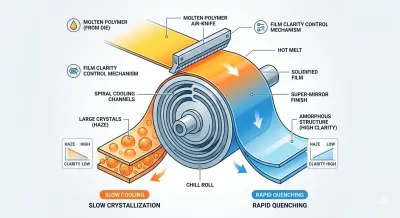
The core function of a chill roll is to quench molten polymer rapidly and uniformly. As molten resin leaves the die, its cooling rate determines its internal molecular structure:
- Rapid Cooling: Fast quenching suppresses crystalline growth, promoting an amorphous structure that yields high clarity.
- Slow Cooling: Slow or uneven thermal transfer allows large crystals to form, which causes light scattering and film haze.
- To maintain a uniform cooling rate across the entire web, advanced stretch film machines utilize premium internal engineering:
- Dual-Layer Spiral Channels: Internal flow paths ensure high-velocity, uniform cooling water circulation.
- Precise Temperature Control: This design maintains a temperature variance of less than ±1°C across the entire roll width, preventing edge-to-center clarity variations on high-speed lines running above 400 m/min.
Surface Micro-Roughness and Light Scattering
The physical surface characteristics of the chill roll replicate directly onto the hot polymer melt. Any micro-imperfections on the roll surface will degrade the film's optical properties.
- Super-Mirror Polishing: High-performance chill rolls are engineered to a surface roughness below Ra 0.025 microns.
- Air Entrapment Prevention: A super-smooth mirror finish eliminates microscopic air pockets between the melt and the roll. Without these micro-voids, light passes through the film without scattering.
- Surface Hardness: Hard chrome or specialized roll coatings prevent micro-scratches during high-speed web release, preserving long-term film aesthetics.
Roll Geometry and Auxiliary Component Integration
Optimizing the physical geometry of the chill roll further enhances the optical and physical properties of the stretch film.
- Larger Roll Diameters: Utilizing chill rolls with diameters between 400 mm and 600 mm extends the contact time between the film web and the cooling surface. This ensures thorough heat transfer even at maximum line speeds.
- Air-Knife and Vacuum Systems: Positioned just before the nip, an air-knife applies a controlled air stream to pin the molten film evenly against the roll. This removes the insulating air barrier, maximizing cooling efficiency and eliminating micro-bubbles.
- Through this integrated design approach, 3-layer and 5-layer stretch film extrusion lines can consistently achieve film haze levels below 2% and gloss values exceeding 130 gloss units (GU). This guarantees exceptional transparency for industrial overwrap and high-clarity pre-stretch film applications.