The Chemistry of Cling: Ensuring Consistent Tackiness in Stretch Film Extrusion Machine
2026-05-25
In stretch film manufacturing, achieving uniform tackiness is a major technical challenge. Inconsistent cling typically stems from the unmanaged surface migration of tackifiers like polyisobutylene (PIB). In poorly regulated extrusion environments, PIB blooms unevenly, creating alternating patches of high tackiness and slippery surfaces. Advanced co-extrusion technology eliminates this defect by controlling the chemical and physical migration of tackifiers from melt to finished roll.
Engineering Solution: Multi-Layer Co-Extrusion Tech
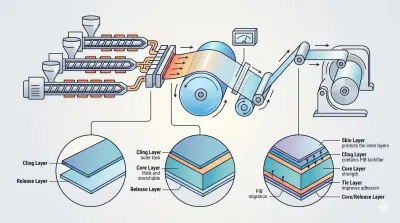
Modern co-extrusion systems regulate film properties through advanced thermal and layer engineering. Our specialized machinery platforms deliver high-precision film structures:
- 2-layer stretch film machine: Configured for targeted tack distribution, enabling a dedicated cling layer paired with a smooth release layer to reduce unwind noise.
- 3-layer stretch film machine: Utilizes an A/B/C structure to isolate the tackifier in the outer layer while optimizing the core layer for high puncture resistance and stretchability.
- 5-layer stretch film machine: Features a highly dedicated layer architecture. By sandwiching the PIB-rich tack layer between a bulk core and a protective skin, this system prevents early air exposure and stabilizes the cling property for over 12 months.
Precision Control: Melt and Cooling Mechanisms
Stabilizing the coefficient of friction (COF) within the optimal range of 0.4 to 0.6 requires exact thermodynamic management across the entire extrusion line.
Advanced Thermal Regulation
The system manages the melt temperature profile across each extruder barrel. This precise control ensures that PIB molecules achieve the correct viscosity required for optimal wetting and migration during the extrusion process.
Closed-Loop Chill Roll Stabilization
The modern stretch film machine integrates closed-loop cooling roll control. The chilling rolls solidify the film at a calculated rate that immediately locks in tackifier migration. This configuration prevents delayed blooming and eliminates "off-roll" tack variances. Precise cooling is critical, as a mere 1°C deviation on the chill roll can measurably alter the film's surface energy.
Scalable Production Platforms and Automation Configurations
Our extrusion machinery platforms maintain strict quality metrics—including a standard deviation of tackiness below 2% and a consistent COF—regardless of the automation setup, allowing manufacturers to scale operations based on throughput requirements:
- Semi-automatic stretch film machine: Utilizing the same high-precision extrusion screw, barrel thermal controls, and chill roll stability as the fully automated line, this system is engineered for smaller production runs or batch operations. It requires manual intervention for paper core loading and finished roll unloading, making it a highly cost-effective yet technically precise solution.
- Fully automatic stretch film machine: Designed for continuous, high-capacity, non-stop manufacturing. This platform integrates an advanced fully automatic winding and roll-changing system (including automatic paper core loading, film cutting, and roll non-stop shifting). By eliminating manual handling at the terminal end, it prevents gauge fluctuations during roll changes, minimizes film breaks during high-speed wrapping (at 120 rpm or higher), and maximizes Overall Equipment Effectiveness (OEE).
Conclusion: Driving Profitability Through Advanced Extrusion Control
Ultimately, mastering the chemistry of cling is not just a matter of technical compliance; it is a critical metric for operational cost control. Consistent tackiness across the entire film roll ensures flawless load containment, eliminating the catastrophic failures of unravelling or shifting during transit. Leveraging multi-layer co-extrusion machinery offers the most practical and scalable solution to this industry-wide challenge.
By isolating functional polymers within specialized layers, these advanced extrusion lines allow manufacturers to engineered high-performance stretch films with lower gauge formulations, significantly reducing material consumption without sacrificing puncture or cling properties. Transitioning to a high-precision 2, 3, or 5-layer stretch film extrusion machine transforms an unpredictable material variable into a stable, high-margin asset, delivering the reliable performance and operational reliability demanded by modern logistics automation.