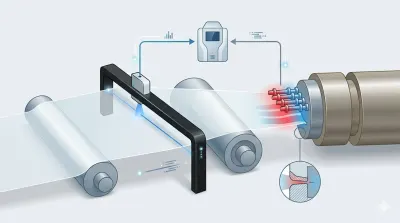
In high-speed stretch film production, maintaining micron-level thickness uniformity is critical to eliminating material waste and ensuring film performance. For advanced stretch film extrusion machines—including semi-automatic stretch film machines as well as 2-layer, 3-layer, and 5-layer stretch film machines—precision gauge tolerance is the primary benchmark of production efficiency. Automated Die Control (ADC) directly addresses this by replacing manual profiling with real-time, closed-loop gauge regulation.
Technical Working Principle of Automated Die Control
The Automated Die Control system operates via a continuous, high-resolution thickness sensor and a thermal-bolt-actuated extrusion die.
- Real-Time Web Scanning: A specialized thickness sensor continuously scans the entire width of the moving film web during extrusion.
- Closed-Loop Data Processing: The sensor transmits real-time thickness profile data directly into the central control system.
- Thermal Bolt Actuation: The system processes the data and automatically adjusts the temperature of individual thermal bolts arranged across the die lip.
- Dynamic Gap Regulation: Thermal expansion or contraction of these bolts modifies the mechanical die gap with micron-level accuracy.
- Instant Flow Correction: This local adjustment immediately regulates the melt flow distribution, automatically correcting any detected gauge deviation.
- This automated cycle ensures that the stretch film extrusion machine maintains a stable target thickness profile within a precision tolerance of ±1–2 microns across the complete film roll.
Practical Benefits for Stretch Film Machines
Integrating ADC technology into modern extrusion lines optimizes mechanical performance and output consistency across various machine configurations:
Layer Uniformity in Multi-Layer Co-Extrusion
For advanced multi-layer systems, such as the 5-layer stretch film machine, precise gauge control prevents inter-layer gauge variations. ADC ensures that each polymer layer is distributed uniformly according to the recipe, preventing localized thin spots that cause film tearing during high-elongation prestretch applications.
Equipment Longevity and Energy Efficiency
- Reduced Component Wear: Eliminating manual, mechanical adjustments prevents uneven stress and premature wear on the flexible die lip.
- Targeted Thermal Control: The system applies heat only to specific thermal bolts requiring adjustment, reducing localized energy consumption compared to continuous manual heating methods.
Industry 4.0 Integration and Data Analytics
Modern Automated Die Control systems act as critical data nodes within smart manufacturing environments. When integrated with Industry 4.0 production dashboards, ADC logs real-time gauge profiles, resin flow variations, and thermal performance metrics. This data enables technical teams to analyze processing recipes, optimize different resin blends, and perform predictive maintenance on the extrusion die assembly, guaranteeing long-term production stability.