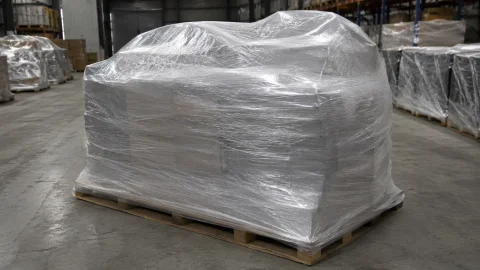
In high-volume distribution centers and 3PL cross-dock facilities, pallet stabilization requires more than basic containment. Environmental factors such as airborne particulates and floor-level moisture vapor frequently compromise corrugated food cartons and industrial goods. Advanced stretch film manufacturing machines solve these warehousing vulnerabilities by producing high-performance, multi-layer wrap tailored for heavy-duty pallet applications. By transitioning from standard film to engineered 5-layer structures, facilities can achieve total environmental isolation for high-density storage.
Enhancing Load Stabilization and Cling in Racking Environments
Pallets stored in high-density racking systems experience severe structural stress during movement. Stretch film manufacturing technology addresses this through the precise distribution of polymers, which directly improves how the film performs on the pallet:
- Delta Cling Performance: The machinery structures the film to have high inner cling and controlled outer slip. This ensures the last film revolution locks tightly to the pallet sidewall, while preventing adjacent pallets from catching or tearing each other during forklift handling.
- Low-Temperature Containment: In climate-controlled or cold-storage warehousing, standard films lose tack, causing film separation overnight. Advanced co-extrusion technology produces films that maintain strict block specifications down to 45°F (7.2°C), eliminating the need for pallet re-wrapping.
- Puncture Resistance: By engineering 15-micron structures using high-molecular-weight blends, the resulting film handles sharp nailhead punctures common on industrial wooden pallets without blowing out.
Moistureproof Applications: Eliminating Vapor Wicking
Moisture damage often begins at the concrete floor level and wicks upward through corrugated packaging. Preventing this requires absolute uniformity in the film wrap to eliminate micro-gaps. Stretch film manufacturing machines achieve this through precise gauge control:
- Hermetic Overlap Seals: Utilizing a closed-loop auto-profile die, the machinery maintains a strict 5-micron thickness variance across the entire web width. This prevents thin, uneven film edges, ensuring that every layer of the pallet overlap forms an airtight, vapor-proof barrier.
Dustproof Applications: Preventing Particulate Infiltration
Airborne dust and fine particulates can easily settle into the micro-gaps left by poorly extruded or kinked film edges, contaminating sensitive cargo like pharmaceutical or food-grade pallets.
- Consistent Seal Bands: Modern cast film lines utilize specialized cooling rolls with spiral baffle patterns to extract heat uniformly. This eliminates chill marks and structural variations in the film.
- Elimination of Micro-Gaps: The resulting perfectly flat film applies smoothly to the pallet without wrinkles, air pockets, or loose tails, creating a seamless shield against heavy dust environments.
Maximizing Material Efficiency in Automated Wrapping
The configuration of the stretch film manufacturing machine directly impacts the material efficiency and cost of the final pallet application:
- Custom Width Applications: Semi-automatic machinery lines allow mid-size operations to switch efficiently between jumbo rolls and custom slit widths (from 25 microns to 75 microns), tailoring the film gauge to specific light or heavy pallet loads.
- High-Volume Continuous Wrapping: Fully automatic configurations with integrated downstream winding systems optimize resin consumption by keeping edge waste below 1.2%. This allows continuous, 24/7 high-volume facilities to wrap thousands of pallets per shift while minimizing film scrap rates to under 0.8%, directly reducing the total cost per wrapped pallet.