How Stretch Film Edge Trim Recycling Systems Boost Your Profit Margins
2026-07-02
In the high-stakes manufacturing landscape of specialized packaging, operational material waste directly erodes bottom-line profitability. During the continuous cast film production process, the immediate and ongoing generation of edge trim presents a significant logistical and financial challenge for factory owners. Traditional scrap handling methods, which typically involve manual removal, off-site mechanical reprocessing, or discarding high-grade linear low-density polyethylene (LLDPE), introduce heavy logistics costs, material degradation, and storage inefficiencies. Modern automated facilities are bypassing these bottlenecks by adopting technical innovations engineered to turn production industrial waste into pure financial return.
Mechanical Bottlenecks of Legacy Edge Trim Processing
Standard industrial manufacturing setups often handle edge scrap through separate, offline recycling operations. This archaic layout creates an open loop where cold edge trim strips are wound onto separate spools or collected loosely in large storage bins. This open-air workflow poses severe quality risks, as exposed LLDPE tacky film surfaces act like magnets for factory ambient dust, localized moisture, and external contaminants. When this degraded material is eventually sent to an offline granulator and pelletizer, it must undergo a secondary thermal melting cycle. This extra exposure to high heat breaks down the long-chain polymer matrix, resulting in severe thermal degradation that limits how much recycled material can safely be reintroduced into premium industrial wraps.
Furthermore, managing offline storage bins and transporting light, bulky film scrap across the factory floor creates a labor-intensive operational bottleneck. Workers must be diverted from primary manufacturing tasks just to handle scrap transport. The resulting offline pellets are often inconsistent in density and size, which introduces feeding complications when blended back into primary extruders. This uneven mixture frequently causes phase separation within the barrel, creating structural weak points, unexpected film breakage, and inconsistent optical clarity across the final product roll.
Technical Architecture of Closed Loop Extrusion Reclamation
Modern high-speed production systems integrate automated inline recycling systems to solve these processing challenges by operating smoothly within the primary co-extrusion loop to maintain stable, maximum throughput.
High Velocity Instant Capture Mechanism
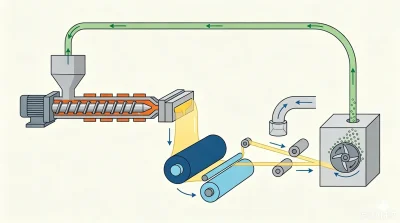
Positioned immediately downstream from the primary die lip and chill roll assembly, the specialized capture module hooks the continuous edge trim bands the millisecond they are trimmed from the main web. Moving at full line speeds that often exceed hundreds of meters per minute, the system uses synchronized pulling tension to guide the trim cleanly away from the primary winding station without causing tension ripples or structural edge defects in the commercial film roll.
Precision Non Thermal Fluff Granulation
The captured LLDPE edge trim strips are immediately drawn into a heavy-duty, low-vibration granulator unit mounted directly alongside the machine frame. Because LLDPE is inherently resilient, highly elastic, and inherently tacky, conventional cutting systems often generate excessive friction heat that melts the plastic inside the cutting chamber, causing catastrophic blade jams. These advanced recycling units utilize proprietary open-rotor designs paired with water-cooled, ultra-sharp knife geometries to shear the film cleanly into a highly uniform, low-density fluff without increasing internal chamber temperatures.
Sealed Pneumatic Closed Loop Conveyance
Once the film is transformed into a uniform fluff, a high-efficiency closed-loop pneumatic transport fan instantly moves the material away from the cutting chamber through highly polished stainless steel ducting. This continuous vacuum loop completely isolates the material from ambient air, guaranteeing the scrap remains pure and dry. Because the material travels from the knife ring to the extruder inlet in mere seconds, the fluff enters the extrusion system while still retaining its residual extrusion heat.
Homogeneous Blending and Hopper Integration
At the top of the processing tower, the warm, low-density fluff is directed into a specialized dual-compartment blending hopper or a multi-component gravimetric dosing unit. Standard gravity hoppers often suffer from bridging defects because ultra-light film fluff does not flow as easily as heavy virgin pellets. To prevent this, specialized stretch film extrusion machines feature active mechanical agitation screws and forced-feeding pocket valves that force the fluff to distribute evenly into the virgin LLDPE stream. This mechanical force feeding ensures a perfectly consistent volumetric blend into the screw flights, preventing polymer separation inside the barrel.
Operational Savings and Performance Preservation Metrics
Integrating this closed-loop reclamation technology delivers immediate, measurable advantages across key financial, energy, and physical performance benchmarks.
Maximized Raw Material Utilization and Procurement Savings
Equipping manufacturing equipment with integrated inline recovery systems improves total raw material utilization by up to five percent across standard production runs. For a high-capacity industrial production line processing substantial volumes of resin every hour, this recovery setup instantly reclaims dozens of kilograms of premium, non-degraded LLDPE every single hour of operation. Over a standard operational production year, this translates to saving hundreds of metric tons of raw polymer material, driving down factory virgin resin procurement expenses significantly while maximizing product output.
Enhanced Thermal Energy Conservation
Because the recovered edge scrap is captured immediately in a continuous loop, it enters the feed throat at near-process temperatures rather than cooling down to room temperature. Reclaiming hot edge trim reduces the total British Thermal Units (BTUs) or kilowatts of thermal energy required by the extruder barrel heaters to melt the material blend back into a uniform liquid state. This thermal advantage lowers overall factory power consumption per ton of finished film, cutting monthly utility overhead.
Pristine Preservation of Critical Film Performance Standards
Because the scrap material is processed entirely within a sealed, contamination-free vacuum loop without experiencing a secondary offline heat cycle, the original polymer chains remain undamaged. This immaculate state ensures that the final multi-layer commercial wrap fully retains its critical structural properties
- Tensile Strength: Outstanding resistance under high tension prevents shifting loads during long-haul transport.
- Elongation Percentage: Optimal stretch ratios are fully maintained for both machine-wrap high-stretch standards and manual hand-wrap applications.
- Puncture Resistance: Pristine polymer structures protect the film from tearing or puncturing when stretched over sharp wooden pallet corners or irregular cargo edges.
Compatibility Across Diversified Extrusion Machinery Platforms
These integrated recycling modules are engineered to scale efficiently to match diverse machinery configurations and factory automation profiles.
Multi Layer Co Extrusion Compatibility
The inline fluff feeding systems integrate into a variety of layer architectures. The feeding controls can be calibrated to inject the recycled fluff exclusively into the core structural layers of a standard 2-layer stretch film machine, a highly versatile 3-layer stretch film machine, or a high-speed, multi-layer 5-layer stretch film machine setup. This layer isolation allows manufacturers to keep the outer skin layers completely virgin for maximum tack and clarity while using the core layer to maximize recycled content.
Full System Automation Integration
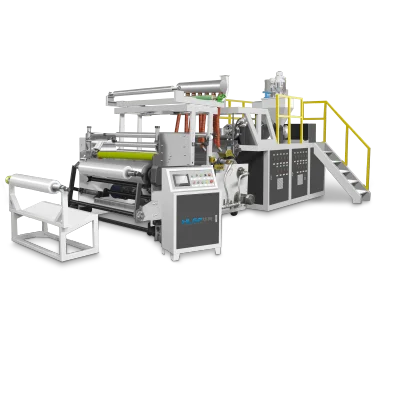
The entire recycling subsystem is designed for deep synchronization within a fully automatic stretch film machine infrastructure, operating continuously via a central PLC platform without requiring operator intervention. The recycling fan speed, granulator cutting speed, and hopper feeding rates adjust automatically based on main line speed adjustments. For factories running older hardware, these modules are available as bolt-on retrofit packages to upgrade a semi-automatic stretch film machine, instantly providing legacy lines with modern, margin-boosting sustainability features.
Securing Long Term Manufacturing Margins
Adopting a closed-loop inline recycling setup transforms edge trim from a wasteful operational liability into an immediate source of cost reduction and manufacturing efficiency. By automating the reclamation workflow, film producers eliminate internal logistics bottlenecks, protect polymer integrity, and reduce factory energy footprints. Incorporating specialized inline recycling into high-capacity stretch film extrusion machines remains one of the most effective, highest-return capital investments a packaging enterprise can make to secure high profit margins against volatile global polymer marketplace pricing.