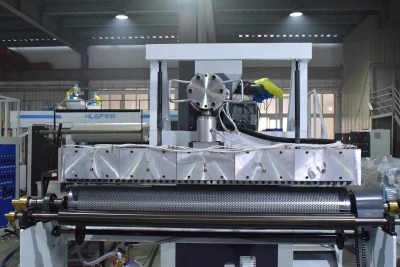
In multi-layer stretch film production, the T-die is one of the key components influencing final film quality. It brings polymer melt streams from multiple extruders together and distributes them into a uniform film structure before the material enters the casting process. The precision of this process can affect thickness uniformity, stretch performance, puncture resistance, and surface quality. Whether producing 2-layer, 3-layer, or 5-layer stretch film, a properly engineered T-die system helps maintain stable layer distribution and consistent film output.
Where Older T-Die Designs Struggle to Keep Up
A lot of the gauge and performance problems that show up in multi-layer stretch film can be traced directly back to how the T-die itself was engineered. Older or simpler die designs were often built without any real computerized flow channel analysis, which means the internal geometry was never optimized to distribute melt evenly across the full die width. The practical result is uneven pressure distribution from one side of the die to the other, which shows up downstream as inconsistent film thickness no matter how well the rest of the line is tuned.
Adjustability tends to be another weak point. Many conventional dies rely on fixed or purely manual lip openings that were set once and rarely revisited, which makes it difficult to hold gauge tolerance — ideally within about ±3% — when polymer viscosity shifts, especially with recycled or blended resins that behave less predictably than virgin material. Add in the absence of integrated thermal management, and melt temperature can vary noticeably across the different layers, which throws off molecular orientation and leaves mechanical properties like tensile strength and puncture resistance inconsistent from one production run to the next.
The layer coordination problem compounds all of this in multi-layer applications. When melt flow between layers isn't properly synchronized, layer ratios drift and adhesion between layers weakens, undermining the entire point of co-extrusion — using separate layers to deliver separate functions, like cling, strength, and puncture resistance, in a single film. On top of the process issues, dies built from lower-grade materials wear and corrode faster under continuous high-throughput operation, driving up maintenance frequency and unplanned downtime.
What Multi-Layer Stretch Film Is Actually Asked to Do
These die-level shortcomings matter because the applications depending on multi-layer stretch film leave very little margin for inconsistency.
On pallet-wrapping lines in logistics and warehousing, film needs dependable holding force and puncture resistance across the entire width of the roll. When die-related thickness variation leaves thin spots scattered through the film, those become the exact points where a wrap fails during transit.
In agricultural bale wrapping and silage applications, the film has to combine high elongation with strong recovery so it conforms tightly to irregular bale shapes without tearing. Gauge inconsistency from an uneven die often shows up as localized tearing or incomplete sealing during wrapping, which can compromise the airtight barrier silage depends on.
For bundling and strapping in construction materials — pipe, profile extrusions, and similar products — even tensile strength across the full film width matters more than almost anything else, since a single under-gauge section under load tends to be where the bundle gives way.

How Our T-Die Technology Addresses This
We engineer the T-die on our stretch film making machine platforms around computerized flow channel analysis from the start, rather than relying on legacy geometry carried over from older designs. The internal flow channels use a progressive structure that distributes melt evenly across the full die width, keeping pressure consistent from edge to edge and holding gauge tolerance within ±3% across the entire roll — a level of consistency that directly reduces the weak points responsible for punctures, tears, and uneven cling.
Where the design goes further is in adjustability. The lip opening allows real-time calibration of both film width and thickness, so the die can be recalibrated on the fly to accommodate shifts in polymer viscosity, including runs incorporating recycled content, without sacrificing gauge consistency. Integrated thermal management keeps melt temperature uniform across every layer simultaneously, which preserves consistent molecular orientation and keeps mechanical performance predictable from batch to batch rather than drifting with ambient or process conditions.
For multi-layer configurations, this precision extends directly into layer ratio control. Each layer can be engineered for a distinct function — one tuned for tensile strength, another for enhanced cling, a third for improved puncture resistance — and the die's flow control keeps that layer structure stable throughout the run. That functional separation is what allows a stretch film making machine to produce film genuinely optimized for load containment, pallet stability, and transport protection, rather than a generic film that compromises on all three. The same layer-level control also reduces overall material usage while maintaining the required mechanical performance, which improves production efficiency and cuts waste without sacrificing film strength.
Durability is built into the die construction as well. Wear- and corrosion-resistant materials allow the die to sustain high-throughput, continuous operation with minimal maintenance, so uniform film thickness and mechanical performance hold steady over extended production runs rather than degrading as the die ages.
Why the T-Die Deserves This Level of Scrutiny
The T-die is easy to overlook because it doesn't move, doesn't have an obvious digital interface, and rarely gets discussed outside of maintenance conversations. But it is the single component most responsible for whether a stretch film making machine can deliver consistent gauge, reliable layer adhesion, and dependable mechanical properties across an entire production run. By combining precision flow channel design, real-time lip calibration, integrated thermal control, and durable construction, our T-die technology is built to give converters and end users the kind of predictable, standards-ready stretch film that industrial and agricultural applications actually require — run after run, without the gauge drift and layer inconsistency that older die designs still struggle to eliminate.