How Automatic Hydraulic Screen Changers Cut Labor & Waste in Stretch Film Extrusion Machines
2026-07-01
In the competitive landscape of industrial plastics manufacturing, production efficiency and material conservation dictate profitability. For manufacturing facilities operating high-speed cast or blown packaging lines, contamination filtration represents both a necessity and a historic bottleneck. Manual filtration methods frequently force operators into a cycle of costly downtime, dangerous physical labor, and severe material degradation.
Integrating modern, high-pressure filtration components directly into stretch film extrusion machines has transformed this volatile operational bottleneck into a highly stable, automated process. Understanding how automatic hydraulic filtration systems reduce overhead requires a deep analysis of traditional mechanical limitations and the advanced engineering solutions now available to global film producers.
The Costly Vulnerabilities of Manual Screen Filtration and Mechanical Downtime
Industrial packaging film manufacturing demands absolute continuity in melt temperature, polymer pressure, and structural consistency. Whether a facility manufactures a basic multi-layer industrial wrap or an advanced high-performance stretch wrap, any disruption to the continuous melting process triggers severe financial and operational penalties.
The Heavy Burden of Physical Maintenance and Workplace Safety Risks
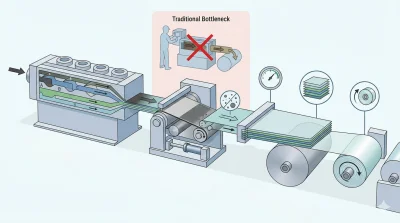
Traditional manual or mechanical screen changers require intense, heavy-duty physical labor performed under extreme environmental conditions. When a standard filter mesh becomes blinded by oxidized polymer, degraded gels, or foreign particulate matter, internal pressure rises rapidly. To change a manual filter, operators must work in close proximity to machinery components heated to well over two hundred degrees Celsius.
This traditional process requires maintenance personnel to use massive manual wrenches and heavy pry bars to physically break loose the adapter flanges and swap out the dirty filter plates. This intense physical exertion under extreme heat introduces severe risks of workplace injuries and debilitating thermal burns.
Furthermore, because the quality and speed of a manual filter change depend entirely on the physical stamina and experience of the specific operator on duty, consistency is impossible. A slightly misaligned seal or an unevenly torqued bolt instantly causes catastrophic polymer leakage, forcing another immediate emergency maintenance shutdown.
Excessive Material Degradation and the Financial Toll of System Fluctuations
The economic penalties of manual filtration go far beyond high labor costs. To execute a manual filter change, the entire extrusion line must be slowed down significantly or brought to a complete standstill. When the continuous flow of linear low-density polyethylene (LLDPE) stops inside the heated barrels of Stretch Film Extrusion Machines, the trapped polymer begins to degrade thermally.
This localized overheating causes rapid polymer carbonization, generating massive quantities of hard black specks and structural gels. Once the line is restarted, it takes hours of continuous running and hundreds of kilograms of expensive resin to completely flush these burned deposits out of the feedblocks and die lips.
During this long restart and stabilization period, the machine produces nothing but scrap material. The resulting film suffers from massive gauge variations, severe thickness fluctuations, and weak spots that cause immediate tearing during winding or high-speed automated wrapping tests, turning valuable raw materials directly into low-value warehouse waste.
Engineering Evolution of Modern Hydraulic Filtration Components
Overcoming these systemic production failures requires a shift toward high-pressure hydraulic filtration technology designed to operate continuously without interrupting the melt stream. Modern melt filtration systems leverage advanced metallurgy and micro-second actuation to maintain perfect system equilibrium during screen transitions.
Continuous Slide-Plate Hydrodynamics and Instant Actuation
Advanced automatic hydraulic filter assemblies utilize a dual-workstation slide plate configuration driven by a high-capacity, dedicated hydraulic power unit. When the internal sensor detects that a filter mesh has reached its dirt-holding capacity, the high-pressure hydraulic cylinders actuate instantly. The slide plate shifts a fresh, clean filter screen into the active melt channel in a fraction of a second.
This micro-second switching capability enables true continuous filtration. Because the slide plate moves with exceptional speed and force, the active flow path of the molten polymer is never restricted or blocked. The extrusion line continues to run at maximum output velocity, entirely eliminating the need to decelerate the primary driving motors or stop production to change a screen.
High-Precision Metallic Alloys and Active Air Evacuation
To withstand continuous operating pressures exceeding two hundred and fifty bar without leaking, these advanced filtration components are manufactured from proprietary steel alloys that undergo deep gas nitriding and specialized heat treatments. The mating surfaces between the moving slide plate and the stationary extruder housing are diamond-ground to a mirror-polished finish. This achieves an exceptionally tight, high-precision metallic seal that prevents polymer bypass and ensures zero-leakage performance under extreme thermal loads.
Additionally, these advanced hydraulic changers feature integrated air evacuation channels. Before the fresh filter screen enters the active melt stream, a tiny portion of the molten polymer is diverted to pre-fill the cavity and vent out all trapped atmospheric air. This prevents air bubbles from entering the adapter tubes and reaching the die lips, eliminating the risk of bubble collapse, web fluttering, and sudden film breaks during the switching sequence.
Holistic Machine Integration for Smart, Automated Factory Operations
The true value of advanced filtration technology is unlocked when the hydraulic component is fully integrated into the central command architecture of modern Stretch Film Extrusion Machines. Synchronizing filtration data with the master control loop creates an autonomous manufacturing environment that optimizes both human labor and material utilization.
Closed-Loop Pressure Monitoring via Master PLC Systems
Modern fully automatic cast and blown film lines replace human guesswork with active, closed-loop sensor networks. High-accuracy melt pressure transducers continuously monitor the pressure differential across the active filtration zone. The master PLC tracks this pressure delta in real time, automatically triggering the hydraulic power unit to execute a screen change the exact moment the filtration resistance reaches a pre-calculated structural limit.
During the split-second slide plate transition, the integrated PLC automatically communicates with the primary screw drive and the volumetric melt pump. The control system applies subtle, real-time adjustments to the screw rotational speed and pump frequency to absorb the minor pressure spike caused by the moving slide plate. This closed-loop synchronization ensures that the volumetric output at the die lips remains completely constant, keeping film gauge tolerances locked within strict micro-metric limits.
Exponential Returns on Investment and Enhanced Plant Efficiency
Transitioning to automated hydraulic filtration delivers immediate, measurable improvements to a manufacturing facility’s bottom line and Overall Equipment Effectiveness (OEE). By removing the physical bottlenecks of manual maintenance, a production plant can easily shift to an optimized "one operator, multiple lines" management model, drastically reducing factory labor costs.
- Continuous Maximum Output: Eliminating planned shutdowns for screen maintenance allows production lines to run twenty-four hours a day without interruption, maximizing daily tonnage yields.
- Near-Zero Raw Material Scrap: Eliminating the thermal degradation and purging cycles caused by line stoppages saves thousands of kilograms of LLDPE resin annually, dramatically reducing material overhead.
- Flawless Film Structural Quality: Maintaining a perfectly steady, constant melt pressure guarantees exceptional film clarity, excellent puncture resistance, and highly predictable stretch percentages for high-demand industrial clients.
- By combining precision hydraulic engineering with smart PLC synchronization, modern film producers can protect their machinery assets, maximize operational uptime, eliminate material waste, and consistently deliver premium-tier packaging film to the global market.