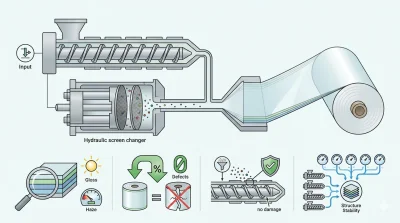
In multi-layer co-extrusion stretch film making machines, maintaining an uninterrupted melt stream is critical for film quality. Hydraulic screen changers are positioned directly between the extruder screw and the die. They deliver continuous, high-pressure melt filtration to remove polymer contaminants without halting extrusion lines. This technical integration ensures seamless operation for 2-layer, 3-layer, and 5-layer stretch film machines.
Technical Challenges in Multi-Layer Film Extrusion
Traditional manual screen filtration introduces significant operational bottlenecks in high-speed stretch film production:
- Thermal Instability: Stopping lines for manual filter replacement causes temperature drops.
- Gauge Fluctuation: Manual changeovers disrupt backpressure, creating thick or thin spots in the film.
- Material Waste: Halting the extrusion process results in lengthy purging and massive resin scrap.
How Hydraulic Screen Changers Eliminate Production Bottlenecks
Dual-Chamber Continuous Filtration
Hydraulic screen changers utilize a precision-engineered dual-chamber piston design. While one filtration screen actively processes the polymer melt stream, the second screen is preheated and standby.
Zero-Pressure Drop Actuation
The hydraulic actuation system executes screen swaps instantly. This rapid movement eliminates the pressure drops and melt surges that typically cause layer delamination or gauge variation in multi-layer co-extrusion processes. It allows semi-automatic and fully automatic stretch film machines to maintain stable, continuous runs for weeks.
Precision Contaminant Removal
The system utilizes filtration mesh ranging from 40 to 120 mesh, calibrated to targeted film thicknesses. This fine filtration traps critical defects before they reach the die:
- Degraded polymer gels
- Carbon specks
- Foreign micro-particles
Core Performance Benefits for Stretch Film Machines
1. Enhanced Optical and Mechanical Properties
By stabilizing the melt flow front, hydraulic filtration optimizes layer-to-layer thickness ratios. This uniform melt distribution prevents pinholes and tear propagation during high-speed winding. The resulting stretch films meet high-clarity standards:
- Gloss Levels: Exceeding 140 GU.
- Haze Levels: Maintained below 1.5%.
2. Significant Scrap Reduction
Consistent, non-stop filtration reduces industrial scrap rates by up to 8%. It eliminates the random micro-defects that cause web breaks and trigger secondary slitting waste.
3. Extended Component Lifespan
Capturing abrasive contaminants before they pass through the die prevents foreign matter from embedding in the machinery. This continuous protection extends the operational lifespan of both the extruder screw and the barrel.
4. Structure Stability in 5-Layer Systems
For 5-layer stretch film machines, maintaining stable, synchronized backpressure across all component extruders is vital. Hydraulic screen changers secure the precise pressure balance needed to achieve exact ABA or ABCBA co-extrusion profiles.
Industry 4.0 Integration for Next-Gen Film Line
Modern hydraulic screen changers feature predictive maintenance capabilities. Integrated sensors track real-time pressure differential thresholds across the filtration mesh. This data feeds into central control systems, triggering automated alerts when a screen change is required, maximizing overall equipment effectiveness (OEE) by 12% to 15% on fully automatic stretch film lines.