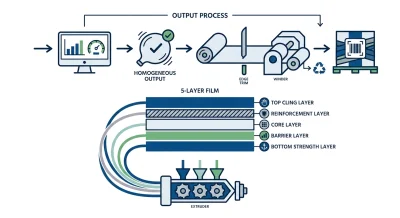
Features of 5-Layer Stretch Film Extrusion Machine

2026-08-24

Modern logistics, warehousing, and industrial packaging require more than basic wrapping protection. Manufacturers need stretch film that can secure pallets, resist punctures, maintain stable load containment, and reduce material consumption without sacrificing packaging reliability. As conventional single-layer stretch film reaches its performance limits, a 5-layer co-extrusion system provides a more flexible way to balance film strength, stretchability, cling, and production efficiency. A well-designed stretch film extrusion machine can combine multiple resin formulations into a controlled multilayer structure, helping manufacturers produce thinner films with reliable packaging performance and consistent quality.

Challenges of Conventional Stretch Film Production

Traditional single-layer stretch film production has inherent limitations when different performance requirements must be achieved simultaneously. A single resin formulation needs to provide sufficient tensile strength, puncture resistance, elongation, and cling. Improving one property can sometimes affect another, making it difficult to optimize the entire film structure.

Increasing film thickness is one common way to compensate for insufficient mechanical strength. However, thicker film increases resin consumption, packaging weight, transportation costs, and waste. For high-volume pallet wrapping applications, even a small increase in film consumption can significantly affect annual material costs.

Production efficiency is another important consideration. Older extrusion systems may have less precise temperature control, less stable melt processing, and longer changeover periods. Manual adjustments can also make it difficult to maintain consistent film thickness and winding quality during continuous production.

For modern stretch film manufacturers, the objective is therefore not simply to produce more film. The priority is to achieve stable output, efficient resin utilization, consistent film properties, and dependable packaging performance at the same time.

Why Stretch Film Matters in Modern Logistics

Stretch film plays a critical role in pallet stabilization and unit-load protection. During transportation and warehouse handling, pallets can experience vibration, acceleration, impacts, and repeated movement. Properly selected stretch film helps hold individual cartons and products together, reducing the risk of shifting or pallet instability.

The film also provides a physical barrier against dust, moisture, and surface abrasion. Transparent stretch film allows operators to identify packaged goods and read labels or barcodes without removing the packaging.

These requirements place greater demands on the manufacturing process. Film must combine controlled thickness with adequate tensile strength, elongation, puncture resistance, and cling. This is where multilayer extrusion technology offers significant advantages.

5-Layer Co-Extrusion for Balanced Film Performance

A 5-layer stretch film extrusion machine allows manufacturers to design the film structure according to its intended application rather than relying on one material formulation for every property.

Different layers can be assigned different functions. For example, outer layers can be formulated to provide suitable surface characteristics and mechanical strength, while an inner layer can be optimized for cling performance. The central layers can contribute to tensile strength, puncture resistance, and overall film stability.

This structure allows resin consumption to be distributed more efficiently. Depending on the film formulation and application, manufacturers can optimize each layer rather than adding material uniformly throughout the film. The result can be a more efficient balance between film thickness and packaging performance.

A properly configured extrusion system also helps maintain stable melt processing. Accurate temperature control, suitable screw design, and consistent material feeding contribute to uniform melt quality before the material reaches the casting and winding stages.

3-5-Layer Automatic Stretch Film Making Machine

Stable Melt Processing and Consistent Film Quality

The extrusion section is fundamental to the performance of any stretch film extrusion machine. Stable plasticization and homogeneous melt flow help reduce fluctuations in film thickness and physical properties.

Multilayer extrusion requires accurate control of the individual material streams. Each extruder must process its assigned resin consistently, while the co-extrusion system combines the layers into a stable multilayer melt. Precise temperature management across the barrel and die helps maintain appropriate processing conditions for different polyethylene formulations.

The T-die and casting section are equally important. Uniform die distribution and controlled cooling contribute to consistent film thickness and surface quality. For commercial stretch film production, thickness variation should be minimized because unstable thickness can affect both film performance and material consumption.

For this reason, the extrusion line should be considered as an integrated system rather than a collection of individual components.

Intelligent PLC and HMI Control

Automation provides another important advantage of a modern 5-layer stretch film extrusion machine. PLC and HMI control systems allow operators to monitor and adjust key production parameters from a centralized interface.

Important parameters can include extrusion temperature, screw speed, line speed, winding conditions, and other process settings. Depending on the machine configuration, production recipes can also be stored for repeat orders. This helps operators reproduce established processing conditions when manufacturing the same film specification.

Recipe management is particularly useful for manufacturers producing several film grades or thicknesses. Instead of rebuilding production settings manually each time, operators can retrieve an existing recipe and make controlled adjustments when required.

Automation does not eliminate the need for skilled production management, but it can reduce unnecessary manual intervention and improve process repeatability.

High Stretchability and Puncture Resistance

For pallet wrapping, mechanical performance is directly related to packaging efficiency. A film with suitable elongation can stretch during wrapping and conform closely to the shape of the load. This can help reduce the amount of film required per pallet when the formulation and wrapping conditions are properly matched.

Puncture resistance is especially important for products with sharp corners, irregular surfaces, or concentrated edges. A multilayer structure can distribute mechanical functions across different layers, helping manufacturers develop film with a better balance between stretchability and resistance to damage.

The actual performance depends on resin selection, layer ratios, film thickness, extrusion conditions, and wrapping equipment. Therefore, a high-quality stretch film extrusion machine should provide the process stability required to maintain these properties consistently from one production batch to another.

Automatic Winding and Production Efficiency

The winding system has a direct influence on finished roll quality and production efficiency. Stable winding tension helps produce uniform rolls with controlled edges and a consistent appearance.

For high-output production, automatic or semi-automatic roll changing can reduce downtime between production cycles. Depending on the machine  configuration, automatic cutting, rewinding, and roll handling systems can further reduce manual intervention.

Edge trim management is also important. During film production, trimmed material can be collected and handled through a suitable recycling system when the material and process allow it. This can help improve material utilization and keep the production area cleaner.

Build a More Efficient Stretch Film Production Line

A 5-layer stretch film extrusion machine provides manufacturers with greater control over film structure and production parameters. By assigning different functions to individual layers, the system can support the development of stretch films with a balanced combination of cling, tensile strength, elongation, and puncture resistance.

Our 5-layer stretch film extrusion machine solutions are developed for manufacturers looking to improve production consistency while optimizing material utilization. With multilayer co-extrusion technology, PLC and HMI control, precise temperature management, stable casting, and reliable winding systems, the complete line can be configured around specific film specifications and production requirements.

For manufacturers planning to upgrade their stretch film production capacity, selecting the right extrusion configuration is an important investment decision. Contact our technical team to discuss your required film thickness, width, resin formulation, output target, and automation requirements, and we can provide a suitable stretch film extrusion machine solution for your production needs.

Blog Cover

GET IN TOUCH NOW

*We respect your privacy. When you submit your contact information, we agree to only contact you in accordance with our Privacy Policy.