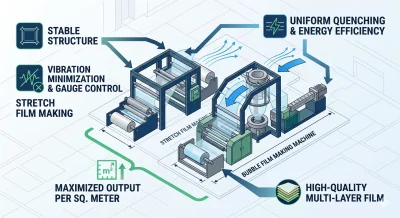
The overall dimensions of a film extrusion line are an important factor influencing equipment performance, production stability, and factory efficiency. For both stretch film making machines and bubble film making machines, the machine footprint is not only related to installation space but also affects structural rigidity, thermal management, component arrangement, and long-term operating reliability.
As packaging manufacturers continue to require wider films, higher output, and more advanced multi-layer structures, extrusion equipment must achieve a balance between compact layout and sufficient mechanical strength. Proper dimensional design helps ensure stable extrusion, efficient cooling, accurate forming, and consistent final product quality.
Engineering Challenges Caused by Improper Machine Dimensions
The dimensions and layout of extrusion equipment directly influence how different systems operate together. A film production line usually integrates multiple sections, including extrusion units, forming systems, cooling components, traction devices, and winding equipment. If the overall structure is not properly designed, production stability may be affected.
For stretch film making machines, insufficient frame strength or unsuitable component positioning may increase vibration during high-speed extrusion and winding. These mechanical fluctuations can influence the stability of film thickness control, tension adjustment, and roll formation.
For bubble film making machines, machine dimensions also influence the stability of the bubble forming process. The distance between extrusion, air cooling, forming rollers, and winding sections affects cooling conditions and bubble consistency. Poor layout design may lead to uneven cooling, unstable bubble height, and variations in bubble structure.
Therefore, overall dimensions are not simply a matter of saving installation space. They are closely related to how efficiently the machine can maintain stable production conditions.
Structural Design and Stability of Modern Film Extrusion Equipment
A reliable film extrusion machine requires a strong mechanical foundation. Both stretch film making machines and bubble film making machines operate with continuous loads from motors, screws, rollers, and drive systems. A rigid frame helps maintain component alignment and reduces the influence of mechanical vibration.
For stretch film production, stable structural support is essential for maintaining accurate positioning between the extruder, T-die, cooling rolls, and winding system. This helps improve film thickness consistency and supports stable tension control during high-speed operation.
For bubble film production, structural stability ensures that forming units and cooling systems remain accurately aligned. This is important because bubble diameter, bubble spacing, and sheet thickness depend on consistent mechanical positioning throughout the production process.
A well-designed machine frame also improves long-term reliability by reducing stress on bearings, transmission components, and other mechanical parts during continuous operation.
The Role of Machine Dimensions in Thermal Management
Thermal control is a key consideration for both stretch film and bubble film production. During extrusion, polymer materials must be heated, melted, formed, and cooled under controlled conditions. The physical arrangement of heating zones, cooling systems, and forming components influences how efficiently heat can be managed.
For a stretch film making machine, the cooling section must remove heat from the molten film quickly and evenly after extrusion through the die. Proper layout of chill rolls and cooling systems helps maintain uniform solidification, supporting consistent thickness, transparency, and mechanical properties.
For a bubble film making machine, cooling performance directly affects bubble stability and film forming quality. The arrangement of air cooling systems, forming rollers, and downstream components helps maintain balanced cooling across the film width, reducing deformation and improving product consistency.
An optimized machine structure allows cooling systems to work more effectively while providing sufficient space for airflow, maintenance, and temperature control.
Optimized Layout for Multi-Layer Film Production
Modern packaging applications increasingly require multi-layer films with improved strength, protection, and functional properties. This trend places higher demands on equipment integration and dimensional planning.
In multi-layer stretch film making machines, multiple extruders, feedblocks, and control systems must operate together with precise coordination. A practical machine layout reduces unnecessary material transfer distance and helps maintain stable polymer flow between extrusion sections.
In multi-layer bubble film making machines, the integration of multiple extrusion layers and forming systems requires accurate space planning. Proper component arrangement supports stable bubble formation while allowing operators to monitor and adjust production parameters efficiently.
Optimized layouts also make maintenance easier by providing reasonable access to key components such as extrusion units, temperature controllers, and winding systems.
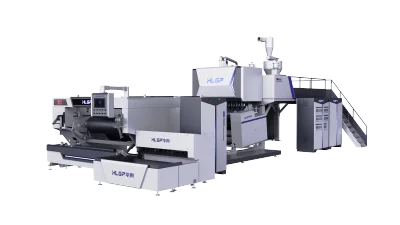
Improving Factory Efficiency Through Practical Machine Design
The overall dimensions of a film production line also influence factory workflow. A well-designed machine footprint helps manufacturers maximize available space while maintaining safe operating areas.
For both stretch film making machines and bubble film making machines, efficient layouts can simplify material handling, reduce unnecessary movement, and improve production management. Operators can monitor key processes more easily, while maintenance teams can access important components with less downtime.
However, compact design should always be balanced with production requirements. Reducing machine size without considering structural strength, cooling efficiency, or operating accessibility may negatively affect long-term performance.
Professional equipment design focuses on achieving the right balance between footprint, output capacity, reliability, and future production needs.
Advanced Film Extrusion Equipment with Optimized Structural Design
The overall dimensions of a stretch film making machine and bubble film making machine reflect important engineering considerations behind stable production performance. From frame structure and thermal management to component layout and maintenance accessibility, every design element contributes to reliable operation.
Our stretch film making machines and bubble film making machines are developed with practical engineering principles, combining strong structural design, optimized system arrangement, and reliable production performance. By considering mechanical stability, cooling efficiency, and production workflow during equipment design, our machines provide manufacturers with dependable solutions for different packaging film applications.
Whether producing stretch film for industrial wrapping or bubble film for protective packaging, selecting equipment with the right dimensional design helps manufacturers improve production efficiency, maintain consistent product quality, and achieve reliable long-term operation.