Role of High-efficiency 2-Layer Bubble Film Extrusion Machine in Reducing Per-ton Costs
2026-09-01
Production costs in bubble film manufacturing are influenced by several factors that work together throughout the extrusion process. Raw material consumption, energy use, production speed, and process stability all affect the cost and efficiency of the finished film. A high-efficiency 2-layer bubble film extrusion machine is designed to manage these factors in a coordinated way, helping producers maintain stable output while making better use of materials and energy.
Where Conventional 2-Layer Machines Fall Short on Cost Control
Many bubble film lines still run on a cost structure that offers little flexibility. Without a genuine dual-extruder configuration capable of assigning different formulations to different layers, most conventional machines default to running the entire film on virgin resin, since there's no reliable way to introduce recycled content into one layer without compromising the strength or clarity of the whole sheet. That constraint locks producers into paying full prime-resin prices for material that, in a properly engineered layer structure, could be substituted with lower-cost recycled or mineral-filled content without sacrificing performance.
Energy consumption tells a similar story. Machines built around standard induction motors typically deliver weaker torque control and less stability at higher speeds, which pushes the energy consumption ratio per ton of film produced well above what modern drive technology can achieve. In a continuous, high-volume production environment, that gap in energy efficiency compounds daily, and it becomes one of the largest hidden costs behind an otherwise competitive-looking production line.
A fixed single-speed configuration adds a third constraint. A machine tuned for one operating speed struggles to serve both ends of a producer's order book — large, standardized volume contracts on one side and frequent changeovers or complex, high-filler-content recipes on the other. Pushing a machine outside the operating range it was actually designed for tends to show up as instability and higher scrap rates, and scrap is one of the most direct ways per-ton cost quietly climbs even when the headline production numbers still look strong.
Why Per-Ton Cost Efficiency Matters Across Different Buyers
These cost pressures land differently depending on who's purchasing the film, but in every case, the producer's ability to control per-ton cost determines what price they can actually offer.
For bulk agricultural and feed packaging, unit packaging cost has a direct effect on margin in an industry that already operates on thin agricultural pricing, and buyers in this space are often willing to accept recycled-content film as long as it holds up under normal handling. A production line that can't work recycled material into the formulation is left competing on price with one hand tied behind its back.
For packaging converters and private-label producers who resupply their own downstream customers, competitiveness depends on consistently quoting a price that reflects genuine production efficiency, not just squeezed margins. These buyers need a supplier — or a production line of their own — that can move fluidly between large standardized runs and smaller custom-formulation orders without a cost penalty attached to either.
For courier and logistics companies procuring bubble film in bulk as a packaging consumable, cost per roll is scrutinized closely because packaging materials are a recurring, high-volume line item in their operating budget. A supplier whose production costs are inflated by outdated motor technology or rigid formulation options struggles to offer the pricing this segment expects at scale.

How Our 2-Layer Bubble Film Extrusion Machine Delivers Lower Per-Ton Costs
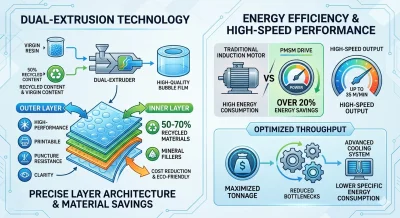
Our 2-layer bubble film extrusion machines are built around a genuine dual-extruder configuration that gives each layer of the film a distinct formulation rather than forcing a single recipe across the whole structure. The outer layer runs on high-performance virgin resin or specialized polymers to preserve printability, puncture resistance, and visual clarity, while the inner layer is capable of incorporating 50 to 70 percent recycled material or mineral-based fillers without compromising the film's overall integrity. For bulk agricultural and feed packaging producers, that formulation flexibility is what makes it possible to hold protection standards while meaningfully reducing dependence on expensive prime resin.
Energy efficiency is addressed directly through Permanent Magnet Synchronous Motor drive systems, which deliver stronger torque control and greater stability at high speed than conventional induction motors. That PMSM drive train cuts power consumption by more than 20 percent compared to standard motor technology, and paired with top-tier models capable of production speeds up to 35 meters per minute, the result is a meaningfully lower specific energy consumption per ton of finished film. For courier and logistics buyers procuring film at volume, that energy efficiency is a real input into the pricing a supplier can sustainably offer.
Throughput is optimized as a system rather than as a single spec figure. Advanced cooling works in tandem with high-speed extrusion to remove the bottlenecks that would otherwise cap daily tonnage, so the higher line speed actually translates into more finished product per shift rather than getting absorbed by cooling or handling delays elsewhere in the process.
That production capacity is also available across a genuine range of configurations rather than a single fixed setup. High-speed models are engineered for large-volume contracts where maximizing output and economies of scale matter most, medium-speed models offer balanced performance for producers managing versatile schedules and frequent product changeovers, and low-speed models deliver the stability needed for complex recipes with high filler content, where quality control matters more than raw throughput. For packaging converters and private-label producers juggling both standardized and custom orders, having the right configuration available — rather than forcing every order through the same speed profile — is what keeps per-ton cost under control across a genuinely mixed order book.
Taken together, formulation flexibility, motor efficiency, optimized throughput, and a genuinely versatile model lineup are what allow a 2-layer bubble film extrusion machine to function as a real cost-leadership tool rather than just a production asset. For manufacturers under pressure to meet sustainability mandates without sacrificing margin, that combination is what makes it possible to do both — lowering per-ton manufacturing cost while still delivering film that holds up to the protection standards their customers expect.