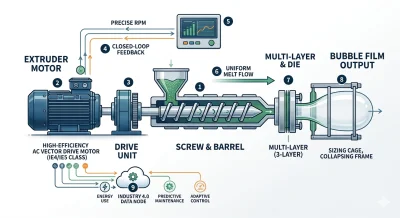
The extruder motor is the primary drive unit of a high-performance bubble film making machine. It serves as the "heart" of the extrusion process, directly determining the stability of production and the quality of the final protective film. Its technical functions extend from basic power delivery to complex melt pressure management.
1. High-Torque Drive and Polymer Plasticization
The core function of the motor is to provide consistent, high-torque rotation to the screw within the barrel. This mechanical action is responsible for:
- Melting and Mixing: Converting electrical energy into the mechanical force required to melt and homogenize polymer resins.
- Handling Viscosity Changes: Maintaining stable rotation even when processing materials with different viscosities, such as LLDPE blends or bio-based PBAT.
- Pressure Stability: Ensuring the screw generates sufficient and steady pressure to push the molten plastic through the die head.
2. Precise Speed Regulation and Gauge Control
Modern motors for bubble film making machines utilize AC vector drives or servo systems to achieve closed-loop feedback. This precision is vital for:
- Uniform Volumetric Output: Maintaining a constant RPM regardless of load fluctuations, which prevents "surging" or "starving" of the screw.
- Consistent Layer Thickness: In 3, 5, or 7-layer co-extrusion, precise motor control ensures each layer reaches the exact micron-level thickness required.
- Structural Integrity: Stable extrusion leads to uniform bubble height and consistent cushioning performance across the entire web.
3. Energy Efficiency and Thermal Management
The efficiency of the extruder motor directly impacts the operational cost of the bubble film making machine.
- Reduced Energy Consumption: High-efficiency motors (such as IE4 or IE5 classes) minimize energy loss during the conversion of electricity to torque.
- Lower Thermal Load: Efficient motors generate less waste heat, reducing the strain on the factory's cooling systems and ensuring a more stable operating environment for sensitive electronic controls.
4. Integration with Smart Manufacturing (Industry 4.0)
Advanced extruder motors now function as data nodes within the production line. By integrating with automation systems, they provide:
- Real-Time Monitoring: Continuous data on energy usage and load variations.
- Predictive Maintenance: Early detection of bearing wear or mechanical stress, preventing unplanned downtime.
- Adaptive Control: Algorithms that can auto-adjust motor speed based on resin lot variations to maintain film clarity and strength.
Conclusion
The extruder motor is fundamental to achieving high Overall Equipment Effectiveness (OEE) in any bubble film making machine. By ensuring precise plasticization, stable pressure, and energy-efficient operation, it enables the production of high-quality packaging materials—from heavy-duty furniture wrap to precision anti-static films for electronics.