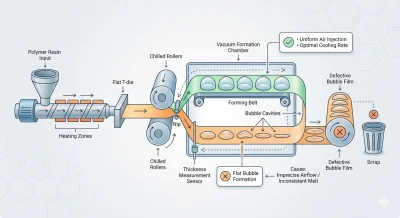
How to Prevent "Flat Bubbles": Troubleshooting Your Bubble Film Extrusion Machine
2026-08-17
Bubble film is widely used as a protective packaging material in logistics, e-commerce, electronics, furniture, industrial products, and export transportation. With the continuous growth of global packaging demand, manufacturers are facing higher requirements for bubble film quality, production efficiency, and material utilization. Among various production problems, flat bubbles are one of the most common defects affecting final product performance.
Flat bubbles occur when the inflated bubble structure cannot maintain a stable and uniform shape during extrusion. This issue reduces cushioning performance, increases material waste, and may lead to customer complaints caused by inconsistent packaging quality. For manufacturers, solving flat bubble problems requires more than simple parameter adjustments. A reliable bubble film extrusion machine must provide stable airflow control, precise melt distribution, accurate die adjustment, and uniform cooling performance to achieve consistent bubble formation.
Problems Caused by Flat Bubbles in Bubble Film Production
In modern packaging applications, bubble film is expected to provide reliable impact protection while maintaining lightweight characteristics. The air-filled bubble structure is the key factor that determines cushioning performance. When bubbles become flat or uneven, the internal air volume decreases, reducing the ability of the material to absorb external impact forces.
For example, during long-distance transportation, packaging materials with unstable bubble structures may not provide sufficient protection against vibration, compression, and accidental impact. This is especially important for industries such as electronics, glass products, precision instruments, and high-value consumer goods, where packaging reliability directly affects product safety.
Flat bubbles also create additional production costs. When bubble formation is unstable, manufacturers may experience higher scrap rates, frequent machine adjustments, and unnecessary raw material consumption. In continuous production environments, these problems can reduce overall equipment efficiency and increase operating expenses.
Traditional bubble film production equipment often relies heavily on manual adjustment based on operator experience. Without precise control systems, small changes in extrusion temperature, cooling airflow, or die conditions can result in inconsistent bubble sizes and unstable film quality. As production speeds increase, these problems become more noticeable because the extrusion process requires higher precision and faster response capability.
The Importance of High-Quality Bubble Film in Modern Packaging
Bubble film plays an important role in protecting products throughout storage, handling, and transportation. A high-quality bubble structure provides excellent cushioning performance while maintaining flexibility, lightweight characteristics, and cost efficiency.
Different industries have different requirements for bubble film performance. E-commerce companies need reliable packaging solutions for daily shipments, while industrial manufacturers require stronger protection for heavy or sensitive components. Export packaging applications often demand stable quality because products may experience long transportation cycles under different environmental conditions.
To meet these market requirements, bubble film manufacturers need to focus on several key quality factors, including uniform bubble diameter, consistent film thickness, stable bubble height, and strong sealing performance. These characteristics depend greatly on the precision and stability of the bubble film extrusion machine.
Modern extrusion technology helps manufacturers achieve better production consistency through improved extrusion control, optimized cooling systems, and advanced die design. Instead of relying only on manual adjustments, automated systems allow operators to maintain stable production parameters and reduce quality fluctuations.
Main Causes of Flat Bubbles in Bubble Film Extrusion Machine
Flat bubbles are usually caused by multiple factors during the extrusion and cooling process. Understanding these causes helps manufacturers identify the correct solutions and improve production stability.
Improper Internal Bubble Cooling Airflow Control
The internal bubble cooling (IBC) system plays an important role in maintaining bubble shape during extrusion. The system controls the airflow inside the bubble, helping regulate cooling speed and bubble expansion.
When airflow distribution is uneven, some areas of the bubble may cool faster than others. This creates differences in bubble strength and expansion behavior, causing the bubble dome to collapse or become irregular.
A well-designed cooling system should provide balanced airflow distribution and stable temperature control. Advanced bubble film extrusion machines use optimized airflow channels and precise cooling management to maintain consistent bubble formation during continuous operation.
Uneven Melt Distribution Across the Die Width
The extrusion die is another critical factor affecting bubble quality. During production, polymer melt must be distributed evenly across the entire die width. If melt flow is inconsistent, some areas of the film may become thinner or weaker.
These weak areas cannot maintain stable air pressure during bubble expansion, resulting in flat bubbles or uneven bubble sizes. Multi-layer extrusion technology and advanced die structures help improve melt balance by providing more uniform polymer flow.
A stable melt distribution system also improves film thickness consistency, which contributes to better mechanical strength and overall packaging performance.
Incorrect Die Gap Adjustment
The die gap directly affects the thickness and expansion behavior of the bubble film. If the die gap is not properly adjusted, the polymer flow may become unstable, causing uneven bubble formation.
An excessively large die gap can create thickness variations, while an excessively narrow gap may restrict material flow and reduce production stability. For high-output applications, manual die adjustment may not provide sufficient accuracy.
Modern bubble film extrusion machines use precision die adjustment systems to achieve more consistent die opening control. Accurate adjustment helps improve bubble uniformity and reduces the need for frequent production interruptions.
Uneven Cooling Rates Between Cooling Rings
Cooling performance has a direct impact on bubble shape and film quality. During extrusion, the bubble needs controlled cooling from both internal and external cooling systems.
If cooling rates vary between different sections, the bubble may expand unevenly or lose stability before reaching the required size. Optimized cooling rings and temperature control systems help maintain a balanced cooling environment, ensuring smoother bubble formation and improved production reliability.
How Our Bubble Film Extrusion Machines Solve Flat Bubble Problems
Our modern bubble film extrusion machine is designed to solve common production challenges through integrated technology improvements. Instead of correcting defects after they occur, advanced equipment focuses on maintaining stable conditions throughout the extrusion process.
Multi-layer extrusion technology is one effective solution for improving bubble stability. For example, 3-5 layer bubble film machines use advanced co-extrusion structures to optimize polymer distribution between different layers. This technology allows manufacturers to combine different materials while maintaining uniform melt flow and consistent bubble formation.
High-performance models, such as 3-5 layer high-speed bubble film machines and 7 layer high-speed bubble film machines, are equipped with advanced die design technologies. Computer-aided die optimization and precise die gap adjustment systems improve extrusion accuracy, supporting stable production at higher speeds.
For standard packaging applications, 2 layer medium-speed and low-speed bubble film machines provide a practical solution with simplified operation and reliable performance. These machines focus on stable temperature control, consistent screw speed, and efficient extrusion processes, making them suitable for manufacturers requiring cost-effective production.
Intelligent control systems also contribute to better quality management. PLC-based control platforms allow operators to monitor key parameters such as temperature, extrusion speed, and production status. This reduces dependence on manual experience and helps maintain consistent product quality during long production cycles.
| Bubble Film Extrusion Machine Type | Key Advantages for Preventing Flat Bubbles | Suitable Applications |
|---|---|---|
| 2 Layer Low-Speed Machine | Stable extrusion control and simple operation for consistent bubble formation | Standard packaging production |
| 2 Layer Medium-Speed Machine | Improved temperature control and cooling stability | General protective packaging |
| 3-5 Layer Medium-Speed Machine | Balanced multi-layer melt distribution for better bubble uniformity | Higher-quality bubble film production |
| 3-5 Layer High-Speed Machine | Precision die control and stable high-speed bubble expansion | Large-scale packaging production |
| 7 Layer High-Speed Machine | Advanced co-extrusion and precise process control for premium bubble quality | High-performance and export packaging |
Choosing the Right Bubble Film Extrusion Machine for Stable Production
Different manufacturers have different production goals, so selecting the right equipment configuration is essential.
For companies producing standard protective packaging materials, a two-layer bubble film extrusion machine can provide efficient and stable operation. For manufacturers requiring higher quality standards and more flexible material combinations, multi-layer extrusion solutions offer better performance.
High-speed production lines are suitable for large-scale packaging suppliers that require higher output capacity and consistent product quality. Advanced models with precision die systems and intelligent controls can reduce material waste, improve production efficiency, and maintain stable bubble structures even under continuous operation.
By selecting equipment based on production capacity, material requirements, and product specifications, manufacturers can achieve better long-term production performance.
Improve Bubble Film Quality with Reliable Extrusion Technology
Preventing flat bubbles requires precise control of airflow, melt distribution, die adjustment, and cooling conditions throughout the extrusion process. While traditional production methods may struggle with quality fluctuations, advanced extrusion technology provides a more stable and efficient solution.
Our bubble film extrusion machines are developed with optimized extrusion systems, reliable cooling technology, precision die structures, and intelligent control solutions to help manufacturers produce high-quality bubble film with uniform bubble formation and consistent performance. With different configurations available, including two-layer, multi-layer, and high-speed production lines, our machines provide flexible solutions for various packaging applications and help customers improve production efficiency, reduce waste, and achieve reliable long-term operation.