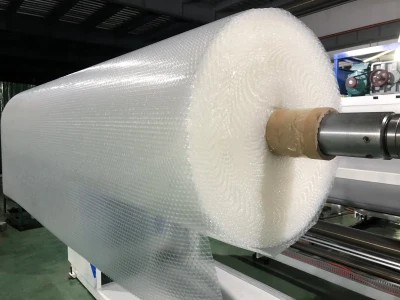
In the highly competitive film industry, every detail is of paramount importance, and one of the most critical yet often overlooked factors is the overall weight of your production machine. As production scales from standard 1600mm lines to industrial 3000mm systems, a fundamental principle applies: higher power requires greater structural mass. In the absence of a rigid, heavy-duty frame, even the most advanced extruder is unable to consistently produce the high-quality film that your customers demand.
It is evident that the physics of this process is clear: larger screws (90mm–100mm) and high-torque motors (37kW–45kW) generate intense mechanical stress. Lightweight frames are not able to absorb these forces, which can lead to issues such as gear wear, frame deflection and misalignment, with the potential to disrupt entire production lines. The use of heavy-duty cast-iron bases and reinforced structures ensures stability and reliable performance, minimising vibration and downtime.
Weight is a key indicator of product quality. At production speeds of 30–50 metres per minute, micro-vibrations from motors and vacuum pumps can cause disturbances to the T-die. Light machines amplify these vibrations, causing uneven thickness and deformed bubbles. A heavy, rigid chassis is essential for effective shock absorption and ensuring parallelism between forming and silicone rollers, even under wide-format hydraulic pressure. This stability ensures uniform bubble sealing across the full 3000 mm width, reducing defects and material waste.
For operations that are 24/7, the weight of the structure is critical to ensure long-term stability. A 15-ton machine has been shown to exhibit superior resistance to thermal expansion and metal fatigue when compared with a 7-ton model. This enhanced durability ensures the preservation of alignment and precision from the machine's initial use through to its prolonged operation over several years. This consistency will safeguard your ROI.
When selecting equipment, it is important to consider factors beyond motor power and theoretical output. Please examine the thickness of the chassis, the design of the rollers, and the overall weight of the structure. A heavier machine delivers superior speed, stability and quality. By choosing mass, you can be assured of reliability, precision, and long-term confidence in every roll produced.