Customizing an Extrusion Machine to Fit Your Specific Production Needs
2026-09-04
The protective packaging industry is becoming more diverse as e-commerce, electronics, industrial manufacturing, furniture, and logistics continue to grow. Different products require different levels of cushioning, surface protection, moisture resistance, insulation, and other functional properties. This has increased the need for production equipment that can adapt to changing product specifications.
A standard production line can work well for manufacturers producing a limited range of bubble packaging products. However, companies handling different widths, bubble sizes, material structures, or production volumes may benefit from a more flexible equipment configuration. A properly designed bubble film extrusion machine can help manufacturers match their production equipment more closely with actual product requirements.
Changing Requirements for Bubble Packaging Production
Traditional bubble packaging production often focuses on long runs of standardized products. In today's market, manufacturers may need to change specifications more frequently to meet different customer requirements. Web width, thickness, bubble dimensions, layer structure, and raw materials can all vary between applications.
Material selection is also becoming an important consideration. Virgin resin remains widely used, while suitable recycled resin may be incorporated into certain products when its quality and processing characteristics meet the application requirements. This requires appropriate control of plasticization, filtration, temperature, and melt stability.
Production efficiency is influenced by more than machine speed. Temperature control, forming conditions, cooling, material utilization, and changeover procedures can all affect operating costs and product consistency. Therefore, equipment selection should consider the complete production process rather than theoretical output alone.
The Role of Bubble Packaging in Protective Packaging
Bubble packaging materials are widely used for cushioning and surface protection during storage, handling, and transportation. Common applications include electronics, furniture, household appliances, glass products, and general industrial goods.
Different products can require different bubble structures. Smaller bubbles may be suitable for applications where surface protection and compact cushioning are important, while larger bubbles can be considered for products requiring greater cushioning volume.
Modern protective packaging can also incorporate additional functions. Depending on the material formulation and product structure, manufacturers may develop bubble packaging with antistatic, moisture-resistant, weather-resistant, or thermal insulation properties.
This means that the extrusion equipment should be selected according to the intended product. Extrusion capacity, forming components, cooling systems, control functions, and optional laminating equipment all need to be considered as part of the overall production solution.
Multilayer Extrusion for Flexible Material Structures
Multilayer extrusion allows manufacturers to combine different materials within one packaging structure. Three-layer and five-layer configurations, for example, can assign different materials to different layers according to product requirements.
Suitable recycled resin may be used in selected layers when the raw material quality is appropriate for the application. This can provide additional flexibility in material selection while allowing manufacturers to maintain the required surface characteristics or mechanical properties in other layers.
The actual recycled resin ratio should be determined according to resin type, material quality, product specifications, and processing conditions rather than using a fixed percentage for every application.
For high-volume e-commerce and logistics packaging, a properly configured multilayer bubble film extrusion machine can help manufacturers balance material utilization, product performance, and production requirements.
Flexible Bubble Size and Web Width
Bubble size has an important influence on cushioning characteristics and product appearance. Different packaging applications may require different bubble dimensions, making forming equipment an important part of the production line.
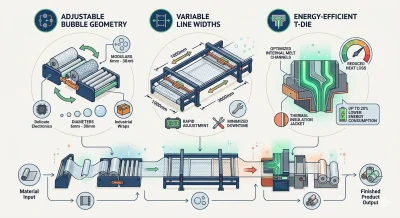
Depending on the machine configuration, suitable forming rolls, vacuum systems, cooling arrangements, and traction controls can be selected for the required bubble structure. Interchangeable forming components can also provide greater flexibility when manufacturers need to produce multiple specifications.
Web width should be selected according to the actual packaging format and downstream converting process. A wider machine is not necessarily better if the additional capacity is rarely used. Matching the working width to the expected order range can help maintain a practical balance between production flexibility, floor space, and equipment investment.

Multilayer Structures for Functional Applications
Some protective packaging applications require functions beyond basic cushioning. Multilayer structures can be designed to incorporate materials with specific properties when required.
EVOH and Nylon, for example, can be used in certain multilayer structures to improve gas barrier performance. Their suitability depends on the complete material combination, layer thickness, processing conditions, and final application.
For moisture-sensitive products, precision components, or specialized industrial packaging, the final packaging structure should be evaluated through appropriate material and product testing. Adding more extrusion layers alone does not automatically guarantee a specific barrier performance.
A bubble film extrusion machine configured for multilayer production can provide the processing flexibility needed for these applications when the extrusion units, die, temperature control, and material distribution are properly matched.
Automation and Process Control
Automation can help manufacturers maintain more consistent production conditions. A PLC-based control system can coordinate important parameters such as extrusion temperature, machine speed, traction, and cooling.
An HMI provides operators with a centralized interface for parameter adjustment and production monitoring. Stable control of these variables can support consistent bubble structure, thickness, and product appearance during continuous production.
For manufacturers producing multiple specifications, parameter management and recipe storage can also make repeated production easier to organize. Energy efficiency should likewise be considered through heating control, insulation, extrusion components, and cooling management. Actual energy consumption varies according to materials, specifications, production speed, and operating conditions.
A Production Solution Built Around Your Requirements
Customization is most effective when it focuses on the functions that directly support the customer's products and production process. The goal is not to add unnecessary equipment features, but to create a suitable combination of extrusion, forming, cooling, control, and optional laminating systems.
Our bubble film extrusion machine solutions can be configured according to different product specifications, material requirements, and production targets. From multilayer extrusion and forming systems to PLC control and optional inline lamination, each configuration can be evaluated according to the customer's actual production needs.
By providing your required film width, thickness, bubble size, raw materials, output target, and application, you can work with our technical team to determine a suitable bubble film extrusion machine configuration for your production line.