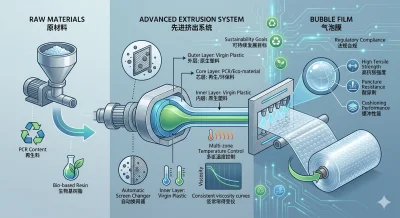
The use of eco-friendly materials, such as post-consumer recycled (PCR) content and bio-based resins, in bubble film production has become essential for meeting global sustainability standards. While these materials offer environmental benefits, their integration into bubble film manufacturing presents specific technical challenges that require advanced machinery and expertise.
Benefits of Eco-friendly Materials in Bubble Film Production
- Sustainability
Eco-friendly materials help reduce the environmental impact of packaging by promoting recycling and supporting the use of renewable resources. This aligns with global sustainability goals and helps businesses stay competitive in an eco-conscious market. - Enhanced Film Performance
When processed correctly, eco-friendly materials can deliver a reliable product with high tensile strength, puncture resistance, and cushioning performance. By optimizing material flow and ensuring uniform wall thickness, bubble film machines can produce high-quality, protective packaging for a variety of applications. - Compliance with Regulations
Using sustainable materials helps businesses meet stricter regulations regarding plastic waste reduction and environmental standards, making it easier to comply with both local and international laws.
Technical Challenges of Using Eco-friendly Materials
- Narrow Thermal Processing Window
Eco-friendly materials, such as PCR content, often have inconsistent melt flow indices (MFI) and impurities. This can result in issues like bubble instability and gauge variation, which affect the film’s consistency and performance. - Processing Complexity
The sensitivity of eco-materials requires precise extrusion control. Modern bubble film machines address this by incorporating multi-zone temperature profiling to manage the viscosity of eco-resins. This ensures uniform melt flow and stable processing, even with challenging materials. - Contamination and Blockage
PCR materials may contain contaminants that can block the extrusion die, leading to downtime and waste. Advanced bubble film machinery is equipped with automatic screen changers that filter out impurities and maintain melt homogeneity, ensuring smooth production without interruptions.
Solution: Advanced Bubble Film Machinery
To overcome these challenges, advanced bubble film machines are engineered with the latest technology to process eco-friendly materials effectively. Features like multi-layer co-extrusion, precise temperature control, and high-performance screen changers help maintain high film quality and consistent output.
- Multi-layer Co-extrusion: Eco-friendly materials, such as PCR, can be placed as a core layer between pristine outer layers, optimizing both cost and performance. This results in a product with a high recycled content while maintaining a smooth, printable surface.
- Temperature Control: Precise multi-zone temperature profiling ensures stable processing and uniform film quality, even when handling eco-resins with varying viscosities.
- Automatic Screen Changers: Continuous filtration of PCR materials prevents contaminants from entering the system, ensuring that the film produced is free from blockages and defects.
Conclusion
Eco-friendly materials offer significant environmental benefits but require specialized equipment to address the technical challenges they present in bubble film production. Investing in advanced machinery with precise control over extrusion and processing helps ensure that sustainability goals do not compromise film quality, performance, or productivity. As material science continues to evolve, advanced bubble film machines offer the flexibility to adapt to new sustainable materials, future-proofing your production and maintaining high-quality output in an eco-conscious market.