Growing Demand for Sustainable Protection in Laboratory Packaging
Laboratory packaging requires a higher level of protection compared with ordinary commercial packaging applications. Fragile glassware, diagnostic specimens, optical components, and precision instruments must remain secure during storage, internal transportation, and global distribution. Any damage caused by impact, vibration, moisture, or contamination may result in sample loss, equipment failure, or increased operational costs.
Traditional plastic cushioning materials can provide basic shock absorption, but they often face challenges related to sustainability, transparency, and specialized performance requirements. With the increasing demand for environmentally responsible packaging solutions, biodegradable PLA bubble film has become an attractive alternative for scientific and pharmaceutical applications.
A reliable bubble film manufacturing machine provides the production foundation for creating high-quality PLA protective materials. Through advanced extrusion technology, precise temperature control, and multi-layer film structures, manufacturers can produce bubble films that combine cushioning performance, optical clarity, and environmental advantages for laboratory packaging needs.
Challenges of Traditional Laboratory Packaging Materials
Limited Protection Performance for Fragile Laboratory Products
Laboratory products often include delicate glass containers, test tubes, medical sample bottles, analytical instruments, and research equipment with strict handling requirements. During transportation, these products may experience sudden impacts, compression forces, and repeated vibrations caused by automated sorting systems or courier networks.
Conventional packaging methods such as paper wrapping, single-layer plastic sheets, or standard protective films may not provide sufficient energy absorption. Without an effective cushioning structure, external forces can directly transfer to fragile items, increasing the possibility of cracks, breakage, or sample contamination.
For laboratory packaging suppliers, the key challenge is developing a protective material that can distribute impact forces evenly while maintaining lightweight characteristics. Bubble film solves this problem through its air-filled bubble structure, which works as a cushioning layer between the product and external impact sources.
Difficulties in Balancing Transparency, Safety, and Sustainability
Laboratory environments require packaging materials that are not only protective but also easy to identify and handle. Transparent packaging allows technicians and warehouse operators to quickly check product labels, sample information, and packaging conditions without unnecessary opening procedures.
However, many traditional plastic packaging materials create environmental concerns due to their dependence on conventional polymers and limited recyclability. In industries such as pharmaceuticals, medical testing, and scientific research, sustainability targets are becoming increasingly important.
PLA-based bubble film offers a balance between visibility, protection, and environmental responsibility. Produced from renewable resources, polylactic acid (PLA) provides excellent transparency and a cleaner packaging appearance while supporting companies seeking alternatives to traditional petroleum-based plastics.
Production Challenges of PLA Bubble Film
Although PLA provides significant advantages, manufacturing high-quality PLA bubble film requires precise processing control. Compared with conventional polyethylene materials, PLA has a narrower processing temperature range and requires stable extrusion conditions to achieve consistent film quality.
A standard bubble film machine may struggle with maintaining uniform bubble formation, stable thickness, and smooth surface performance when processing biodegradable polymers. Manufacturers need equipment capable of controlling melt temperature, cooling efficiency, extrusion pressure, and film forming accuracy.
A modern bubble film manufacturing machine must therefore provide flexible material compatibility, accurate process control, and reliable operation to support the production of advanced PLA protective films.
Application Value of Biodegradable PLA Bubble Film in Laboratory Packaging
Providing Reliable Cushioning Protection for Glassware and Sensitive Instruments
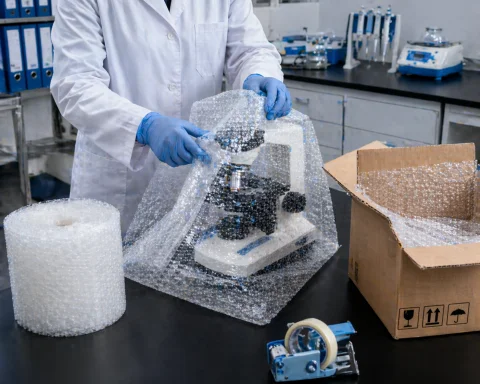
The primary function of bubble film in laboratory packaging is to create a protective buffer layer around fragile products. The air-filled bubble structure absorbs external impact energy and reduces direct contact between packaged items and surrounding materials.
For laboratory applications, PLA bubble film can be used for protecting:
- Laboratory glass bottles and containers
- Test tubes and sample storage tubes
- Medical diagnostic packaging components
- Optical instruments and precision devices
- Research equipment accessories
By improving shock absorption performance, bubble film helps reduce transportation risks during domestic and international logistics. The lightweight structure also minimizes additional packaging weight while maintaining effective protection.
Supporting Transparent and Clean Packaging Requirements
High-clarity PLA bubble film provides important advantages in laboratory environments where product identification is essential. Transparent film allows operators to inspect packaged items quickly and confirm product conditions without removing protective layers.
The smooth surface of PLA bubble film also supports clean handling procedures. Compared with some traditional packaging materials, properly processed PLA films can provide a low-odor and residue-free packaging experience, making them suitable for applications where packaging cleanliness is an important consideration.
For pharmaceutical and scientific supply chains, this combination of visibility and protection improves packaging efficiency while reducing unnecessary handling steps.
Meeting Sustainable Packaging Goals in Scientific Industries
Sustainability has become a growing requirement across medical, pharmaceutical, and research industries. Organizations are increasingly evaluating packaging materials based on environmental impact, resource efficiency, and compliance with internal sustainability programs.
Biodegradable PLA bubble film helps packaging manufacturers provide greener solutions by reducing dependence on traditional plastic materials. When combined with efficient production technology, PLA film production can support lower material consumption and more sustainable packaging strategies.

How a Bubble Film Manufacturing Machine Supports Laboratory Packaging Production
Multi-Layer Extrusion Technology for Functional PLA Bubble Film
Different laboratory applications require different levels of protection and functional performance. A professional bubble film manufacturing machine can be configured with multiple extrusion layers to produce customized film structures.
A 2-layer bubble film production line is suitable for standard protective packaging applications where cost efficiency and stable cushioning performance are the main requirements.
A 3-layer or 5-layer bubble film machine provides greater flexibility by allowing manufacturers to combine different materials and functional layers. For example, the outer layer can improve transparency and surface quality, while inner layers can enhance cushioning performance or incorporate special additives such as anti-static properties.
A 7-layer bubble film production system is designed for advanced applications requiring higher performance, improved barrier characteristics, and optimized material combinations. This configuration is suitable for large-scale packaging producers serving pharmaceutical and laboratory markets.
Precision Control for Stable Film Quality
The production quality of PLA bubble film depends heavily on accurate process control. Advanced bubble film manufacturing machines integrate precise temperature regulation systems, stable extrusion components, and automated control technologies to maintain consistent film performance.
Servo-driven systems and optimized cooling designs help maintain stable operation during continuous production. These technologies allow manufacturers to produce reliable bubble film rolls that meet the quality expectations of laboratory packaging suppliers.
Flexible Production Solutions for Different Market Requirements
Laboratory packaging manufacturers often serve diverse customers with different material requirements. A flexible bubble film manufacturing machine allows producers to adjust production parameters according to application needs.
The equipment can support biodegradable PLA materials, traditional polymers, and functional additives depending on the final packaging requirements. Quick material changeover capability also improves production flexibility for manufacturers handling customized orders.
With adjustable film thickness, bubble dimensions, and layer structures, producers can develop solutions ranging from lightweight laboratory wrapping materials to higher-performance protective packaging products.
High-Performance Bubble Film Manufacturing Machines
The development of sustainable laboratory packaging requires not only advanced materials but also reliable manufacturing technology. Biodegradable PLA bubble film provides an effective solution for protecting fragile glassware, diagnostic specimens, and sensitive instruments while supporting modern environmental objectives.
A professional bubble film manufacturing machine enables packaging manufacturers to achieve stable extrusion performance, precise film quality, and flexible production capabilities. With advanced multi-layer technology, accurate process control, and compatibility with sustainable materials, our bubble film machines help customers produce high-performance protective films for laboratory, medical, and scientific applications.
By combining equipment reliability with customized production solutions, we support packaging manufacturers in developing safer, greener, and more competitive protective packaging products for global markets.