Compliant with Carbon Footprint Regulations: How Our Bubble Film Extrusion Machine Perfect Recycled LDPE Blending
2026-05-26
Global packaging regulations enforce strict carbon footprint limits. Consequently, manufacturers must incorporate recycled low-density polyethylene (rldpe) into bubble film production. However, rldpe exhibits inconsistent melt flow indices and degraded mechanical properties. Reprocessing causes molecular chain scission and material contamination. This variability leads to bubble instability, thickness irregularities, and frequent web breaks on conventional extrusion lines. Our advanced bubble film extrusion machines solve these bottlenecks to ensure sustainability compliance without sacrificing throughput.
Advanced Screw Engineering for Material Homogenization
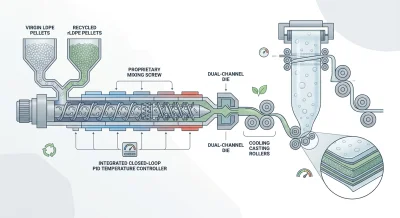
Processing high-recycled-content formulas requires precise thermal and mechanical control. Our machinery lineup handles these demanding material blends through proprietary mixing screw geometries and precision thermal control systems. The specialized barrier mixing sections generate intensive shear and distributive mixing. This process effectively homogenizes the recycled fraction with virgin polymer to stabilize melt viscosity.
Simultewise, multi-zone barrel heating and adaptive air ring cooling maintain a consistent thermal profile across the die circumference. This synchronized thermal management eliminates localized melt temperature fluctuations that cause bubble oscillation.
Configuration-Specific Solutions for Recycled Polyethylenes
Different machinery configurations deploy targeted technical mechanisms to stabilize the extrusion process:
- 7-Layer High-Speed Bubble Film Machine: Grooved feed sections and high-dispersion mixing pins ensure even dispersion of recycled pellets. Closed-loop PID temperature controllers hold melt temperatures within a tight ±1.5°C range. This delivers exceptional bubble stability at speeds exceeding 120 meters per minute, even with rldpe content up to 40%.
- 3–5-Layer High-Speed and Medium-Speed Machines: A multi-stage screw with integrated decompression zones minimizes shear heating. This configuration preserves the residual mechanical strength of the recycled material during multi-layer co-extrusion.
- 2-Layer High-Speed and Medium-Speed Machines: A dual-channel die design with separate thermal zones prevents cross-layer interference. This setup maintains consistent lay-flat widths during high-speed runs.
- 2-Layer and 3–5-Layer Low-Speed Machines: These robust lines offer accessible processing for diverse film thicknesses. Energy-efficient servo drives consume 15% less power per kilogram of output, directly lowering operational power requirements.
Measurable Performance and Regulatory Compliance
Optimizing the rldpe blending process directly improves final product properties and machine efficiency:
- Flawless Bubble Stability: Enhanced melt uniformity reduces scrap rates caused by bubble fluttering and film tearing.
- High Recycled Content: The system enables stable production with up to 50% post-consumer recycled content. This capability meets EU Packaging Waste Directive targets and California's SB 54 regulations.
- Preserved Film Quality: Precise extrusion allows downgauging into thinner categories (15–30 microns) while maintaining standard puncture resistance and tensile strength.
From producing high-speed e-commerce cushioning on a 2-layer low-speed bubble film machine to manufacturing complex industrial protective wraps on a 7-layer high-speed bubble film machine, our hardware design ensures stable, compliant, and highly efficient manufacturing