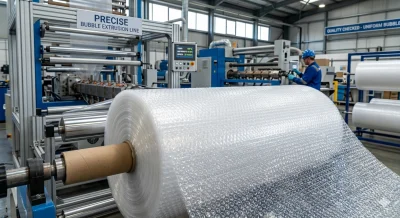
For procurement specialists sourcing bubble film extrusion equipment, understanding the engineering factors that influence product consistency is essential. Among these, thermal uniformity throughout the extrusion system is one of the most critical parameters affecting both product quality and process stability.
During extrusion, variations in temperature along the barrel can lead to changes in melt viscosity. Since polymer flow behavior is highly temperature-dependent, even small thermal gradients may result in uneven material distribution at the die. This can contribute to thickness variations, affecting both mechanical performance and material efficiency. Thin areas may reduce cushioning strength, while thicker مناطق can lead to unnecessary material consumption and downstream processing challenges.
To address these issues, heavy-wall barrel designs are commonly used to improve thermal stability. The increased mass of the barrel enhances thermal inertia, allowing it to retain and distribute heat more evenly. This helps reduce localized temperature fluctuations and creates a more stable thermal profile along the extrusion path. As a result, the polymer melt reaches the die under more consistent conditions, supporting improved thickness control and overall product uniformity.
A stable thermal environment also contributes to better process efficiency. When heat loss is minimized, heating elements require less frequent adjustment to maintain set temperatures. This reduces energy consumption and limits temperature cycling, which can otherwise affect both equipment performance and material properties. In addition, more consistent processing conditions can help reduce the occurrence of defects associated with thermal instability, such as degradation or uneven melt flow.
From an operational perspective, evaluating an extrusion system should involve more than nominal output capacity or line speed. Factors such as barrel design, heating zone configuration, and temperature control strategy all play important roles in determining long-term performance. A well-balanced thermal system supports consistent production, reduces variability, and contributes to more efficient use of both energy and raw materials.
In summary, thermal uniformity is a fundamental requirement for achieving stable and controlled bubble film extrusion. Equipment designed with appropriate thermal management considerations can provide measurable benefits in product consistency, process reliability, and overall operational efficiency.