ROI Analysis of Bubble Film Extrusion Machine Investment
2026-09-04
For manufacturers of protective packaging, investing in production equipment is a decision that affects both immediate capital expenditure and long-term operating costs. As demand for protective packaging continues to develop across e-commerce, logistics, electronics, industrial products, and other sectors, producers are under increasing pressure to maintain consistent quality while controlling production expenses.
A bubble film extrusion machine is therefore more than a piece of production equipment. Its configuration, output capacity, automation level, energy efficiency, and maintenance requirements can all influence the cost of producing bubble film over its service life. A practical investment assessment should consider total cost of ownership (TCO), production efficiency, material utilization, and potential revenue opportunities rather than focusing only on the initial equipment price.
Cost Challenges in Traditional Bubble Film Production
Energy consumption is one of the operating factors that manufacturers need to consider when evaluating bubble film production equipment. Extrusion, heating, cooling, air systems, traction, and winding all contribute to overall energy use. The actual energy cost per unit of production depends on machine configuration, operating conditions, material type, product specifications, and production efficiency.
Production stability is another important consideration. Variations in melt temperature, extrusion conditions, cooling, or traction can affect bubble formation and product thickness. When production conditions are not stable, manufacturers may need to make frequent adjustments or remove products that do not meet specifications. This can increase material consumption and reduce effective output.
Labor and maintenance also contribute to the total cost of operating a bubble film production line. Manual winding, parameter adjustments, roll changes, and routine inspections can require significant operator involvement, particularly on less automated equipment. At the same time, components such as screws, barrels, bearings, seals, and transmission parts require regular inspection and maintenance during normal operation.
Bubble Film Production and Protective Packaging Requirements
Bubble film is widely used for cushioning, surface protection, void filling, and packaging of products that may be exposed to impact or vibration during handling and transportation. Typical applications include electronics, glass products, furniture, household goods, industrial components, and e-commerce shipments.
Different applications require different bubble film specifications. Thickness, bubble size, layer structure, raw material selection, and mechanical properties can all be adjusted according to the intended use. For example, packaging for lightweight consumer products may require a different structure from packaging designed for larger or more sensitive industrial components.
Product consistency is particularly important for packaging manufacturers supplying customers with repeat orders. Stable bubble dimensions and film thickness help maintain predictable packaging performance and make it easier for downstream users to select an appropriate amount of packaging material.
For this reason, the performance of a bubble film extrusion machine should be considered together with the final product requirements. Equipment capable of supporting the required specifications consistently can help manufacturers build a more controlled production process.
How Modern Bubble Film Extrusion Machines Can Improve ROI
Multi-Layer Extrusion for Flexible Product Development
Multi-layer extrusion technology provides manufacturers with greater flexibility when developing bubble film structures. Different layers can be designed for specific functions, depending on the material system and product requirements.
Multi-layer configurations can support applications where producers need to balance cushioning, strength, sealing characteristics, appearance, or other film properties. This flexibility can allow manufacturers to serve a broader range of packaging requirements without relying on a single product specification.
From an ROI perspective, the value of multi-layer technology is not simply related to machine complexity. Its economic benefit depends on whether the additional production capability matches actual market demand and allows the equipment to maintain a useful utilization rate.
Temperature Control and Process Stability
Temperature management is fundamental to extrusion production. A bubble film extrusion machine normally uses multiple temperature control zones to regulate the heating process from material feeding through extrusion and forming.
Stable processing conditions help operators maintain more consistent melt behavior and support uniform film formation. Appropriate machine design, temperature control, extrusion components, and operating parameters work together to influence the final product.
For manufacturers, better process control can also make production adjustments more predictable. However, actual product performance depends on the selected materials, formulation, machine configuration, and production conditions, so equipment evaluation should include testing with the intended raw materials whenever possible.
Automation and Labor Efficiency
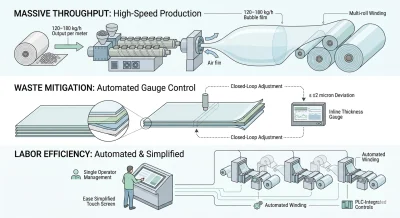
Automation can influence production costs by reducing repetitive manual operations and providing operators with more centralized control over the production process.
PLC-based control systems and touch-screen interfaces can simplify parameter management, while automated winding and tension-control systems can support more consistent roll handling. The actual labor benefit depends on the machine configuration and the factory's existing production organization.
Rather than assuming a fixed reduction in labor requirements, manufacturers can evaluate the number of operators currently required for each production line and compare this with the staffing requirements of the proposed equipment.
Output and Material Utilization
Production capacity is another major factor in ROI calculations. A machine with suitable output capacity can help manufacturers produce more saleable material within the available operating time and distribute fixed production costs across a larger volume of products.
However, rated machine output should not be treated as guaranteed production output. Actual capacity can vary according to film thickness, bubble size, material properties, layer structure, machine settings, and operating conditions.
Material utilization should also be evaluated alongside output. Stable extrusion and thickness control can help reduce unnecessary variation and improve the consistency of finished products. For high-volume production, even relatively small differences in material consumption can become significant when calculated across annual production volumes.
From Equipment Investment to Production Efficiency
The ROI of a bubble film extrusion machine depends on much more than its initial purchase cost. Production capacity, material utilization, energy consumption, labor requirements, maintenance, product consistency, and equipment utilization all contribute to the long-term economic value of an extrusion line.
For manufacturers planning to increase production capacity, improve product consistency, or expand their bubble film product range, a detailed TCO and ROI evaluation can provide a practical basis for equipment investment. Matching machine configuration with actual materials, specifications, production volumes, and market requirements is essential for achieving sustainable operating efficiency.
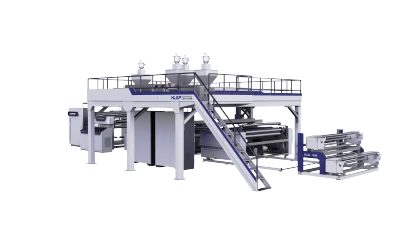
Our bubble film extrusion machines are developed with a focus on stable extrusion, practical production control, flexible product configurations, and long-term manufacturing requirements. With equipment options suited to different bubble film structures and production needs, we help packaging manufacturers build production lines that balance product quality, operating efficiency, and long-term equipment value.