Advantages of Using PLA Raw Materials in Bubble Film Making Machine

2026-08-26

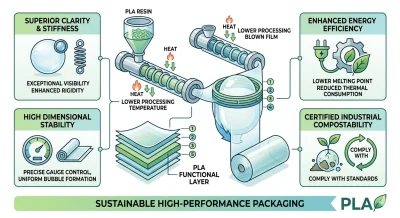
As sustainability requirements become an increasingly important part of packaging procurement, more manufacturers are exploring PLA (polylactic acid) as an alternative to conventional polyolefins. PLA offers several useful characteristics for packaging applications, including good clarity, stiffness, and compostability under appropriate conditions. However, processing PLA is not simply a matter of replacing one raw material with another. Its thermal and mechanical characteristics differ from those of materials such as LDPE, particularly in areas such as melting behavior, cooling response, and shrinkage. As a result, a bubble film making machine configured primarily for traditional polyethylene materials may require specific adjustments to process PLA consistently and maintain stable bubble formation.

Thermal and Process Control Challenges of PLA

Most bubble film production lines were engineered with polyolefins in mind, and that design bias shows up the moment PLA enters the process. Extrusion temperature zones calibrated for LDPE or similar resins tend to run hotter than PLA actually needs, and pushing a lower-melting-point polymer through a temperature profile built for a higher-melting-point one invites thermal degradation, reduced clarity, and unstable bubble structure — the opposite of what makes PLA attractive in the first place.

Precision is the other recurring problem. PLA's low shrinkage rate and strong dimensional stability are genuine technical advantages, but only if the equipment processing it can actually hold tight, consistent control over pressure and gauge. Machines without fine-grained thermal and pressure control tend to squander that advantage, producing thickness variation and uneven bubble formation that PLA, properly processed, shouldn't exhibit at all. On top of that, many multi-layer systems are tuned for a fixed set of polyolefin-based materials, making it difficult to integrate PLA as a functional or outer layer without compromising the performance of the layers around it. For manufacturers under pressure to meet compostability standards like EN 13432 or ASTM D6400, the lack of equipment flexibility often becomes the real barrier to actually switching materials — not cost, and not material performance.

Bubble Film Sample.jpg

Applications for PLA Bubble Film

Premium and display-oriented consumer packaging depends heavily on product visibility — customers expect to see what they're buying through the packaging itself. PLA's high optical clarity and structural stiffness are a natural fit here, delivering the kind of crisp, transparent presentation that standard polyolefin bubble film often can't match at comparable gauge.

Food and fresh produce packaging brands are under growing pressure to carry credible low-carbon and compostable claims, and PLA's certified industrial compostability makes it a strong candidate for outer cushioning layers or standalone protective packaging in this space. The catch is that food brands still need dependable cushioning and sealing performance — a compostable claim means little if the product arrives damaged.

Electronics manufacturers with active ESG commitments are increasingly interested in incorporating degradable materials into their packaging without giving up the functional protection their products require — antistatic properties, cushioning, and puncture resistance chief among them. For this group, PLA is attractive mainly as a component within a broader multi-layer structure rather than a wholesale material replacement.

How Our Bubble Film Making Machines Support PLA Processing

We designed the thermal control systems of our bubble film making machines to provide the temperature flexibility required for PLA processing, rather than relying on fixed settings developed primarily for conventional polyolefins. Extruder barrel and die temperature zones can be adjusted according to the specific processing requirements of PLA, helping reduce the risk of overheating and unnecessary thermal losses. For display and premium packaging applications, stable thermal conditions also help preserve the material's optical clarity and dimensional characteristics during extrusion.

This control extends to film formation and dimensional stability. Our systems are designed to provide consistent processing conditions across the film width, helping maintain uniform thickness and stable bubble formation across different production speeds. For food and fresh produce packaging, consistent film structure can support reliable cushioning and sealing performance while allowing manufacturers to incorporate PLA where compostability is an important packaging requirement.

Multi-layer integration provides additional flexibility for electronics and other demanding applications. Across our 2-layer to 7-layer bubble film machine configurations, PLA can be incorporated as a functional or outer layer depending on the material formulation and final product requirements. It can be combined with other layers designed for cushioning, antistatic performance, or barrier properties, allowing manufacturers to explore PLA-based packaging structures without relying on PLA as the sole material. This approach provides greater flexibility for developing protective packaging that balances material requirements with the performance expected from the finished bubble film.

A Practical Path to Sustainable Packaging

The gap between PLA's potential and its real-world adoption has largely come down to processing equipment, not the material itself. A bubble film making machine engineered with PLA's specific thermal and dimensional characteristics in mind — rather than one simply repurposed from polyolefin production — is what allows manufacturers to capture the material's full advantages: superior clarity and stiffness for premium packaging, reliable cushioning performance for food and produce applications, and flexible multi-layer integration for electronics packaging that still needs functional protection. For producers evaluating a shift toward more sustainable raw materials, the equipment question deserves the same attention as the material selection itself, because even the best-suited polymer can only perform as well as the machine processing it allows.

Advantages of Using PLA Raw Materials in Bubble Film Making Machine

GET IN TOUCH NOW

*We respect your privacy. When you submit your contact information, we agree to only contact you in accordance with our Privacy Policy.