How Bubble Film Extrusion Machine Strengthen Brand Competitiveness
2026-09-01
Packaging has quietly shifted from a background cost to a visible measure of brand reliability. When a customer unboxes a product and finds it intact, that experience reflects back on the brand as much as the product itself — and when it arrives damaged, the packaging failure becomes the brand's failure in the customer's eyes. For manufacturers and brand owners alike, the bubble film extrusion machine behind that protective layer has become a strategic decision, not just a procurement line item.
Where Conventional Bubble Film Production Falls Short of Brand Expectations
Single-layer extrusion lines remain common, but they force a difficult trade-off between protection and cost. Without the ability to assign different functions to different layers — abrasion resistance on the outside, energy-absorbing cushioning in the core, reliable sealing where it matters most — a single-layer machine can only offer a generalized compromise rather than film engineered for a specific protection need. That compromise shows up downstream as inconsistent cushioning performance, and inconsistent cushioning performance shows up as damaged goods, unhappy customers, and reviews that reflect on the brand rather than the carrier.
Thickness control compounds the problem. Machines without closed-loop gauge monitoring tend to run wider tolerances, which means more resin gets used than the application actually requires, and material efficiency suffers as a result. That inefficiency has become harder to justify as sustainability expectations have shifted from a nice-to-have to a baseline requirement — brand owners are increasingly expected to demonstrate real material efficiency and recycled-content capability throughout their supply chain, and a production line that can't compatibly process post-industrial recycled resin without sacrificing film stability puts that expectation out of reach.
Automation and traceability gaps create a third layer of exposure. Conventional lines that lack real-time HMI monitoring and automatic die centering tend to carry higher scrap rates from avoidable die misalignment, and without production data logging, there's no record to point to when a buyer or logistics partner asks for proof of consistent quality control. For brand owners working with major retail platforms or global logistics partners, that absence of traceable data isn't just an inconvenience — it can be the difference between passing and failing a supplier audit.
Why Bubble Film Performance Shapes Brand Reputation Across Industries
These gaps matter differently depending on who's relying on the film, but in every case, the film's performance becomes an extension of the brand behind it.
For private-label brands selling through cross-border e-commerce platforms, packaging consistency has become a genuine differentiator. Customers rarely see the factory, but they always see the unboxing experience, and a damaged product traced back to inadequate cushioning does lasting damage to review scores and repeat purchase rates — damage that's far more expensive to repair than the packaging itself would have cost to get right.
For consumer packaged goods and personal care brands under growing sustainability pressure, packaging suppliers are being asked to prove recycled-content capability and material efficiency, not just claim it. A production process that can't maintain film stability while running recycled resin leaves brand owners unable to back up their sustainability commitments with a verifiable supply chain.
For industrial equipment manufacturers exporting to large-scale buyers and global logistics networks, packaging quality is scrutinized as part of broader supplier audits. Buyers increasingly expect documented, traceable quality data across every stage of production, and a supplier that can't provide it faces a harder path to qualifying for — and keeping — high-value contracts.
How Our Bubble Film Extrusion Machine Turns These Advantages Into Brand Value
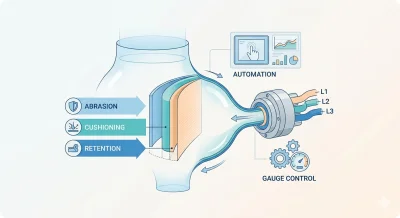
Our bubble film extrusion machines use multi-layer co-extrusion technology to give different layers specific functional roles. Depending on the film structure, outer layers can provide abrasion and puncture resistance, while inner layers are designed for cushioning performance, flexibility, air retention, or sealing strength. This layered approach allows the film structure to be matched more closely to the requirements of e-commerce packaging, consumer goods, and industrial cushioning applications.
Material efficiency is supported through integrated gauge control, which helps maintain more uniform film thickness and bubble geometry across the film width. More consistent extrusion can reduce unnecessary resin consumption during production, while compatibility with suitable post-industrial recycled resins gives producers greater flexibility when adjusting material formulations without compromising process stability.
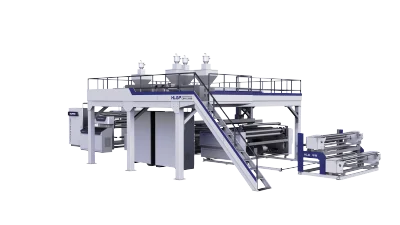
Production configurations can also be selected according to required output and application. Higher-speed lines are suited to continuous, high-volume production, while medium- and lower-speed configurations can provide greater process flexibility for specialized or smaller-volume applications. This allows the extrusion system to be matched to actual production requirements rather than relying on a single machine configuration for every application.
Automation provides an additional layer of process consistency. Touchscreen HMI controls allow operators to monitor key parameters such as temperature and line speed, while automatic die centering can help maintain more uniform film quality and reduce material waste. Integrated production data and parameter records also make it easier to reproduce established settings across different production runs and shifts.
Together, these capabilities support more stable bubble film production through controlled thickness, consistent bubble formation, flexible material selection, and repeatable operating conditions. For producers evaluating a bubble film extrusion machine, these process-control features can have a more direct impact on long-term production efficiency and film quality than headline output capacity alone.