Why High-Performance Bubble Film Extrusion Machine Fits Export Markets
2026-09-17
Export logistics subject packaging to a level of punishment that domestic distribution rarely matches. A container crossing multiple regions can endure weeks of vibration, stacking pressure, humidity changes, and repeated loading and unloading before reaching the buyer's warehouse. Under these conditions, packaging performance becomes critical. A bubble film extrusion machine designed for demanding export applications needs to deliver more than high output; it must produce stable film quality that maintains its cushioning and protective properties throughout long-distance transportation.
Where Conventional Extrusion Lines Fall Short
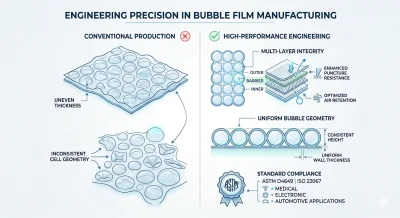
Bubble film produced on outdated or poorly calibrated equipment can develop uneven wall thickness, inconsistent bubble dimensions, and unstable air retention. These defects may appear minor during production but can become significant when packaged goods experience repeated vibration and compression during transportation. Localized weak areas can tear under concentrated stress, reducing the film's ability to protect the product throughout the shipment.
Single-layer film can also limit performance when exporters need greater puncture resistance, cushioning, or structural stability. Electronics, automotive components, furniture, and other higher-value goods often require packaging that can withstand more demanding handling conditions.
At the same time, exporters supplying overseas customers may need to demonstrate compliance with specific testing requirements or packaging standards. If an existing production line cannot maintain stable process conditions, achieving repeatable test results becomes more difficult and can increase qualification time. The underlying challenge is often a familiar one: improving production speed without sacrificing thickness consistency and film quality.
The Role Bubble Film Plays in Global Trade
Within the logistics chain, bubble film provides a protective layer against mechanical impact, vibration, abrasion, and compression. It cushions packaged goods against contact with other products and helps reduce the risk of surface damage during loading, transportation, and unloading.
Different export products require different levels of protection, so film construction needs to match the application. A lightweight consumer product may require a different structure from precision instruments, fragile components, or large furniture pieces. This is where 2-layer, 3-to-5-layer, and 7-layer configurations give manufacturers greater flexibility in balancing cushioning performance, material consumption, and production requirements.
For suppliers serving overseas customers over the long term, stable film quality also supports more consistent internal quality control and customer qualification processes. When packaging performance remains predictable from batch to batch, manufacturers can reduce the risk of variations that lead to complaints, rework, or additional testing.
Multi-Layer Structure for Demanding Applications
A high-performance bubble film extrusion machine can use co-extrusion technology to combine multiple resin layers within a single film structure. Instead of relying on one formulation for every performance requirement, different layers can be designed to contribute specific properties such as toughness, flexibility, puncture resistance, or material efficiency.
This approach is particularly useful for furniture and home-goods exporters. Wooden edges, metal fittings, and glass components can create concentrated abrasion during long-distance transportation. A properly engineered multi-layer structure can provide greater resistance to tearing while maintaining the cushioning function of the air bubbles.
The advantage is not simply adding more layers. The real value lies in assigning the right material and thickness to each layer according to the intended application, allowing manufacturers to balance protection with overall film weight and resin consumption.
Precision Die Design for Consistent Cell Geometry
Bubble height and wall thickness directly influence cushioning consistency across the film width. Advanced die systems and stable extrusion conditions help maintain more uniform bubble geometry, reducing variations that can create weak areas or inconsistent cushioning.
This becomes increasingly important when packaging heavy, fragile, or precision-machined components. If one section of a roll has noticeably different bubble dimensions from another, the protective performance may vary across the packaged surface.
A bubble film extrusion machine with precise die control and stable melt distribution can therefore provide more consistent film quality during extended production runs. Instead of relying solely on occasional spot checks, manufacturers can build greater process stability into the production stage itself.
Consistent Quality for Export Requirements
Export customers often require suppliers to provide documented product performance and repeatable quality control. The specific standards and testing methods depend on the application, destination market, and customer's requirements, so manufacturers should verify the relevant standards before specifying a machine or film structure.
A stable extrusion process helps manufacturers produce film with more consistent thickness, bubble dimensions, mechanical properties, and appearance. This makes quality verification more predictable and can simplify communication with overseas buyers during product qualification.
Rather than treating compliance as a final inspection step, manufacturers can build process control into everyday production. Stable temperature, pressure, material dosing, and film forming conditions create a stronger foundation for repeatable test results.
Configuration Range Matched to Export Diversity
No single bubble film specification is ideal for every category of export cargo. This is why a production range covering 2-layer, 3-to-5-layer, and 7-layer configurations can be valuable for manufacturers serving multiple markets.
Lightweight packaging applications may prioritize material efficiency and production cost, while fragile electronics, industrial components, or other high-value cargo may require greater cushioning and puncture resistance. A higher-layer configuration can provide more opportunities to distribute functional properties across the film structure.
Production speed is another consideration. Manufacturers with different order volumes may need low-speed, medium-speed, or high-speed equipment depending on their output requirements. A flexible machine portfolio allows production capacity and film construction to be matched more closely to actual export demand.
Process Stability Across Long Production Runs
Export orders can involve substantial production volumes, making consistency across an entire batch just as important as the specification of an individual roll. Automated monitoring of key process parameters such as temperature, pressure, and film speed can help operators identify deviations before they develop into larger quality problems.
Stable dosing and melt-flow control also contribute to more efficient resin use. When extrusion conditions remain consistent, manufacturers can reduce unnecessary thickness variation and minimize material lost through unstable production, start-up waste, or defective film.
Servo-driven systems can further support precise speed control and efficient machine operation. The actual energy and material savings depend on machine configuration, operating conditions, resin formulation, and production speed, but process optimization can have a meaningful effect on the cost of high-volume export production.
Built for the Realities of International Shipping
A bubble film extrusion machine designed for export-oriented production needs to address several requirements at the same time: stable film quality, appropriate layer configuration, precise bubble formation, efficient material use, and reliable operation over long production runs.
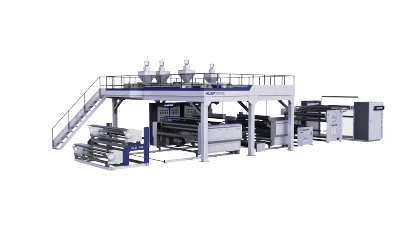
Our bubble film extrusion machines combine multi-layer co-extrusion, precision die systems, and automated process control across configurations from 2-layer to 7-layer and from lower-speed to high-speed production. This range allows manufacturers to select equipment according to their target film structure, output requirements, and export applications.
For manufacturers supplying protective packaging to international markets, the right extrusion configuration can help create a more consistent production process and more reliable film performance from the first roll to the last.