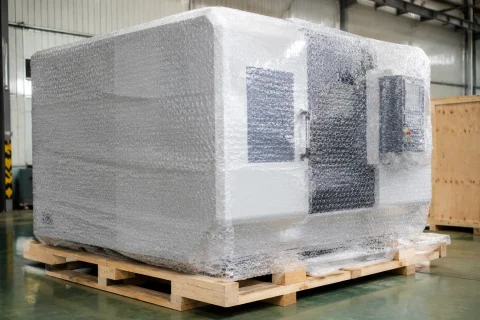
CNC machines, including multi-ton machining centers, Vertical Machining Centers (VMC), and Vertical Turning Lathes (VTL), are precision-engineered industrial assets that require reliable protection throughout global transportation. Unlike ordinary industrial products, CNC equipment integrates heavy mechanical structures with highly sensitive components such as spindles, linear guideways, ball screws, and electronic control systems. Any unexpected impact, vibration, or environmental exposure during shipping may affect machine accuracy and increase commissioning costs after delivery.
During long-distance road transportation and overseas ocean shipping, CNC machines face complex logistics conditions, including continuous vibration, loading impact, humidity changes, and salt exposure. To reduce these risks, manufacturers increasingly rely on high-performance protective packaging materials produced by an advanced bubble film manufacturing machine. Heavy-duty bubble film provides a flexible cushioning layer, surface protection, and moisture isolation capability, helping industrial equipment suppliers improve transportation safety and maintain product quality throughout international delivery.
Transportation Problems Faced by CNC Machines During Global Shipping
The transportation of CNC equipment requires careful consideration because of its size, weight, and precision structure. A machining center may weigh several tons, while its core processing components often require micron-level accuracy during operation. Even when the machine is properly fixed inside a container or transport vehicle, external forces during handling and shipping can create risks for sensitive components.
Mechanical vibration is one of the most common challenges during transportation. Road conditions, trailer movement, crane handling, and container shifting can generate repeated vibration and impact forces. These forces may gradually affect components such as spindle assemblies, linear guideways, and precision positioning systems if sufficient protective measures are not applied.
Improper handling during loading and unloading can also create sudden impact risks. Heavy industrial machines are commonly moved by forklifts, cranes, or lifting equipment, and unstable contact points or excessive pressure during handling may damage exposed surfaces. Sharp machine edges, exposed metal structures, and sensitive operating panels require additional protection to avoid scratches, deformation, or surface damage.
Ocean transportation creates another layer of difficulty. CNC machines shipped internationally may experience high humidity, salt spray, and condensation inside containers caused by temperature fluctuations. Exposed steel surfaces, including guide rails and precision mechanical parts, may develop corrosion when they remain unprotected in a humid marine environment for extended periods.
Electronic systems require special attention as well. Modern CNC machines depend on control cabinets, sensors, and electrical components to maintain machining accuracy and operational stability. Moisture intrusion, dust contamination, and electrostatic discharge may affect electronic performance and increase installation difficulties after arrival.
Why Traditional Packaging Materials Are Insufficient for Heavy Machine Protection
Traditional packaging methods for CNC equipment usually involve a combination of wooden cases, plastic wrapping, foam materials, and basic protective films. Although these methods can provide general protection, they may not always meet the requirements of heavy industrial equipment transportation.
Ordinary plastic films mainly provide surface coverage but offer limited cushioning performance. When exposed to sharp machine corners, strong fixing straps, or repeated friction during transportation, thinner packaging films may stretch, puncture, or lose their protective ability.
Foam cushioning materials can absorb impact energy, but long-term compression during storage and shipping may reduce their elasticity. In high-humidity marine environments, certain cushioning materials may also experience performance changes that affect their protective reliability.
For large CNC machines, another challenge is achieving complete and consistent coverage. Manual wrapping with multiple small pieces of packaging material can create weak connection areas, uneven protection thickness, and additional labor requirements. These limitations make it difficult for manufacturers exporting large quantities of industrial equipment to maintain stable packaging quality.
Compared with conventional materials, heavy-duty bubble film produced by a professional bubble film manufacturing machine provides improved flexibility, impact absorption, and wrapping efficiency. Its air-filled structure creates a protective buffer layer that helps distribute external forces and reduce direct contact between the machine surface and surrounding packaging materials.
How Heavy-Duty Bubble Film Protects CNC Machine Components
High-performance bubble film is designed to provide multiple layers of protection for industrial equipment. Through advanced co-extrusion technology, manufacturers can produce bubble film with optimized material combinations to achieve a balance between strength, flexibility, and cushioning performance.
One of the key advantages of heavy-duty bubble film is its shock absorption capability. Large air bubbles, such as 12 mm bubble structures, provide increased cushioning space compared with standard small-bubble materials. This structure helps absorb impact energy generated during transportation and reduces the transmission of external forces to sensitive CNC components.
Material formulation also plays an important role in protective performance. By combining LDPE, LLDPE, and mLLDPE materials, manufacturers can improve tensile strength, flexibility, and puncture resistance. This allows the bubble film to withstand external pressure, mechanical friction, and strong wrapping tension during industrial packaging operations.
For CNC machines with sharp metal edges and complex surface structures, high-strength bubble film provides a durable protective barrier. The flexible film can closely follow different equipment shapes while maintaining stable cushioning performance, reducing the risk of scratches and surface damage.
Moisture protection is another important function of industrial bubble film packaging. When combined with appropriate wrapping methods, bubble film helps reduce direct exposure to humidity, condensation, and contaminants. This additional protective layer is especially valuable for electronic control cabinets, precision components, and exposed metal surfaces during ocean transportation.
For export-oriented CNC manufacturers, customized bubble film widths also improve packaging efficiency. Wide-format bubble film allows larger sections of equipment to be wrapped continuously, reducing the number of joints and improving overall packaging integrity.
How Bubble Film Manufacturing Machines Produce High-Performance Industrial Packaging Materials
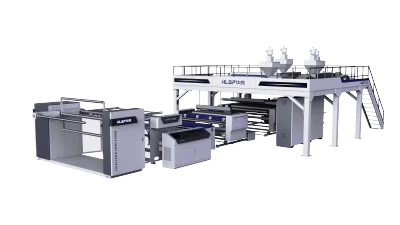
The quality of protective bubble film depends heavily on production stability and manufacturing precision. A professional bubble film manufacturing machine enables packaging producers to manufacture consistent materials suitable for demanding industrial applications such as CNC machine transportation.
Modern bubble film production lines are available with different layer configurations, including two-layer, three-to-five-layer, and seven-layer systems. Each configuration can be selected according to packaging requirements, production capacity, and cost considerations.
Two-layer bubble film machines provide an economical option for general industrial packaging applications. Flexible material combinations allow manufacturers to balance production efficiency and protective performance while maintaining stable output.
Three-to-five-layer bubble film machines are designed for higher-performance packaging requirements. Multiple extrusion layers allow better control of film strength, flexibility, and cushioning characteristics, making them suitable for large-volume industrial packaging production.
Seven-layer bubble film machines provide advanced material design capabilities for heavy-duty applications. Multiple layers enable manufacturers to optimize outer protection, internal cushioning, and overall mechanical strength, making them suitable for CNC machines, automation equipment, and other high-value industrial products.
Production accuracy is essential for maintaining reliable bubble film performance. Advanced extrusion systems use precise temperature control technology to maintain stable melt conditions. Extrusion temperature stability within approximately ±2°C helps improve material uniformity, reduce weak areas, and maintain consistent film quality.
Automatic thickness control and optimized die systems further improve production consistency by helping maintain uniform bubble diameter and film thickness across the entire roll. Stable thickness distribution ensures more predictable cushioning performance during heavy equipment packaging.
A closed-loop tension control system also improves finished roll quality by preventing excessive stretching during production. Combined with flexible cutting systems, manufacturers can produce customized bubble film widths ranging from narrow rolls to large industrial formats according to different packaging requirements.
Heavy-Duty Bubble Film Production Systems for Capital Equipment and CNC Packaging
Protecting high-value CNC machines during international transportation requires packaging materials with reliable thickness, strength, and consistency. Heavy industrial equipment cannot rely on basic wrapping methods alone, especially when exposed to vibration, humidity, and long-distance shipping conditions.
An advanced bubble film manufacturing machine provides packaging manufacturers with the ability to produce customized protective materials designed for CNC machining centers, VMC systems, VTL equipment, and other precision industrial machinery. Through multi-layer extrusion technology, accurate temperature control, stable production systems, and flexible configuration options, manufacturers can achieve higher packaging reliability and reduce transportation-related risks.
Our company specializes in the development and manufacturing of high-performance bubble film manufacturing machines, offering flexible solutions from two-layer to seven-layer production systems. With precise process control, customized film thickness options up to 150 microns, and advanced production technologies, our machines help industrial packaging suppliers create stronger and more reliable protective materials for global equipment transportation. Choosing our bubble film manufacturing machine means investing in safer logistics, improved packaging efficiency, and dependable protection for valuable CNC equipment worldwide.