Fast Lead Times: How China Factories Deliver Bubble Film Extrusion Machine Quicker
2026-08-18
The global packaging industry is experiencing rapid growth as e-commerce logistics, industrial transportation, electronics protection, and export packaging continue to expand. This market growth has created increasing demand for reliable and high-performance protective materials, especially bubble film products that provide lightweight cushioning, impact protection, and cost-effective packaging solutions.
However, equipment delivery speed has become a critical factor for manufacturers planning new production capacity. Traditional plastic machinery manufacturing processes often require 12 to 16 weeks or even longer for a complete production line delivery. Such extended lead times can delay business expansion, increase investment pressure, and cause manufacturers to miss valuable market opportunities.
Modern manufacturing strategies are changing this situation. Through modular engineering, vertical integration, standardized components, and optimized assembly systems, advanced manufacturers can significantly reduce production cycles while maintaining machine precision and reliability. A well-designed bubble film extrusion machine can now be delivered faster, helping packaging producers establish new production capabilities with greater efficiency.
Why Traditional Manufacturing Methods Create Long Equipment Lead Times
The long delivery cycle of traditional extrusion equipment is usually caused by several interconnected manufacturing limitations. Many conventional machine builders rely heavily on customized production processes, external suppliers, and sequential assembly methods, which increases uncertainty throughout the manufacturing process.
One major challenge comes from the design stage. Traditional customized extrusion systems often require completely new screw configurations, die structures, and mechanical solutions for every customer project. Engineers must redesign processing components from the beginning, perform repeated adjustments, and wait for individual manufacturing approval. This approach increases engineering time and extends the overall project schedule.
Supply chain dependence is another important factor affecting delivery speed. Key components such as cooling rollers, air rings, precision shafts, and special mechanical parts are sometimes produced by external suppliers. Any delay in casting, machining, surface treatment, or transportation can directly affect the final delivery date. Since these processes are controlled by different companies, manufacturers have limited ability to respond quickly when unexpected delays occur.
In addition, traditional assembly methods often follow a single-line production sequence. Extrusion units, cooling systems, traction sections, and winding systems are assembled one after another instead of being prepared simultaneously. This inefficient workflow creates unnecessary waiting periods and can extend the entire manufacturing cycle by several months.
The Growing Importance of Bubble Film Production in Modern Packaging
Bubble film has become an essential protective packaging material across multiple industries due to its excellent cushioning performance, lightweight structure, and flexible application range. From online retail shipments and warehouse logistics to electronic components and precision equipment transportation, bubble film provides reliable protection against vibration, impact, and surface damage.
As global supply chains become faster and more competitive, packaging manufacturers need equipment that can respond quickly to changing market requirements. Customers increasingly expect customized bubble film solutions, including different thicknesses, bubble sizes, material combinations, and performance characteristics.
At the same time, bubble film technology continues to evolve. Modern producers are moving beyond traditional single-layer structures and investing in advanced multi-layer co-extrusion technology. Three-layer, five-layer, and seven-layer bubble film production systems provide improved mechanical strength, better barrier performance, and optimized material usage.
For example, multi-layer structures allow manufacturers to combine different polymers such as LDPE, LLDPE, recycled materials, and functional additives in specific layers. This approach helps reduce raw material costs while maintaining the required protection performance. As a result, the demand for efficient and quickly deployable bubble film extrusion machine solutions continues to increase.
How Advanced Bubble Film Extrusion Machine Manufacturing Reduces Delivery Time
Modern equipment manufacturers are adopting new production strategies to overcome traditional delivery limitations. Instead of relying on fully customized manufacturing from the beginning, advanced factories combine standardized engineering platforms with flexible customization capabilities.
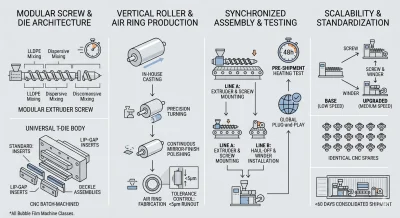
Modular Screw and Die Architecture for Faster Production
A modular design concept is one of the most effective methods for shortening equipment manufacturing time. By using pre-validated screw geometries and optimized extrusion structures, manufacturers can quickly adapt machines for different materials and production requirements.
For bubble film production, screw designs are carefully optimized for commonly used polymers such as LDPE and LLDPE. Instead of manufacturing completely new screw systems for every order, manufacturers can use interchangeable screw components and proven configurations. This approach can reduce screw preparation cycles from several weeks to approximately 10 days depending on the machine specification.
The T-die system also benefits from standardized manufacturing methods. Through optimized die structures and repeatable machining processes, die production can be completed more efficiently while maintaining accurate melt distribution and thickness consistency. In many cases, standardized die combinations can be prepared within approximately two weeks, significantly improving overall project efficiency.
Vertical Integration Improves Supply Chain Control
One of the biggest advantages of modern Chinese machinery manufacturers is stronger control over key manufacturing processes. By producing critical components internally, factories can reduce dependence on external suppliers and avoid unnecessary delays.
Important components such as cooling rollers, shafts, and mechanical frames can be manufactured, processed, and inspected within the same production facility. This integrated approach allows engineers to monitor quality throughout every stage of production and quickly solve potential issues.
For example, precision cooling rollers used in advanced bubble film extrusion machine systems require excellent surface quality and rotational accuracy. Through continuous mirror finishing and strict machining control, high-performance cooling rollers can achieve minimal runout levels, helping ensure stable film forming and consistent product quality.
Vertical integration not only improves delivery speed but also provides better control over machine reliability. Each component can be tested according to the final equipment requirements rather than relying only on external supplier standards.
Parallel Assembly and Full Performance Testing
Efficient assembly management is another key factor in reducing delivery time. Modern factories organize production through synchronized assembly processes, allowing different machine sections to be prepared simultaneously.
While the extrusion system is being assembled, other modules such as the traction unit, cooling section, electrical cabinet, and automatic winding system can be manufactured and tested in parallel. This reduces idle time between production stages and allows the complete machine to move into final commissioning faster.
Before shipment, professional manufacturers conduct comprehensive testing procedures to verify machine performance. A complete bubble film extrusion machine may undergo continuous operation testing, temperature control verification, extrusion stability checks, and winding performance inspections.
Through full-load testing before delivery, manufacturers ensure that customers receive equipment capable of immediate production after installation. This reduces commissioning time at the customer site and improves the overall investment return.
Building the Future of Efficient Bubble Film Production
The future of bubble film manufacturing depends not only on machine performance but also on delivery efficiency, production flexibility, and long-term reliability. Packaging companies need equipment partners that understand market speed and can provide solutions without unnecessary delays.
Advanced manufacturing methods have transformed how extrusion equipment is designed and produced. Through modular engineering, vertical integration, synchronized assembly, and standardized production systems, modern factories can deliver high-quality bubble film extrusion machine solutions with significantly shorter lead times.
With advanced engineering design, precision manufacturing processes, and strict quality inspection procedures, our bubble film extrusion machine solutions are designed to help manufacturers quickly establish efficient and stable production capacity. From two-layer economical models for standard packaging applications to multi-layer co-extrusion systems for high-performance protective films, our equipment can be customized according to different production requirements, material selections, and market demands.
By combining fast delivery capability with reliable machine performance, we help customers reduce investment waiting time, improve production efficiency, and respond faster to changing packaging market opportunities. Contact our engineering team today to explore a customized bubble film production solution and accelerate your business growth with advanced extrusion technology.