Key Features of 2 Layer Bubble Film Extrusion Machine
2026-08-24
In the high-demand packaging industry, production consistency and equipment reliability are not optional extras, they are what determine whether a line can keep up with order volume without generating scrap. Two-layer bubble film has long been a workhorse material for this kind of demand, but the equipment producing it has not always kept pace with how fast and how precisely that film now needs to be made.
Where Traditional Two-Layer Production Falls Short
Most conventional two-layer lines still rely on a stepwise approach, forming one layer and then bonding a second layer to it in a separate stage. That extra step introduces a natural point of inconsistency. Because the two layers are not shaped together, small timing or tension mismatches between them tend to show up as uneven lamination, inconsistent bubble height, or weaker barrier performance than the raw materials should otherwise allow.
Mechanical wear compounds the problem over time. Older frame and screw designs were not always built with vibration in mind, and on a line running continuously, even minor vibration gradually affects film surface quality and shortens the service life of key components. None of this is usually a single dramatic failure. It shows up gradually, as slightly more variation from roll to roll and slightly more time spent on adjustments that should not be necessary.
Changeovers add another layer of friction. Switching film thickness or bubble size on a traditional line often involves a longer sequence of manual adjustments, which eats into uptime and makes it harder to run smaller, more specialized batches profitably alongside high-volume production.
Why Consistency Matters More in High-Demand Packaging
Bubble film earns its place in modern packaging because it is lightweight, absorbs impact effectively, and offers strong value relative to more rigid protective materials. That makes it a default choice for e-commerce parcels, retail packaging, and general product protection where volume is high and margins are tight. The catch is that at high volume, small inconsistencies compound quickly. A slight variation in bubble height or bonding strength that would barely matter on a short run becomes a real cost issue across tens of thousands of meters of film, either in material waste or in customer complaints about protection quality.
This is exactly the gap a new generation of two-layer bubble film extrusion machines is built to close, by addressing consistency at the point where it actually originates: how the two layers are formed in the first place. A machine that only performs well under ideal conditions is not much help on a factory floor where material batches vary, ambient temperature shifts through the day, and orders change from run to run. The real test of a two-layer line is whether it holds its output steady across all of that variation, not just under controlled test conditions.
Once-Through Shaping: The Core of the Machine
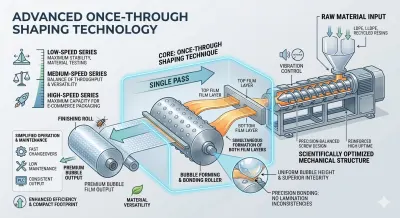
At the center of this design is once-through shaping technology. Instead of forming one layer and bonding a second afterward, this approach forms both film layers simultaneously in a single pass. Because there is no separate lamination stage, there is no window for the timing or tension mismatches that cause uneven bonding on traditional lines. The result is precision bonding between layers as a natural outcome of the process rather than something that has to be corrected after the fact.
That single-pass formation also supports far more consistent bubble geometry. With both layers shaped together, bubble height stays uniform across the width of the film, which is what ultimately determines barrier protection and cushioning performance. Manufacturers get a film with genuinely superior structural integrity, not just a film that looks acceptable at a glance.
The efficiency gains follow naturally from the simplified process. Removing an entire lamination step reduces the equipment footprint needed for a given output level and allows the line to run at meaningfully higher throughput without adding complexity. For a facility weighing floor space against production targets, that combination of a smaller footprint and higher output is a practical advantage, not just a technical one.

Built for Reliability: Frame, Screw Design, and Material Versatility
Once-through shaping only delivers consistent results if the mechanical platform underneath it is equally stable, which is why the frame and screw design get the same level of engineering attention. A reinforced, rigid frame paired with a precision-balanced screw keeps mechanical vibration to a minimum, which protects film surface quality and extends the working life of components that would otherwise wear faster under constant motion. That stability is what allows the machine to run continuously, 24 hours a day, with minimal technical intervention, rather than needing frequent stops for adjustment.
Material flexibility matters just as much in daily operation. The machine is built to process a range of resins, including standard LDPE, LLDPE, and recycled materials, so manufacturers are not locked into a narrow input specification and can adjust their material mix based on cost targets or customer requirements without switching equipment. This matters most for operations that shift between virgin and recycled resin depending on order specifications, since a machine that only performs well with one material grade forces a manufacturer to either limit their product range or accept a drop in quality whenever the input changes.
Configured to Match Your Production Targets
Because not every production line needs the same throughput, the series is offered in low-speed, medium-speed, and high-speed configurations rather than a single fixed setup. The low-speed series is built around maximum stability and precision, which makes it well suited to specialized applications or to testing new material blends before committing to full-scale production. The medium-speed series strikes a balance between throughput and versatility, handling a wide range of raw material grades with the agility that many general-purpose operations need. The high-speed series is designed for maximum capacity, producing premium-grade bubble film for high-volume e-commerce and retail packaging where output speed is the primary constraint.
Simplified Operation, Predictable Output
None of this consistency matters much in practice if the machine is difficult to run day to day, so the control system and mechanical layout are designed with operator time in mind. Changeovers between film thicknesses and bubble sizes are simplified rather than requiring an extended manual sequence, and easy-access maintenance points reduce the labor and downtime associated with routine service. Automated temperature and pressure controls keep output predictable across a shift, a day, or a full production run, so operators spend less time chasing variation and more time running the line.
If your production line is dealing with inconsistent bonding, uneven bubble height, or more downtime than a high-volume schedule can absorb, a once-through shaping machine addresses that variation at its source rather than papering over it downstream. We build our 2-layer bubble film extrusion machines across low-speed, medium-speed, and high-speed configurations, so manufacturers can match equipment to their actual production targets instead of compromising on either precision or capacity. If you would like to discuss which configuration fits your material mix and output goals, we are glad to walk through the details with you.